October 2026 - SashaHealthCare
Search for:
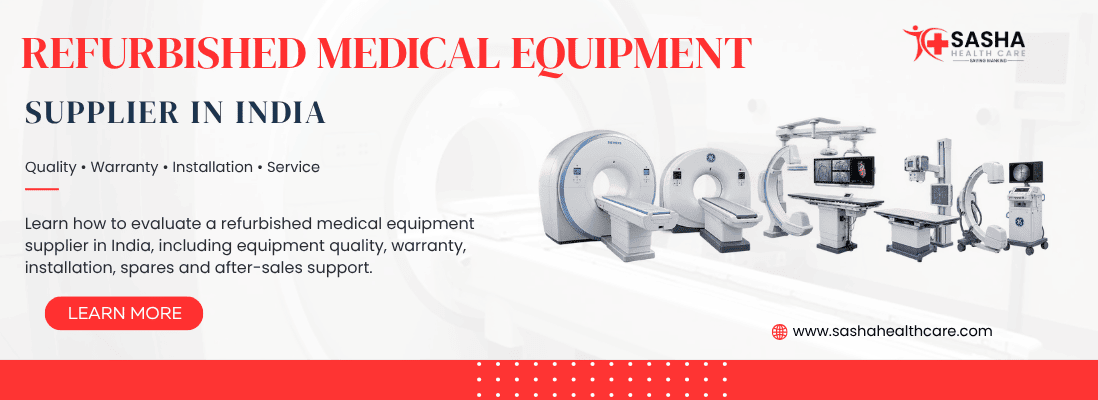
How to evaluate a refurbished medical equipment supplier in India
How to Evaluate a Refurbished Medical Equipment Supplier in India

Choosing the right refurbished medical equipment supplier in India is an important decision for hospitals, diagnostic centres, radiology departments, and healthcare investors. Refurbished medical equipment can offer significant cost advantages compared with new systems, but the quality of the equipment and the supplier’s technical support can vary considerably.

Before purchasing a refurbished MRI machine, CT scanner, Cath Lab, Digital X-Ray system, mammography system, or other medical equipment, buyers should evaluate the supplier carefully.

The key factors include equipment condition, refurbishment process, documentation, warranty, installation, spare-parts availability, technical expertise, and after-sales service.

Why Choosing the Right Refurbished Medical Equipment Supplier Matters

A refurbished medical machine is more than a piece of equipment. It is a significant investment that directly affects the operational efficiency of a hospital or diagnostic centre.

A reliable refurbished medical equipment supplier should be able to provide information about the machine’s specifications, condition, service history, refurbishment work, warranty, installation requirements, and ongoing technical support.

Selecting a supplier based only on the lowest quotation can create problems later through unexpected repair costs, unavailable spare parts, installation issues, or prolonged equipment downtime.

10 Things to Check When Evaluating a Refurbished Medical Equipment Supplier in India

1. Check the Supplier’s Experience

Start by evaluating the supplier’s experience in the medical equipment industry.

Look for a supplier with experience handling the type of equipment you want to purchase. MRI, CT, Cath Lab, and X-Ray systems require specialized knowledge for transportation, installation, commissioning, maintenance, and troubleshooting.

Ask about previous installations and whether the supplier can provide relevant customer references.

2. Verify the Equipment Brand and Model

Before purchasing refurbished medical equipment, verify the exact:

  • Brand
  • Model
  • Manufacturing year
  • Configuration
  • Software version
  • Technical specifications
  • Included accessories

For imaging equipment, buyers may encounter systems from brands such as Siemens, GE Healthcare, Philips, Canon, and Hitachi.

The exact model and configuration can significantly influence equipment capabilities, maintenance requirements, and long-term costs.

3. Understand the Refurbishment Process

One of the most important questions is: What exactly was done to refurbish the equipment?

A professional refurbishment process may involve inspection, preventive maintenance, component testing, replacement of worn components, functional testing, and final quality checks.

However, refurbishment procedures differ between suppliers and equipment types. Buyers should ask the supplier for a clear explanation of the work performed on the specific machine.

Do not assume that every machine described as “refurbished” has undergone the same level of inspection.

4. Request Equipment Documentation

Documentation helps buyers understand what they are actually purchasing.

Depending on the equipment, ask for available:

  • Model and serial number
  • Equipment specifications
  • Service records
  • Maintenance history
  • Component replacement information
  • Equipment photographs
  • Technical documentation
  • Warranty documentation

A supplier that provides clear documentation makes it easier for a hospital or diagnostic centre to evaluate the equipment before making a purchase decision.

5. Evaluate the Warranty

Warranty terms should be clearly understood before purchasing refurbished medical equipment.

Ask:

  • How long is the warranty?
  • Which components are covered?
  • Are labour costs covered?
  • What exclusions apply?
  • Who handles warranty-related service?
  • What is the expected response time?

A written warranty can provide greater clarity about the supplier’s responsibilities after installation.

6. Check Installation and Transportation Support

Large medical imaging systems require specialized handling.

For equipment such as MRI and CT machines, buyers should determine whether the supplier provides services such as:

De-installation → Transportation → Lifting → Installation → Commissioning → Testing

These activities can involve specialized technical and logistical requirements.

A supplier offering complete project support can simplify the procurement process and reduce coordination between multiple vendors.

7. Ask About Genuine Spare Parts

Spare-parts availability is an important consideration when evaluating a refurbished medical equipment supplier in India.

Before purchasing, ask the supplier about the availability and sourcing of replacement components for the specific model.

This is particularly important for complex systems such as MRI and CT scanners, where certain components can be specialized and expensive.

The availability of qualified technical engineers and appropriate spare parts can have a significant impact on equipment uptime.

8. Verify Customer References

Customer references can provide valuable insight into a supplier’s real-world performance.

Where possible, ask about previous installations involving similar equipment.

Useful questions include:

  • Was the equipment delivered as promised?
  • Was installation completed properly?
  • How was the supplier’s technical support?
  • Were warranty issues handled effectively?
  • Was after-sales support available?

Relevant references are particularly useful when purchasing high-value refurbished medical imaging equipment.

9. Compare Total Cost, Not Just Purchase Price

The cheapest refurbished medical equipment quotation is not necessarily the best value.

Compare the total cost of ownership, including:

Cost FactorWhat to Evaluate
EquipmentBrand, model and condition
TransportationDelivery and specialized handling
InstallationInstallation and commissioning
WarrantyCoverage and duration
Spare partsAvailability and expected costs
MaintenancePreventive maintenance requirements
AMC/CMCLong-term service options
DowntimePotential operational impact

A slightly higher initial investment may provide better long-term value if it includes stronger warranty and technical support.

10. Evaluate After-Sales Service

After-sales service should be an important part of your supplier evaluation.

Ask whether the supplier provides:

  • Breakdown support
  • Preventive maintenance
  • Genuine spare parts
  • Technical assistance
  • AMC
  • CMC
  • Installation support
  • De-installation services

For hospitals and diagnostic centres, reliable technical support can help reduce unexpected downtime and protect the investment in refurbished medical equipment.

What Should You Check Before Buying a Refurbished MRI Machine?

When purchasing a refurbished MRI machine, buyers should evaluate more than the magnet strength.

Important considerations may include:

  • MRI field strength, such as 1.5T or 3T
  • Magnet condition
  • Gradient system
  • RF system
  • Coil availability
  • Software and applications
  • Image quality
  • Cooling requirements
  • Installation requirements
  • Service and spare-parts support

The exact evaluation criteria depend on the MRI model and configuration.

Similarly, buyers evaluating a refurbished CT scanner should examine the slice configuration, X-ray tube condition, detector system, gantry, generator, software, image quality, and service requirements.

Be cautious if a supplier:

  • Cannot clearly explain the refurbishment process
  • Does not provide equipment documentation
  • Offers unclear warranty terms
  • Cannot explain after-sales support
  • Has no relevant installation references
  • Provides unusually low pricing without explaining why
  • Cannot clarify spare-parts availability
  • Pressures you to make an immediate purchase

A transparent supplier should be willing to answer technical and commercial questions before you commit to the purchase.

Questions to Ask a Refurbished Medical Equipment Supplier

Before placing an order, ask:

  1. What is the exact model and manufacturing year?
  2. What refurbishment work has been completed?
  3. Can you provide available service records?
  4. What testing has been performed?
  5. What warranty is included?
  6. Does the quotation include installation?
  7. Is transportation and lifting included?
  8. Are spare parts available?
  9. Do you provide AMC or CMC?
  10. Can you provide references from previous installations?

These questions can help hospitals and diagnostic centres compare suppliers more effectively.

Why Choose Sasha HealthCare?

Sasha HealthCare provides refurbished medical imaging equipment solutions for hospitals, diagnostic centres, and healthcare organizations.

The company deals in equipment categories including MRI, CT, Cath Lab, Digital X-Ray, Mammography, PET-CT, and Ultrasound, along with related technical services.

Depending on project requirements, support can include installation and de-installation, transportation and lifting, preventive maintenance, AMC/CMC, genuine spares, and technical support.

When evaluating any supplier, buyers should always verify equipment specifications, refurbishment details, warranty terms, and service commitments before making a purchase.

Final Refurbished Medical Equipment Supplier Checklist

Before purchasing refurbished medical equipment, verify:

  • ✓ Supplier experience
  • ✓ Equipment brand and model
  • ✓ Technical specifications
  • ✓ Refurbishment process
  • ✓ Equipment documentation
  • ✓ Warranty terms
  • ✓ Installation support
  • ✓ Transportation arrangements
  • ✓ Spare-parts availability
  • ✓ After-sales service
  • ✓ AMC/CMC options
  • ✓ Customer references
  • ✓ Total cost of ownership
Conclusion

Choosing a refurbished medical equipment supplier in India requires more than comparing prices. Buyers should evaluate the equipment’s condition, refurbishment process, documentation, warranty, installation support, spare-parts availability, technical expertise, and long-term after-sales service.

Whether you are purchasing a refurbished MRI machine, CT scanner, Cath Lab, or Digital X-Ray system, a structured supplier evaluation can help you make a more informed procurement decision.

For refurbished medical equipment requirements, contact Sasha HealthCare to discuss your equipment specifications, installation requirements, and service needs.

How do I choose a refurbished medical equipment supplier in India?

Evaluate the supplier’s experience, equipment quality, refurbishment process, documentation, warranty, installation capabilities, spare-parts availability, customer references, and after-sales support.

Is refurbished medical equipment reliable?

Refurbished equipment can be a practical option when it has been properly inspected, tested, maintained, and supported by a qualified supplier. Buyers should evaluate each machine individually.

What should I check before buying refurbished medical equipment?

Check the equipment model, condition, service history, refurbishment process, technical specifications, warranty, installation requirements, spare-parts availability, and after-sales support.

Is refurbished medical equipment cheaper than new equipment?

Reliable technical support, spare parts, preventive maintenance, and breakdown assistance can help hospitals and diagnostic centres manage equipment downtime and protect their investment.
MRI machine cost in India and refurbished MRI machine buying guide
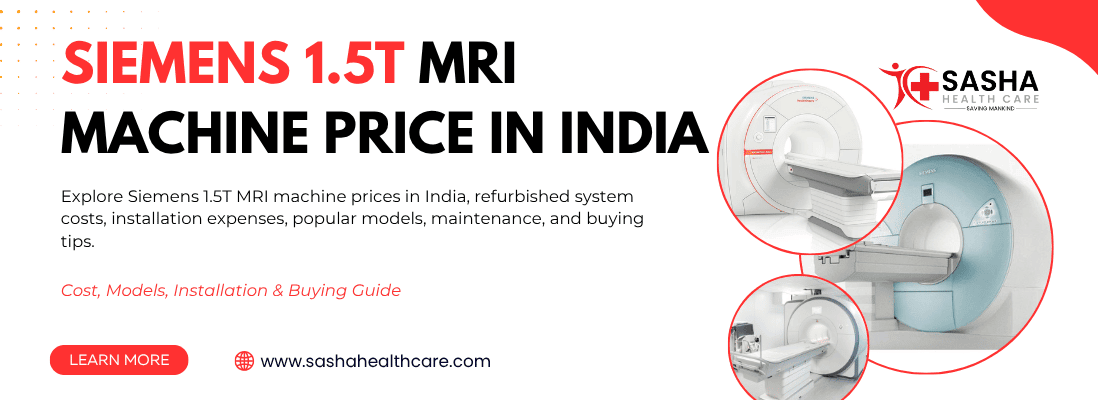
MRI Machine Cost in India | Complete Buying Guide

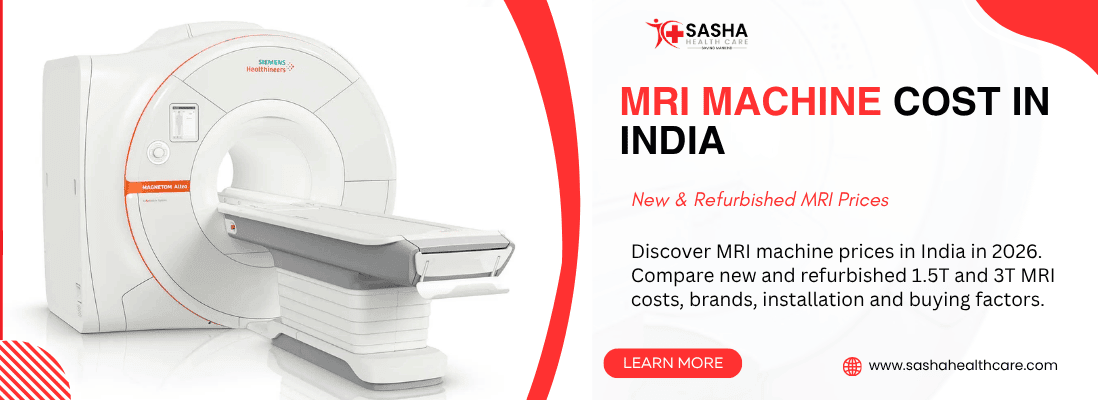
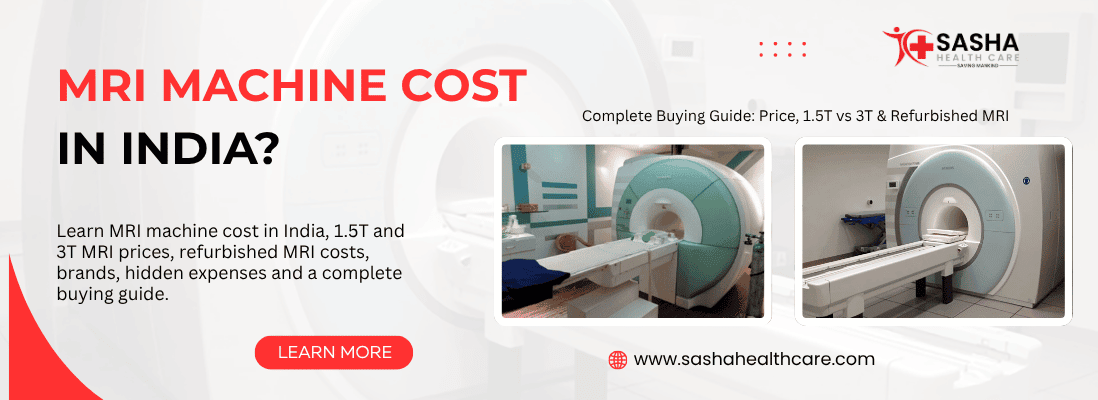
If you are planning to buy an MRI machine in India, the MRI machine cost can vary significantly depending on the field strength, brand, model, condition, configuration, software, coils, installation requirements and after-sales support. As a broad market indication, refurbished MRI machines can cost considerably less than new systems, while 3T systems generally require a higher investment than 1.5T systems.

For hospitals and diagnostic centres, the right MRI machine should be selected based not only on the purchase price but also on clinical requirements, patient volume, infrastructure, maintenance and long-term operating costs.

MRI Machine Cost in India at a Glance

The following table provides an indicative comparison. Actual prices can vary substantially based on the specific system, model, year, configuration, refurbishment level, warranty and installation scope.

MRI Machine TypeIndicative Price Range in India*Suitable For
Refurbished 1.5T MRI₹60 lakh–₹1.5 crore+Diagnostic centres, hospitals
New 1.5T MRI₹1.5–₹3 crore+Hospitals, high-volume centres
Refurbished 3T MRI₹1.2–₹2.5 crore+Advanced diagnostic centres, hospitals
New 3T MRI₹2.5–₹5 crore+Advanced hospitals and imaging centres

*These are broad indicative ranges, not fixed quotations. The actual MRI machine price in India depends on brand, model, configuration, machine condition, coils, software, installation, warranty and service requirements.

For an accurate quotation, buyers should compare complete machine specifications and total project costs rather than comparing the equipment price alone.

MRI Machine Price vs MRI Machine Cost

The terms MRI machine price and MRI machine cost are often used interchangeably, but they can represent different things.

The purchase price is the amount paid for the MRI system itself. The total project cost can include:

  • MRI machine purchase price
  • Transportation
  • Loading and lifting
  • Installation
  • Site preparation
  • RF shielding
  • Electrical work
  • HVAC requirements
  • UPS or power infrastructure
  • Accessories and coils
  • Cryogen requirements where applicable
  • Warranty
  • Preventive maintenance
  • AMC or CMC
  • Spare parts
  • Software and application packages

Therefore, a machine with a lower purchase price does not necessarily have the lowest total cost of ownership.

What Determines MRI Machine Cost in India?

Several factors influence the final MRI machine price.

1.5T vs 3T MRI

1.5T MRI systems are widely used for routine diagnostic imaging and are suitable for many hospitals and diagnostic centres. They can provide a strong balance between image quality, clinical capability and investment.

3T MRI systems provide higher magnetic field strength and can offer advantages for selected neurological, musculoskeletal, vascular and advanced imaging applications. However, they generally require a higher investment and may have additional infrastructure and operational considerations.

The right choice depends on patient volume, clinical applications, budget and available infrastructure rather than simply choosing the highest Tesla strength.

Brand and Model

Major MRI manufacturers include:

  • Siemens
  • GE
  • Philips
  • Canon
  • Hitachi/Fujifilm

The price can vary significantly between models from the same manufacturer. Newer generations, advanced gradients, additional coils, software applications and higher specifications can increase the overall investment.

New vs Refurbished MRI Machine

One of the biggest factors affecting MRI machine cost in India is whether the system is new or refurbished.

A new MRI machine generally provides the latest available platform, newer components and manufacturer-specific support options. However, the initial investment can be significantly higher.

A refurbished MRI machine can provide an alternative for hospitals and diagnostic centres that want to control capital expenditure.

A professionally refurbished MRI system should be evaluated for:

  • Magnet condition
  • System history
  • Coil condition
  • Image quality
  • Gradient performance
  • Software
  • Hardware condition
  • Cryogen system
  • Preventive maintenance
  • Replacement components
  • Warranty
  • Installation
  • Technical support

A refurbished machine should not be evaluated only by its low price. The refurbishment process, technical inspection and supplier support are equally important.

Refurbished MRI Machine Cost in India

The refurbished MRI machine price depends on the manufacturer, model, field strength, age, configuration, condition and refurbishment scope.

Refurbished systems can be particularly attractive to:

  • New diagnostic centres
  • Hospitals with limited capital budgets
  • Centres replacing older MRI systems
  • Healthcare investors
  • Facilities expanding imaging capacity

Before purchasing a refurbished MRI machine, ask the supplier for the complete machine specification, manufacturing year, model information, refurbishment details, included coils, software configuration, warranty and service terms.

A reliable supplier should also be able to explain the transportation, installation and after-sales support process.

1.5T MRI Machine Cost in India

A 1.5T MRI machine is one of the most commonly considered MRI configurations for hospitals and diagnostic centres.

Its popularity comes from its broad clinical usability and balance between investment and capability.

A refurbished 1.5T MRI can be a cost-effective option when the system has been properly inspected and refurbished.

When comparing 1.5T systems, evaluate:

  • Manufacturer
  • Exact model
  • Manufacturing year
  • Magnet condition
  • Gradient specifications
  • Number and type of coils
  • Software packages
  • Patient table specifications
  • Image quality
  • Warranty
  • Installation
  • Service support

The cheapest 1.5T MRI is not necessarily the best investment. A machine with stronger technical support and a comprehensive warranty may provide better long-term value.

3T MRI Machine Cost in India

A 3T MRI machine generally requires a higher investment than a 1.5T system.

3T systems can be considered by hospitals and diagnostic centres that require advanced imaging capabilities and have sufficient patient volume and infrastructure.

Before purchasing a 3T MRI, evaluate:

  • Clinical applications
  • Expected patient volume
  • Available infrastructure
  • Electrical requirements
  • Cooling requirements
  • MRI room specifications
  • RF shielding
  • Quench arrangements
  • Coils and accessories
  • Software applications
  • Service availability

A 3T MRI is not automatically the right choice for every facility. A properly selected 1.5T system may be a better investment for a centre whose clinical workload does not require 3T capabilities.

MRI Machine Price Comparison by Brand

Brand pricing varies by model and configuration, so buyers should compare specific systems rather than assuming that one manufacturer always costs more.

BrandCommon MRI OptionsTypical Field StrengthKey Considerations
SiemensMAGNETOM systems1.5T, 3TStrong range of clinical applications
GESIGNA systems1.5T, 3TWide range of configurations
PhilipsIngenia and other systems1.5T, 3TAdvanced imaging technologies
CanonVantage systems1.5T, 3TPatient comfort and imaging features
Hitachi/FujifilmVarious systems1.5T and othersModel availability and service support

For refurbished MRI equipment, availability can depend on the specific model and market.

New MRI vs Refurbished MRI: Which Should You Buy?
FactorNew MRIRefurbished MRI
Initial investmentHigherLower
TechnologyLatest available platformDepends on model
Budget suitabilityHigher capital requirementMore budget-friendly
WarrantyUsually manufacturer/supplier basedSupplier/refurbisher based
DepreciationHigher initial depreciationGenerally lower acquisition cost
AvailabilityDepends on manufacturerDepends on available inventory
MaintenanceManufacturer/service networkSupplier/service network
Best suited forNew high-end installationsCost-conscious facilities

A refurbished MRI machine can be a practical option when the equipment has been properly evaluated, professionally refurbished and supported by a reliable technical team.

Hidden Costs When Buying an MRI Machine

The machine price is only one part of the investment.

Potential additional costs include:

Site Preparation

The MRI room may require RF shielding, electrical work, HVAC, structural modifications and other infrastructure.

Transportation and Lifting

MRI equipment is heavy and requires specialized transportation, handling and lifting arrangements.

Installation

Installation should be performed by qualified technical personnel and may include system assembly, calibration, testing and commissioning.

Maintenance

Long-term costs can include preventive maintenance, breakdown support, genuine spare parts, AMC and CMC.

Cryogen and Cooling

Depending on the MRI system, cryogen-related requirements and components such as the cold head may need attention during the machine’s lifecycle.

Understanding these costs before purchase helps hospitals and diagnostic centres prepare a realistic investment budget.

How to Calculate the Total MRI Investment

A simple approach is:

Total MRI Investment = Machine Price + Transportation + Lifting + Site Preparation + Installation + Accessories + Warranty/Service + Other Applicable Costs

For a better financial assessment, buyers should also calculate the Total Cost of Ownership (TCO).

TCO considers not only the initial purchase but also maintenance, downtime, spare parts, service, energy requirements and other expenses throughout the machine’s useful life.

MRI Machine Buying Guide for Hospitals and Diagnostic Centres

Before buying an MRI machine, follow these steps:

  1. Estimate expected patient volume.
  2. Identify required clinical applications.
  3. Decide between 1.5T and 3T.
  4. Compare Siemens, GE, Philips and other suitable brands.
  5. Compare new and refurbished systems.
  6. Check the exact model and manufacturing year.
  7. Review magnet and coil condition.
  8. Check software and applications.
  9. Confirm infrastructure requirements.
  10. Evaluate warranty coverage.
  11. Ask about AMC/CMC options.
  12. Confirm spare parts availability.
  13. Compare installation and transportation services.
  14. Review supplier technical support.
  15. Request a detailed quotation.
  16. Conduct technical due diligence before finalizing the purchase.
Questions to Ask an MRI Machine Supplier

Before purchasing, ask:

  • What is the exact MRI model?
  • What is the field strength?
  • Is the machine new or refurbished?
  • What is the manufacturing year?
  • What is the refurbishment scope?
  • Which coils are included?
  • Which software applications are included?
  • What is the magnet condition?
  • What warranty is provided?
  • Is transportation included?
  • Is installation included?
  • Is lifting included?
  • What site requirements are necessary?
  • Are AMC or CMC services available?
  • What technical support is provided?
  • Are genuine spare parts available?

These questions help buyers compare quotations on a like-for-like basis.

Is a Refurbished MRI Machine Worth Buying?

A refurbished MRI machine can be worth considering when budget, availability and clinical requirements are important factors.

However, buyers should focus on the overall condition and support package rather than purchasing solely based on the lowest price.

A professionally refurbished system with proper inspection, suitable coils, verified image quality, warranty and technical support can be a practical option for many hospitals and diagnostic centres.

For a high-end facility requiring the latest technology and manufacturer-specific features, a new MRI may be more appropriate.

How to Choose the Right MRI Machine Supplier in India

The supplier is an important part of the MRI investment.

Before choosing a supplier, evaluate:

  • Medical equipment experience
  • Technical expertise
  • Refurbishment process
  • Machine inspection
  • Installation capability
  • Transportation and lifting support
  • Warranty
  • Spare parts availability
  • AMC/CMC support
  • Technical assistance
  • Transparent quotation
  • After-sales service

Sasha HealthCare supplies medical imaging equipment and supports customers with MRI transportation, installation, de-installation, technical support, preventive maintenance, AMC/CMC and related services.

If you are planning to purchase an MRI machine, you can contact Sasha HealthCare to discuss available systems, specifications and your project requirements.

MRI Machine Cost Comparison: Quick Reference
MRI SystemRelative InvestmentSuitable ForMain Consideration
Refurbished 1.5TLowerDiagnostic centres and hospitalsCondition and service support
New 1.5TMedium–HighHospitals and imaging centresHigher initial investment
Refurbished 3TMedium–HighAdvanced imaging centresInfrastructure and refurbishment
New 3THighAdvanced hospitalsCapital and infrastructure requirements

The final MRI machine cost in India should always be confirmed through a detailed quotation for the exact machine configuration.

Conclusion:

The right MRI machine is not necessarily the cheapest machine or the most expensive machine. The best choice depends on the balance between clinical requirements, patient volume, machine condition, technology, infrastructure, service support and total cost of ownership.

Whether you are considering a 1.5T MRI, 3T MRI, new MRI or refurbished MRI machine, compare the complete package before making your investment decision.

What is the cost of an MRI machine in India?

The cost varies depending on field strength, brand, model, condition and configuration. Refurbished MRI systems can be significantly less expensive than new systems. A detailed quotation is required to determine the actual investment.

Which is better, 1.5T or 3T MRI?

Neither is universally better. A 1.5T MRI may suit routine clinical requirements and many diagnostic centres, while 3T can be appropriate for facilities requiring advanced imaging applications. The choice depends on clinical needs and budget.

What should I check before buying a refurbished MRI?

Check the exact model, manufacturing year, system history, magnet condition, coils, software, image quality, refurbishment scope, warranty, installation and technical support.

What affects MRI machine cost?

Major factors include Tesla strength, brand, model, age, condition, coils, software, installation, transportation, warranty and service requirements.

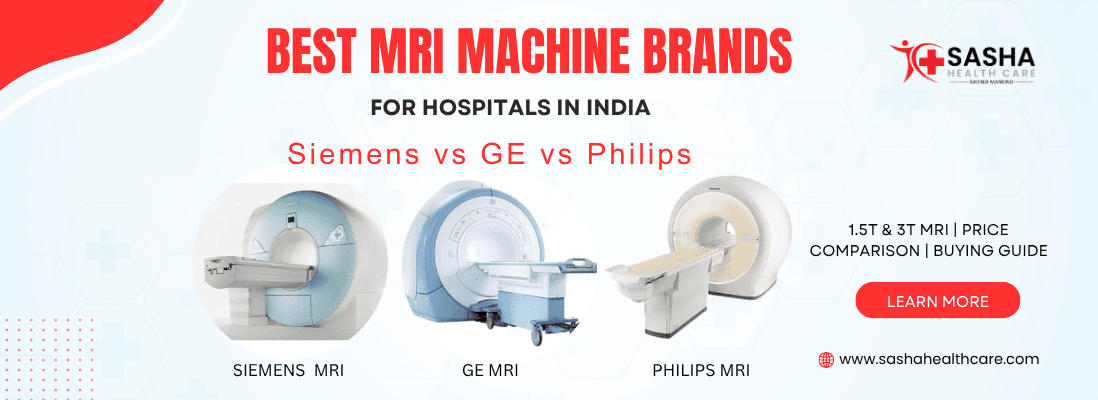
Best MRI machine brands for hospitals in India – Siemens vs GE vs Philips
Best MRI Machine Brands for Hospitals in India: Siemens vs GE vs Philips

Choosing the right MRI machine is an important decision for hospitals and diagnostic centres in India. The MRI system affects diagnostic capabilities, patient throughput, operating costs, service requirements, and long-term return on investment.

Among the major MRI manufacturers, Siemens Healthineers, GE HealthCare, and Philips are widely considered by healthcare providers. Each brand offers different MRI platforms, configurations, software, coils, and clinical applications.

So, which is the best MRI machine brand for hospitals in India?

There is no single answer for every hospital. The right choice depends on clinical requirements, patient volume, budget, infrastructure, field strength, service support, and total cost of ownership.

Siemens vs GE vs Philips MRI: Quick Comparison
FactorSiemensGE HealthCarePhilips
Brand positioningPremium MRI technologyStrong clinical & workflow solutionsAdvanced imaging & patient-focused solutions
Common hospital choice1.5T & 3T1.5T & 3T1.5T & 3T
Suitable forHospitals & diagnostic centresHospitals & diagnostic centresHospitals & diagnostic centres
Image qualityHigh, configuration dependentHigh, configuration dependentHigh, configuration dependent
Clinical applicationsBroadBroadBroad
Refurbished availabilityAvailableAvailableAvailable
Key considerationModel, configuration & serviceModel, configuration & serviceModel, configuration & service

Siemens MRI Machines

Siemens Healthineers is one of the leading names in medical imaging and offers MRI systems across different field strengths and clinical requirements.

Siemens MRI systems are available in configurations suitable for routine imaging as well as more advanced applications. Hospitals considering Siemens should evaluate the exact model, magnet condition, software, coils, gradients, installation requirements, and available technical support.

For hospitals looking for a 1.5T MRI machine, Siemens has several established systems that can be considered depending on the hospital’s requirements and budget.

Refurbished Siemens MRI machines can also be an option for hospitals seeking to reduce the initial equipment investment.


GE MRI Machines

GE HealthCare is another major MRI manufacturer with systems used across hospitals and diagnostic centres.

GE MRI systems are available in both 1.5T and 3T configurations, depending on the model and application requirements.

When comparing a GE MRI machine, hospitals should look beyond the brand name and evaluate the specific system configuration, available coils, software, gradient performance, installation requirements, service history, and warranty.

For hospitals with budget considerations, a properly refurbished GE MRI machine can provide an alternative to purchasing a new system.


Philips MRI Machines

Philips is also an established MRI manufacturer offering systems for different clinical applications.

Philips MRI systems focus on imaging capabilities, workflow, patient experience, and clinical applications. As with Siemens and GE, the actual capabilities depend on the specific MRI model and configuration.

Hospitals evaluating Philips MRI should compare the complete package, including coils, software, installation, warranty, service support, and long-term maintenance requirements.


Siemens vs GE vs Philips: MRI Price Comparison in India

MRI machine prices in India vary significantly. There is no single price for a particular brand because the final quotation depends on whether the machine is new or refurbished, its field strength, model, software, coils, installation, transportation, warranty, and service package.

The following ranges are indicative planning ranges, not fixed market quotations.

MRI CategoryIndicative Price Range in India
Refurbished 1.5T MRI₹1.0 crore – ₹2.5 crore*
Refurbished 3T MRI₹2.0 crore – ₹4.0 crore*
New 1.5T MRI₹3.0 crore – ₹6.0+ crore*
New 3T MRI₹5.0 crore – ₹10.0+ crore*

*Indicative ranges only. Actual pricing can vary substantially based on manufacturer, model, configuration, year, coils, software, installation, warranty, taxes, logistics, and site requirements.

For a specific Siemens vs GE vs Philips price comparison, hospitals should compare equivalent systems—for example, a 1.5T system against another 1.5T system with similar coils, software, accessories, warranty, and service coverage.

A lower initial quotation does not necessarily mean lower overall cost. Total cost of ownership should also be considered.


1.5T vs 3T MRI for Hospitals

One of the most important decisions is whether the hospital needs a 1.5T or 3T MRI machine.

1.5T MRI

A 1.5T MRI can be suitable for many routine hospital and diagnostic applications. It can offer a practical balance between clinical capability, infrastructure requirements, patient throughput, and investment.

It may be particularly suitable for hospitals performing a broad range of routine MRI examinations.

3T MRI

A 3T MRI can provide advantages for certain advanced imaging applications and may be attractive to hospitals with higher patient volumes or specialized clinical requirements.

However, 3T is not automatically the best choice for every hospital. Infrastructure, budget, clinical workload, applications, and technical support should all be considered.


How Should Hospitals Choose the Best MRI Brand?

Before purchasing an MRI machine, hospitals should evaluate:

  • Patient volume
  • Clinical applications
  • 1.5T or 3T requirements
  • MRI machine price
  • Available budget
  • Room and infrastructure requirements
  • RF shielding
  • Electrical requirements
  • HVAC requirements
  • MRI coils
  • Software
  • Patient comfort
  • Scan workflow
  • Installation
  • Transportation and lifting
  • Warranty
  • AMC/CMC
  • Spare parts availability
  • Technical support

For refurbished MRI equipment, also check the system’s service history, magnet condition, software, coils, error history, refurbishment process, warranty, and installation support.


New vs Refurbished MRI Machines

A new MRI machine provides access to current manufacturer offerings and typically comes with manufacturer warranty and support options. However, the initial investment can be significant.

A refurbished MRI machine can offer a lower acquisition cost and may be suitable for hospitals and diagnostic centres with budget constraints.

However, buyers should purchase refurbished equipment only after evaluating the system’s technical condition, refurbishment quality, warranty, installation, spare parts availability, and after-sales support.

Sasha HealthCare supplies refurbished MRI systems from leading manufacturers, including Siemens, GE, and Philips, subject to model and availability.


Which Is the Best MRI Machine Brand for Hospitals in India?

Siemens, GE, and Philips can all be suitable MRI brands for hospitals in India. The best choice depends on the hospital’s clinical requirements, patient volume, budget, infrastructure, preferred applications, and service support.

Rather than choosing a brand solely based on reputation, hospitals should compare specific MRI models and complete configurations.

For example, a hospital looking for a cost-effective routine imaging solution may evaluate refurbished 1.5T systems, while a high-volume or specialized centre may consider a 3T system.

The right MRI machine is therefore the one that provides the required clinical capability, reliability, workflow, service support, and total cost of ownership for that particular facility.

Conclusion:

When comparing Siemens vs GE vs Philips MRI machines, hospitals should focus on the complete equipment package rather than the brand alone.

Evaluate the MRI model, 1.5T/3T field strength, clinical applications, coils, software, infrastructure, price, warranty, installation, maintenance, and technical support before making a purchasing decision.

Looking for a Siemens, GE, or Philips MRI machine for your hospital or diagnostic centre? Sasha HealthCare can help you evaluate suitable new or refurbished MRI systems based on your requirements and budget.

Which is the best MRI machine brand for hospitals in India?

Siemens, GE HealthCare, and Philips are major MRI brands that hospitals can consider. The best choice depends on the hospital’s clinical applications, field strength requirements, budget, infrastructure, and service support.

Is Siemens MRI better than GE MRI?

Neither can be universally considered better. The comparison should be made between specific Siemens and GE models with similar field strength, coils, software, applications, and configurations.

Is 1.5T or 3T MRI better for hospitals?

Both have important applications. A 1.5T MRI can be suitable for many routine hospital applications, while 3T can be valuable for certain advanced imaging requirements. The appropriate choice depends on the hospital’s workload and clinical needs.

How much does an MRI machine cost in India?

MRI machine prices vary widely. Refurbished systems can cost considerably less than new systems, while 3T systems generally require a higher investment than comparable 1.5T systems. The exact quotation depends on the model and configuration.

CT scan machine for hospitals and diagnostic centres in India
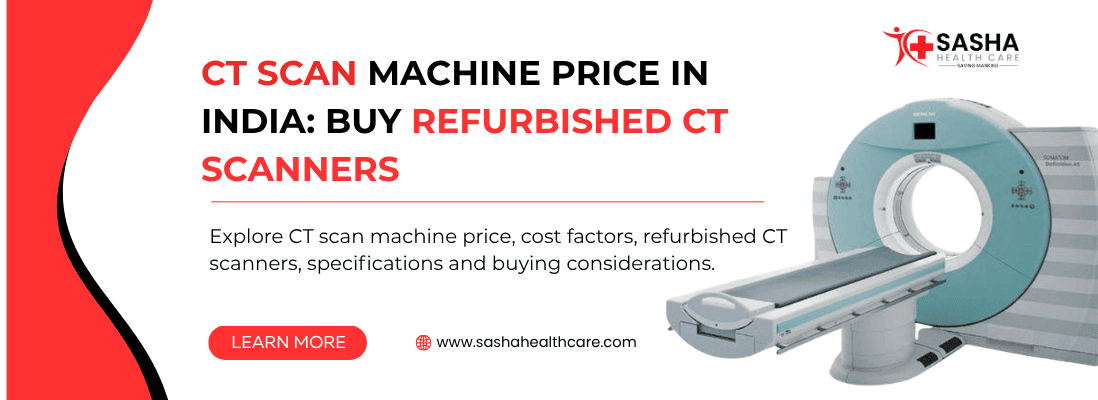
Buy CT Scanners at Best Price in India: CT Scan Machine Price & Cost Guide

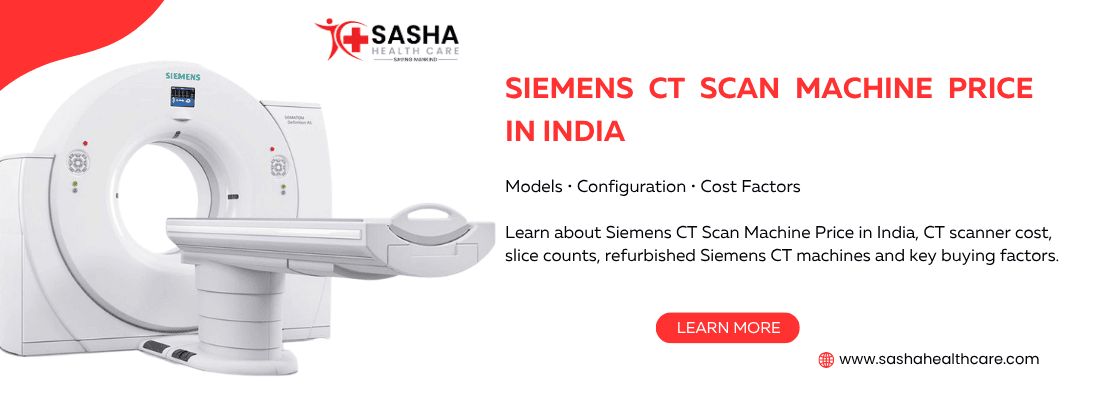
Looking to buy a CT scanner in India? The CT scan machine price depends on several factors, including slice configuration, brand, model, machine condition, software, X-ray tube condition, installation requirements and after-sales support. Hospitals and diagnostic centres can consider both new and refurbished CT scan machines depending on their clinical requirements, infrastructure and budget.

Choosing a CT scanner should not be based only on the lowest purchase price. A reliable buying decision should consider machine specifications, image quality, system condition, installation, warranty, service support, spare parts and long-term ownership costs.

CT Scan Machine Price in India

The CT scan machine price in India varies considerably depending on the configuration and condition of the system. A basic CT scanner and a high-end multi-slice CT scanner can have very different acquisition costs.

For refurbished CT scanners, the price can also vary depending on the manufacturer, model year, number of slices, X-ray tube condition, detector condition, software configuration, refurbishment level and warranty.

Some of the major factors that influence CT scanner pricing include:

  • Number of slices
  • Brand and model
  • New or refurbished condition
  • X-ray tube condition and remaining life
  • Detector configuration
  • Gantry condition
  • Patient table
  • Generator
  • Image reconstruction technology
  • Software and clinical applications
  • Workstation configuration
  • Installation requirements
  • Transportation and lifting
  • Site preparation
  • Warranty
  • AMC or CMC options
  • Availability of spare parts and technical support

Because these factors differ from one machine to another, buyers should request a configuration-specific quotation instead of relying on a generic CT machine price.

What is the CT scan machine price?

There is no single price applicable to every CT scanner. The final purchase cost depends on the exact machine configuration, brand, model, condition and services included in the quotation.

For this reason, a buyer comparing two CT scanners should compare the complete configuration and total ownership requirements, rather than comparing only the headline machine price.


What Is the CT Scan Machine Cost?

The CT scan machine cost should be considered as more than the equipment purchase price.

A hospital or diagnostic centre may need to budget for several components associated with purchasing and commissioning a CT scanner.

These can include:

  • CT scanner equipment
  • X-ray tube
  • Patient table
  • Workstation
  • Software
  • Accessories
  • Transportation
  • Lifting
  • Installation
  • Calibration
  • Commissioning
  • Electrical requirements
  • HVAC requirements
  • Radiation shielding and room preparation
  • Warranty
  • Preventive maintenance
  • AMC or CMC
  • Spare parts and future repairs

Therefore, when comparing CT scanner quotations, ask the supplier exactly what is included and excluded.

A machine with a lower initial quotation may not necessarily have the lowest overall ownership cost if important services or components are excluded.


Refurbished CT Scan Machine: Is It a Good Option?

A refurbished CT scan machine can be an option for hospitals and diagnostic centres that want to control their initial equipment investment while obtaining an established CT imaging platform.

Refurbishment should involve more than simply reselling a previously used machine.

Depending on the supplier and equipment, refurbishment and evaluation may include:

  • Mechanical inspection
  • Electrical inspection
  • System testing
  • Image quality assessment
  • X-ray tube evaluation
  • Detector assessment
  • Gantry inspection
  • Patient table testing
  • Software verification
  • Preventive maintenance
  • Calibration
  • Replacement of selected components where required
  • Final testing before installation

However, the term “refurbished” can mean different things in the medical equipment market. Buyers should therefore ask for details about what work has actually been performed on the machine.

Refurbished vs Used CT Scan Machine

A used or pre-owned CT scanner generally refers to equipment that has previously been operated and is being offered for resale.

A refurbished CT scanner may have undergone inspection, testing, servicing and replacement of selected components before being offered to another healthcare facility.

The actual refurbishment process varies by machine and supplier, so buyers should request documentation describing the machine’s condition and the work performed.


Why Buy a Refurbished CT Scan Machine?

A refurbished CT scanner may be suitable for healthcare facilities that have a defined budget but still require CT imaging capabilities.

Potential advantages include:

Lower Initial Investment

Refurbished equipment can provide an alternative to purchasing a completely new system, depending on the model and condition.

Established Technology

A properly evaluated pre-owned system can provide access to established CT platforms that are already widely used in clinical environments.

Budget Flexibility

A refurbished system may allow a diagnostic centre or hospital to allocate part of its budget to other requirements such as infrastructure, staffing, software or service support.

Availability

Depending on market availability, refurbished systems can sometimes be sourced more quickly than certain new configurations.

However, buyers should evaluate the machine carefully before purchase. Lower acquisition cost should never replace proper technical due diligence.


Factors That Affect CT Scan Machine Price in India

1. Number of Slices

The number of slices is one of the commonly discussed specifications when comparing CT scanners.

Configurations can include:

  • 16-slice
  • 32-slice
  • 64-slice
  • 128-slice
  • Higher-end multi-slice configurations

However, a higher slice count does not automatically mean that a particular CT scanner is the best choice for every hospital or diagnostic centre.

The appropriate configuration depends on:

  • Patient volume
  • Clinical applications
  • Scan requirements
  • Throughput
  • Budget
  • Existing infrastructure
  • Future expansion plans

A diagnostic centre with routine imaging requirements may have different needs from a tertiary-care hospital.


2. Brand and Model

The manufacturer and specific model can influence the CT scanner price and long-term ownership considerations.

When comparing different systems, buyers should evaluate:

  • Model generation
  • System specifications
  • Software
  • Clinical applications
  • Service availability
  • Spare parts
  • X-ray tube availability
  • Technical support
  • Upgrade possibilities

Rather than selecting a machine based only on brand name, compare the complete system configuration with the facility’s clinical requirements.


3. New vs Refurbished Condition

The condition of the CT scanner has a major impact on acquisition cost.

A new system generally provides the latest available configuration from the manufacturer, while a refurbished system may provide a more budget-oriented alternative.

When purchasing a refurbished CT scanner, ask about:

  • Original installation date
  • Model
  • Previous usage
  • Tube condition
  • Tube exposure information where available
  • Detector condition
  • Software version
  • Service history where available
  • Components replaced during refurbishment
  • Testing performed
  • Warranty
  • Installation support

4. X-Ray Tube Condition

The X-ray tube is one of the most important components to evaluate when purchasing a CT scanner.

For a refurbished system, buyers should ask the supplier about:

  • Tube model
  • Tube condition
  • Tube usage
  • Tube history where available
  • Expected service considerations
  • Replacement availability
  • Replacement cost

A low purchase price should not be evaluated separately from the condition and future service requirements of the tube.


5. Software and Clinical Applications

Software can significantly affect the functionality and value of a CT scanner.

Depending on the system, available applications may include tools for different clinical workflows, image reconstruction and advanced visualization.

Before purchasing, identify the applications actually required by the facility.

Instead of paying for features that will not be used, buyers should match software capabilities with their clinical workload.


6. Installation and Site Requirements

The CT scanner price is only one part of the procurement process.

The installation site may need appropriate:

  • Electrical infrastructure
  • HVAC
  • Radiation shielding
  • Room dimensions
  • Floor loading considerations
  • Network connectivity
  • Equipment access
  • Patient access
  • Safety arrangements

Transportation and lifting must also be planned, particularly when the equipment needs to be moved into an existing hospital building.

A professional supplier should discuss site requirements before finalizing the installation.


How to Choose the Right CT Scanner for a Hospital or Diagnostic Centre

The right CT scanner depends on the facility’s actual requirements.

Before requesting quotations, define the following:

Patient Volume

Estimate the expected number of examinations per day and determine the required throughput.

Clinical Applications

Identify the examinations that the facility plans to perform.

Slice Configuration

Select the appropriate slice configuration based on clinical requirements rather than simply choosing the highest available specification.

Budget

Establish the equipment budget along with installation, infrastructure and service costs.

Infrastructure

Confirm whether the existing facility can accommodate the CT system.

Service Support

Evaluate the availability of technical support, spare parts and maintenance services.

Warranty

Understand what components and services are covered under the warranty.

AMC/CMC

Ask about preventive maintenance and annual maintenance contract options after the warranty period.

Future Requirements

Consider whether the system can support expected growth in patient volume and clinical services.


New vs Refurbished CT Scan Machine

FactorNew CT ScannerRefurbished CT Scanner
Initial investmentGenerally higherOften more budget-oriented
TechnologyCurrent/new configurationEstablished configuration
Machine historyNewPreviously operated
AvailabilityDepends on manufacturer and configurationDepends on market availability
WarrantyManufacturer/supplier dependentSupplier dependent
Condition assessmentNew equipment checksDetailed inspection and testing are important
Spare partsDepends on modelModel and availability should be verified
Service supportDepends on manufacturer/supplierSupplier and model support should be evaluated
Suitable forFacilities seeking new technologyFacilities considering cost-effective equipment options

The right choice depends on the hospital’s clinical requirements, budget, infrastructure and long-term equipment strategy.


What Should Be Included in a CT Scanner Quotation?

When requesting a quotation, don’t ask only for the CT machine price.

Ask the supplier to provide a detailed scope of supply.

A CT scanner quotation may include:

  • CT gantry
  • Patient table
  • X-ray tube
  • Generator
  • Detector system
  • Operator workstation
  • Software
  • Clinical applications
  • Accessories
  • Installation
  • Transportation
  • Lifting
  • Calibration
  • Commissioning
  • Warranty
  • User training, where applicable
  • Technical support
  • AMC/CMC options

The quotation should clearly identify what is included and what will be charged separately.

This makes it easier to compare proposals from different suppliers.


How to Buy a CT Scan Machine in India

Buying a CT scanner is a major healthcare equipment decision. A structured procurement process can help reduce unexpected costs and technical issues.

Step 1: Define Your Clinical Requirements

Identify the examinations and patient volume expected at the facility.

Step 2: Determine Your Budget

Consider the complete acquisition and ownership cost rather than only the equipment price.

Step 3: Decide Between New and Refurbished

Evaluate whether a new or refurbished CT scanner better matches your requirements.

Step 4: Compare Specifications

Compare slice configuration, model, software, tube, detector and other relevant specifications.

Step 5: Evaluate Machine Condition

For refurbished equipment, request information about machine history, testing and components.

Step 6: Check Service and Spare Parts

Confirm that technical support and important replacement components can be sourced.

Step 7: Assess Site Requirements

Check room dimensions, electrical systems, HVAC, radiation shielding and equipment access.

Step 8: Compare Complete Quotations

Compare the machine, installation, transportation, warranty and service scope.

Step 9: Review Warranty and Support

Understand what is covered and how technical issues will be handled.

Step 10: Plan Installation and Commissioning

Coordinate transportation, lifting, installation, testing and commissioning.


What Should You Check Before Buying a Refurbished CT Scanner?

Before purchasing a refurbished CT scan machine, ask the supplier for as much technical information as reasonably available.

A practical checklist includes:

  • Manufacturer
  • Model
  • Slice configuration
  • Year of manufacture
  • Previous usage information where available
  • X-ray tube condition
  • Detector condition
  • Gantry condition
  • Patient table condition
  • Software configuration
  • System testing details
  • Refurbishment work completed
  • Components replaced
  • Warranty
  • Installation scope
  • Transportation scope
  • Technical support
  • AMC/CMC availability
  • Spare-part availability

If possible, buyers should also arrange a technical evaluation or demonstration before finalizing the purchase.


CT Scanner for Hospital vs Diagnostic Centre

Hospitals and diagnostic centres may have different CT procurement requirements.

CT Scanner for a Hospital

A hospital may require a system capable of supporting a broad range of examinations and potentially higher patient volumes.

The selection may depend on:

  • Emergency imaging requirements
  • Inpatient workload
  • Outpatient workload
  • Clinical specialties
  • Advanced imaging requirements
  • Throughput
  • Integration with hospital systems
CT Scanner for a Diagnostic Centre

A diagnostic centre may place greater emphasis on:

  • Patient volume
  • Routine imaging
  • Operating cost
  • Reliability
  • Service support
  • Budget
  • Return on equipment investment

The ideal system should therefore be selected based on the facility’s specific workflow rather than a generic “best CT scanner” ranking.


Why Choose Sasha HealthCare for CT Scan Machines?

Sasha HealthCare provides medical imaging equipment solutions for hospitals, diagnostic centres and healthcare facilities.

For buyers looking for a CT scan machine in India, Sasha HealthCare can assist with equipment sourcing and related project requirements.

Services and support can include:

  • CT scanner supply
  • Refurbished medical equipment
  • Equipment sourcing
  • Installation and de-installation
  • Transportation and lifting
  • Technical support
  • Repairs
  • Preventive maintenance
  • AMC/CMC support

A CT scanner purchase involves more than supplying the machine. Transportation, installation, commissioning and technical support are important parts of bringing the imaging system into operation.

Looking to Buy a CT Scan Machine in India?

If you are planning to purchase a CT scanner for a hospital, diagnostic centre or healthcare facility, contact Sasha HealthCare with your required configuration, budget and installation requirements.

Sasha HealthCare

Website: https://sashahealthcare.com/

Phone/WhatsApp: +91 8009699599

Email: info@sashahealthcare.com

Request a quotation based on your required CT scanner configuration and project requirements.

Conclusion

Buying a CT scanner is a significant investment for any hospital or diagnostic centre. The CT scan machine price should therefore be evaluated together with the machine’s configuration, condition, clinical capabilities, installation requirements, warranty and long-term service support.

For facilities with budget constraints, a properly evaluated refurbished CT scan machine can be an alternative to purchasing a new system. The key is to evaluate the complete equipment package rather than choosing solely on the lowest quoted price.

Before making a purchase, define your clinical requirements, compare specifications, verify machine condition, assess infrastructure, review warranty and service support, and request a detailed quotation.

If you are planning to buy a CT scanner in India, Sasha HealthCare can help you evaluate equipment options and related installation and support requirements.

Contact Sasha HealthCare for a CT scanner quotation based on your requirements.

What is the CT scan machine price in India?

The CT scan machine price in India varies based on the number of slices, brand, model, machine condition, software, X-ray tube, installation requirements and service support. New and refurbished CT scanners can have significantly different prices.

How much does a refurbished CT scan machine cost?

The cost of a refurbished CT scan machine depends on its brand, model, slice configuration, age, condition, X-ray tube, detector, software and refurbishment work. A supplier should provide a quotation based on the specific machine configuration.

How do I choose the right CT scanner for a hospital?

Choose a CT scanner based on patient volume, clinical applications, required slice configuration, budget, infrastructure, image quality requirements, service support, warranty and future expansion plans. The highest slice count is not necessarily the best choice for every hospital.

Sasha HealthCare medical equipment supplier in India for refurbished MRI, CT Scan and Cath Lab machines
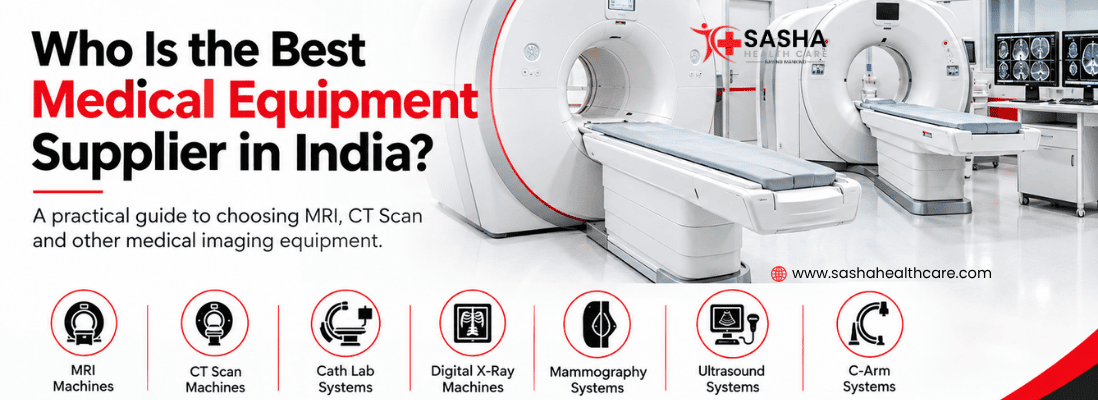
Who is the Best Supplier of Medical Equipment in India?

Choosing the best medical equipment supplier in India is an important decision for hospitals, diagnostic centres, radiology departments, and healthcare investors. The right supplier should provide suitable equipment, transparent pricing, reliable installation support, clear warranty terms, and dependable technical assistance throughout the equipment’s operating life.

There is no single supplier that is automatically the best choice for every healthcare facility. The right choice depends on the type of medical equipment required, the available budget, clinical requirements, equipment condition, service capabilities, and long-term operating costs.

For hospitals and diagnostic centres looking for medical imaging systems, Sasha HealthCare is a Hyderabad-based medical equipment supplier offering refurbished MRI machines, CT Scan machines, and other medical imaging equipment, subject to availability. The company also supports relevant installation, transportation, and technical service requirements depending on the equipment and project.

This guide explains how to evaluate medical equipment suppliers in India, what to check before purchasing imaging equipment, and how to select a supplier that meets your facility’s requirements.

Who Is the Best Medical Equipment Supplier in India?

The best medical equipment supplier in India is one that meets your facility’s clinical and technical requirements, provides accurately documented equipment specifications, offers transparent commercial terms, and has the capabilities to support delivery, installation, warranty, and after-sales service.

When comparing suppliers, hospitals and diagnostic centres should evaluate:

  • Equipment quality, condition, and configuration
  • Availability of suitable brands and models
  • New versus refurbished equipment options
  • Warranty coverage and exclusions
  • Installation, commissioning, transportation, and lifting arrangements
  • Availability of spare parts and technical support
  • Regulatory documentation and site requirements
  • Total cost of ownership rather than purchase price alone
  • Verified customer references and relevant project experience

For facilities purchasing MRI, CT Scan, Cath Lab, Digital X-Ray, Mammography, or other medical imaging systems, a supplier’s experience with the specific equipment category is particularly important.

Sasha HealthCare, based in Hyderabad, supplies medical imaging equipment to healthcare facilities across India, subject to product availability and project requirements. Buyers can contact the company to enquire about available systems, specifications, installation arrangements, and quotations.

What Makes a Medical Equipment Supplier Reliable?

A reliable supplier should do more than offer a machine at an attractive price. Medical imaging equipment is a significant investment, and its suitability depends on technical performance, installation requirements, serviceability, and the facility’s intended clinical applications.

1. Equipment Quality and Technical Evaluation

Before purchasing medical equipment, request detailed specifications and documentation about the machine’s condition.

For refurbished equipment, ask for information such as:

  • Manufacturer, model, and year of manufacture
  • Magnet strength for MRI systems or slice configuration for CT scanners
  • Hardware and software configuration
  • Equipment service and maintenance history, where available
  • Inspection and testing records
  • Included accessories, coils, workstations, and other components
  • Known limitations, replaced components, and outstanding issues
  • Applicable safety and regulatory documentation

The exact checks will depend on the equipment type. For example, an MRI buyer should assess magnet condition, available coils, system configuration, and cooling requirements. A CT buyer should examine detector configuration, tube condition, software, and system performance documentation.

A supplier should explain what has been inspected, what is included in the quoted configuration, and what remains the buyer’s responsibility.

2. Transparent Pricing and Quotations

A medical equipment quotation should clearly describe what the buyer will receive and which costs are included.

Depending on the project, the quotation may need to specify:

  • Machine price and configuration
  • Applicable taxes and commercial terms
  • Packing and transportation
  • Loading, unloading, and lifting
  • Installation and commissioning
  • Civil work, electrical work, and room preparation
  • HVAC, shielding, or other site requirements where applicable
  • Warranty duration and coverage
  • Training and handover arrangements, if included
  • Payment milestones and delivery schedule

Do not compare two suppliers solely on their headline machine prices. One quotation may include transportation and installation, while another may exclude these expenses.

Ask for an itemised quotation so that you can compare the complete project cost.

3. Installation and Commissioning Capabilities

Medical imaging systems require careful planning before delivery and installation. MRI and CT projects may involve site surveys, equipment movement, room readiness, electrical infrastructure, cooling, safety requirements, and coordination with hospital teams.

Before selecting a supplier, clarify who is responsible for:

  • Pre-installation site assessment
  • Transportation and lifting
  • Equipment positioning and installation
  • Commissioning and applicable acceptance tests
  • Coordination with civil and electrical contractors
  • Documentation and handover
  • Technical assistance during the initial operating period

Responsibilities should be documented in the purchase agreement. Confirm that the personnel performing installation and commissioning are appropriately qualified for the equipment and scope of work.

4. Warranty and After-Sales Support

Medical equipment can require maintenance, troubleshooting, and replacement components over time. Buyers should understand how support will be delivered after installation.

Ask the supplier about:

  • Warranty duration and exclusions
  • Response procedures for technical issues
  • Availability of trained service personnel
  • Spare parts sourcing and lead times
  • Preventive maintenance arrangements
  • Annual Maintenance Contract (AMC) or Comprehensive Maintenance Contract (CMC) options
  • Costs that fall outside the warranty
  • Availability of support for the specific make and model

Obtain these details in writing. A clear service agreement is more useful than a general promise of ongoing support.

5. Verifiable Experience and Customer References

A supplier’s experience should be assessed using relevant evidence rather than marketing statements alone.

Where possible, review genuine installation photographs, project documentation, customer references, and examples involving equipment similar to the system you plan to purchase.

For refurbished imaging equipment, ask whether the supplier has experience with the specific manufacturer, model, and configuration you are considering.

This helps you evaluate the supplier’s practical capabilities before committing to a major investment.

Types of Medical Imaging Equipment Available in India

Hospitals and diagnostic centres need different equipment depending on their specialties, patient volumes, clinical services, and infrastructure. A supplier focused on medical imaging may support the following equipment categories.

MRI Machines

Magnetic Resonance Imaging (MRI) systems use magnetic fields and radio waves to produce detailed images of internal body structures.

MRI systems are available in different configurations, including 1.5 Tesla and 3 Tesla systems. The appropriate option depends on clinical applications, required throughput, available space, budget, and technical infrastructure.

When comparing MRI machines, review magnet specifications, gradient performance, available coils, software applications, cooling requirements, service history, and warranty terms.

Facilities considering refurbished MRI systems should also verify the system’s condition, configuration, parts availability, and installation requirements.

CT Scan Machines

Computed Tomography (CT) scanners use X-rays to produce cross-sectional images of the body.

When evaluating a CT scanner, consider detector configuration, clinical applications, image quality, radiation-dose management features, software, tube condition, serviceability, and expected patient volume.

The appropriate scanner should match the facility’s clinical needs rather than being selected on slice count alone.

Cath Lab Systems

Catheterisation laboratory systems support image-guided cardiovascular procedures. Hospitals should evaluate imaging capabilities, system configuration, room requirements, software, service support, and compatibility with their intended procedures.

Because Cath Lab equipment is used in specialised clinical environments, confirm that the proposed system and installation meet applicable safety and regulatory requirements.

Digital X-Ray Machines

Digital X-Ray systems produce radiographic images using digital detectors. They are used in hospitals, clinics, and diagnostic centres for a variety of examinations.

Buyers should assess detector specifications, image processing, workstation configuration, installation requirements, serviceability, and compatibility with the facility’s imaging workflow.

Mammography Systems

Mammography systems are designed for breast imaging. Selection should consider the facility’s screening or diagnostic requirements, system configuration, image quality, workflow, software, and applicable regulatory requirements.

PET-CT Systems

PET-CT combines positron emission tomography with computed tomography. These systems are used in specialised diagnostic and oncology settings.

Procurement requires careful evaluation of clinical requirements, infrastructure, radiation safety, installation complexity, service support, and applicable regulatory approvals.

Ultrasound and C-Arm Systems

Ultrasound systems use sound waves for diagnostic imaging, while C-arm systems provide fluoroscopic imaging for procedures and surgical applications.

The best configuration depends on the intended specialty, transducer or detector requirements, mobility, image quality, software, and serviceability.

New vs Refurbished Medical Imaging Equipment: Which Should You Choose?

Healthcare facilities may consider new or refurbished medical equipment depending on their budget, clinical requirements, operating plans, and expected equipment lifespan.

Neither option is automatically suitable for every facility.

Evaluation factorNew equipmentRefurbished equipment
Initial investmentGenerally higherMay be lower
Equipment conditionNew from the manufacturer or authorised supply channelDepends on the specific system and refurbishment work
ConfigurationDepends on the selected model and orderDepends on the available system and included upgrades
WarrantyDepends on the manufacturer’s or seller’s termsDepends on the supplier’s written warranty
TechnologyDepends on the model selectedDepends on the original model and configuration
Spare partsDepends on manufacturer support and modelRequires careful verification for the specific system
InstallationDepends on the supplier’s scopeDepends on the supplier’s scope and site requirements
Best evaluation methodSpecifications, support terms, and total costInspection records, service history, configuration, warranty, and total cost
Benefits of Considering Refurbished Medical Equipment

Refurbished equipment may offer a lower initial purchase cost compared with a comparable new system. This can make it worth evaluating for facilities that want to expand imaging capacity while managing capital expenditure.

However, the financial benefit depends on the machine’s condition, included configuration, maintenance needs, parts availability, warranty, and expected operating costs.

Before buying refurbished equipment, request:

  1. The exact manufacturer and model.
  2. The system’s technical configuration.
  3. Available inspection and testing records.
  4. Service history and known limitations, where available.
  5. Written warranty terms and exclusions.
  6. Installation, transportation, and commissioning scope.
  7. Information about parts availability and technical support.
  8. A clear breakdown of the total project cost.

A refurbished machine should be evaluated individually. A lower purchase price does not automatically mean a lower lifetime cost.

When Is New Equipment Worth Considering?

New equipment may be appropriate when a facility requires a particular current-generation technology, specific manufacturer support arrangements, a defined software configuration, or clinical capabilities not available in the refurbished systems being considered.

Compare the actual specifications and commercial terms of available options before making a decision.

How to Choose the Best Medical Equipment Supplier in India

Follow this practical checklist before placing an order.

Step 1: Define Your Clinical Requirements

Identify the equipment category, intended applications, expected patient volume, required features, and preferred configuration.

For MRI or CT procurement, involve the radiology team, biomedical engineering team, procurement department, and relevant hospital decision-makers.

Step 2: Set a Realistic Project Budget

Budget for the entire project, not just the machine.

Consider transportation, lifting, installation, room preparation, electrical infrastructure, cooling, taxes, maintenance, consumables where applicable, and future service expenses.

Step 3: Compare Multiple Suitable Suppliers

Shortlist suppliers that can demonstrate relevant equipment availability and technical capabilities.

Compare the same or equivalent configurations wherever possible. Ask each supplier to explain differences in specifications, included components, warranty, and service coverage.

Step 4: Verify Equipment Details

For refurbished equipment, confirm the machine’s identity, configuration, inspection records, condition, and service history where available.

Ask for written confirmation of included accessories and components. Clarify any exclusions before signing the agreement.

Step 5: Check Installation and Site Requirements

Confirm the delivery route, lifting arrangements, room readiness, power requirements, cooling, shielding where applicable, and commissioning responsibilities.

For complex imaging installations, arrange a site assessment before finalising the project schedule.

Step 6: Review Warranty and Maintenance Terms

Check warranty coverage, exclusions, response procedures, spare parts availability, and the cost of maintenance beyond the warranty period.

If AMC or CMC support is required, request a separate written scope and quotation.

Step 7: Review Documentation and Compliance

Confirm that the equipment and proposed installation meet the applicable Indian regulatory requirements for the device and its intended use.

Request relevant documentation, including equipment records, applicable licences or approvals, installation documentation, and acceptance records as appropriate to the project.

Step 8: Finalise a Written Agreement

The final agreement should specify the machine configuration, price, payment schedule, delivery timeline, installation responsibilities, warranty, acceptance criteria, and handover documentation.

A clear agreement helps reduce misunderstandings during delivery and commissioning.

Why Consider Sasha HealthCare for Medical Imaging Equipment?

Sasha HealthCare is a Hyderabad-based medical equipment supplier serving hospitals, diagnostic centres, and other healthcare buyers seeking medical imaging systems.

The company supplies refurbished imaging equipment, with availability depending on the required make, model, and configuration.

Medical Imaging Equipment Supply

Buyers can enquire about MRI machines, CT Scan machines, Cath Lab systems, Digital X-Ray machines, Mammography systems, PET-CT systems, Ultrasound systems, and C-arm equipment, subject to current availability.

For refurbished MRI systems, enquiries may include models from manufacturers such as Siemens, GE Healthcare, Philips, Canon, and other brands, depending on sourcing and availability.

Prospective buyers should request the exact model, technical configuration, machine condition, included accessories, and applicable warranty details.

Transportation, Installation, and De-Installation

Medical imaging projects require coordinated handling and careful planning. Sasha HealthCare can discuss relevant transportation, lifting, installation, and de-installation requirements according to the equipment and project scope.

The exact responsibilities, site preparation requirements, and costs should be confirmed in the quotation.

Technical Support and Maintenance

Depending on the equipment and service requirements, buyers can enquire about preventive maintenance, AMC/CMC support, MRI liquid helium filling and top-ups, cold head replacement, spare parts, and technical troubleshooting.

Confirm service availability, response arrangements, equipment compatibility, and commercial terms before finalising the project.

Equipment Enquiries Across India

Based in Hyderabad, Sasha HealthCare serves customers across India subject to equipment availability, project feasibility, and agreed service scope.

For hospitals and diagnostic centres comparing refurbished imaging systems, contacting the supplier directly can help establish which configurations are available and what is included in the proposed supply.

To enquire about medical imaging equipment, contact Sasha HealthCare:

Request current machine availability, specifications, warranty details, installation scope, and an itemised quotation before making a purchasing decision.

Questions to Ask Before Buying Medical Equipment

Before choosing a supplier, ask these questions and request written answers.

1. What is the exact make, model, and configuration of the machine?

Confirm the equipment identity, specifications, included accessories, and software configuration.

2. Is the machine new or refurbished?

For refurbished equipment, ask about its condition, inspection process, service history where available, and any known limitations.

3. What does the quoted price include?

Clarify taxes, transportation, lifting, installation, commissioning, and any additional site preparation costs.

4. What warranty is provided?

Request the warranty duration, covered components, exclusions, and process for raising service requests.

5. Is installation included?

Confirm the installation scope, site readiness requirements, commissioning responsibilities, and handover process.

6. Are spare parts and technical support available?

Ask about support for the specific manufacturer and model, including likely parts lead times and service arrangements.

7. Can the supplier provide relevant references or project evidence?

Where possible, review genuine installation examples or speak to previous customers who purchased comparable equipment.

8. What documentation will be provided?

Confirm equipment records, technical specifications, applicable compliance documents, warranty documents, and handover records.

9. What are the estimated operating and maintenance costs?

Ask about preventive maintenance, major components, consumables where relevant, and other recurring costs.

10. What is the delivery timeline?

Clarify the expected schedule and the factors that could affect delivery, installation, or commissioning.

Conclusion

Choosing the best medical equipment supplier in India requires a careful assessment of equipment quality, technical suitability, pricing, warranty, installation, documentation, and long-term support.

Hospitals and diagnostic centres considering refurbished MRI, CT Scan, Cath Lab, Digital X-Ray, or other imaging systems should verify the specific machine configuration and condition before committing to a purchase. A detailed quotation and written agreement can help clarify the full project cost and each party’s responsibilities.

Sasha HealthCare, based in Hyderabad, supplies medical imaging equipment and can discuss relevant installation, transportation, and technical support requirements according to equipment availability and project scope.

Looking for a medical imaging machine for your hospital or diagnostic centre?

Contact Sasha HealthCare to enquire about available equipment, request technical specifications, and obtain a quotation.

Website: https://sashahealthcare.com/

Email: info@sashahealthcare.com

Phone/WhatsApp: +91 8009699599

Who is the best supplier of medical equipment in India?

The best supplier depends on the equipment required, technical specifications, budget, warranty, installation capabilities, and after-sales support. Buyers should compare suppliers using documented equipment details and written commercial terms. Sasha HealthCare is one option for buyers enquiring about medical imaging equipment, particularly refurbished systems, subject to availability.

How do I choose a reliable medical equipment supplier in India?

Check the supplier’s experience with the relevant equipment category, equipment documentation, inspection records, warranty terms, installation capabilities, service arrangements, and customer references. Obtain an itemised quotation and confirm responsibilities in writing.

Where can I buy refurbished MRI machines in India?

You can enquire with medical imaging equipment suppliers that offer refurbished MRI systems. Before purchasing, verify the model, magnet strength, system configuration, condition, available inspection records, warranty, parts availability, and installation scope. Sasha HealthCare accepts enquiries for refurbished MRI machines, subject to availability.

Does Sasha HealthCare supply refurbished MRI and CT Scan machines?

Sasha HealthCare supplies refurbished medical imaging equipment, including MRI and CT Scan systems, subject to current availability and the requested configuration. Contact the company to confirm available models, specifications, warranty terms, and quotation details.

7 Tesla MRI scanner in a modern medical research imaging facility
How Much Does a 7 Tesla MRI Machine Cost in India? Price Guide

The 7 Tesla MRI machine cost in India can vary significantly depending on the scanner configuration, installation requirements, research applications, import expenses, and supporting infrastructure. Unlike conventional 1.5 Tesla and 3 Tesla MRI systems used in many hospitals, a 7 Tesla MRI scanner is an ultra-high-field imaging system primarily associated with advanced medical research and specialized clinical applications.

As a preliminary budgeting reference, a 7T MRI project may require an investment of several tens of crores of rupees. An indicative planning range of ₹40 crore to ₹85 crore or more may be considered for initial discussions, but this is not a verified Indian market quotation. Buyers should obtain current manufacturer or authorized supplier quotations to establish the actual equipment and project cost.

For hospitals and diagnostic centres evaluating their options, it is also important to compare 7T systems with new and refurbished 1.5T and 3T MRI machines. These alternatives may be more practical for routine diagnostic imaging, depending on patient volume, clinical requirements, available infrastructure, and budget.

In this guide, Sasha HealthCare explains the factors influencing MRI machine prices in India, the differences between 7T, 3T, and 1.5T systems, refurbished MRI purchasing considerations, and the additional costs involved in establishing an MRI facility.

Quick Answer: What Is the Price of a 7 Tesla MRI Machine in India?

The cost of a 7 Tesla MRI machine depends on the manufacturer, configuration, research or clinical applications, site requirements, and installation scope.

Pricing considerationDetails
Preliminary 7T budget estimate₹40–85 crore or more; unverified planning range
Actual equipment quotationDepends on the selected system and supplier
Installation and infrastructureMay involve substantial additional expenditure
Annual maintenanceDepends on the service agreement and system configuration
Refurbished alternatives1.5T and 3T MRI systems may offer more practical purchasing options for routine diagnostic services

Important: The range above is an indicative budgeting assumption, not a confirmed selling price, official market average, or guaranteed installed cost. A complete project budget should be based on a current written quotation that clearly identifies equipment, taxes, installation, infrastructure, warranty, and service coverage.

What Is a 7 Tesla MRI Machine?

A 7 Tesla MRI machine is a magnetic resonance imaging system that operates at a magnetic field strength of 7 Tesla. The Tesla unit measures magnetic flux density, which describes the strength of the scanner’s magnetic field.

For comparison, many conventional hospital MRI systems operate at 1.5T or 3T. A 7T system produces a substantially stronger magnetic field and can provide increased signal-to-noise ratio for selected imaging applications. This can support high-resolution anatomical imaging and advanced research into brain structure, neurological conditions, functional imaging, and other specialized applications.

However, a higher magnetic field does not automatically make a scanner the best option for every patient or clinical requirement. Image quality also depends on the imaging protocol, coils, sequence design, artifacts, patient characteristics, and the expertise of the imaging team.

Common applications of 7T MRI

Depending on the system, regulatory authorization, and clinical or research setting, 7T MRI may be used for:

  • Advanced neurological and neuroscience research
  • High-resolution brain imaging
  • Studies of small anatomical structures
  • Functional MRI research
  • Research into neurological disorders
  • Specialized musculoskeletal imaging
  • Academic and translational medical research

A 7T system is not simply a more powerful version of a standard diagnostic scanner. It requires specialized protocols, safety procedures, infrastructure, trained personnel, and careful evaluation of clinical indications.

Why Is a 7 Tesla MRI Machine So Expensive?

The cost of a 7T MRI scanner reflects more than the magnet itself. The system requires specialized engineering, radiofrequency technology, imaging hardware, installation planning, and ongoing technical support.

1. Ultra-high-field magnet technology

The magnet is a central component of an MRI system. Ultra-high-field equipment requires precise engineering, stringent field-uniformity requirements, and specialized system integration.

The magnet design, cryogenic or cooling arrangements, operating requirements, and overall scanner configuration can significantly affect the purchase price.

2. Specialized imaging technology

A 7T scanner may require specialized radiofrequency coils, receiver channels, software, pulse sequences, and reconstruction capabilities.

The final configuration depends on whether the system is intended for neuroscience research, advanced anatomical imaging, or other approved applications.

3. Dedicated site infrastructure

A facility planning to install a 7T MRI system must evaluate the room layout, structural requirements, electromagnetic environment, electrical supply, cooling, access routes, and magnetic-field safety arrangements.

The infrastructure budget depends on the building, scanner specifications, site preparation, and manufacturer’s installation requirements.

4. Transportation and installation

Transporting and installing a specialized MRI scanner can require detailed logistics planning, suitable lifting equipment, access-route assessment, specialist engineers, and commissioning.

The cost depends on the origin of the equipment, transport arrangements, site accessibility, and installation scope.

5. Service and maintenance

MRI equipment requires planned maintenance, technical support, software support, and access to suitable spare parts.

For an ultra-high-field system, buyers should clarify the manufacturer’s service coverage, engineer availability, response times, replacement-part arrangements, and the cost of the service contract before making a purchasing decision.

Factors Affecting the 7 Tesla MRI Machine Cost in India

There is no single price that applies to every 7T MRI system. The following factors influence the overall investment.

Manufacturer and scanner configuration

The selected manufacturer, model, magnet design, software options, imaging coils, and included accessories affect the quotation. Research-focused configurations may differ from systems intended for specific clinical applications.

New or previously installed equipment

A new system and a previously installed system may have different purchase prices. However, a lower purchase price does not necessarily mean a lower total project cost.

The buyer must consider equipment condition, remaining service life, component availability, software support, installation feasibility, and any refurbishment or recommissioning work.

Import expenses and taxes

Where equipment is imported, the final cost may be affected by freight, insurance, applicable customs duties, taxes, exchange rates, and local delivery expenses. The treatment of these costs depends on the transaction and applicable regulations.

Site preparation

A building that already meets the necessary engineering requirements may need less modification than a facility requiring extensive structural or electrical work.

A site survey should be completed before the project budget is finalized.

Warranty and service agreement

Warranty duration, parts coverage, labour, preventive maintenance, software support, and emergency service arrangements can change the total cost of ownership.

Buyers should compare the complete scope of each quotation rather than considering only the scanner’s headline price.

7 Tesla vs 3 Tesla vs 1.5 Tesla MRI Machines

Choosing an MRI scanner requires balancing clinical requirements, image quality, patient volume, installation costs, operating expenses, and available expertise.

Feature1.5T MRI3T MRI7T MRI
Magnetic field strength1.5 Tesla3 Tesla7 Tesla
Typical roleRoutine diagnostic imaging and many specialist applicationsAdvanced diagnostic imaging and selected researchUltra-high-field clinical and research applications
Relative equipment costGenerally lowerGenerally higher than comparable 1.5T systemsSpecialized, high-investment category
InfrastructureStandard MRI-specific planningMRI-specific planning, with configuration-dependent requirementsSpecialized site assessment and safety planning
Patient suitabilityBroad range of routine applicationsBroad range, subject to clinical considerationsMore specialized indications and protocols
Refurbished purchasingEstablished option in many marketsAvailable, depending on model and conditionAvailability and support require specific verification

Actual costs depend on the manufacturer, model, included accessories, installation scope, and market conditions. This table describes broad differences rather than a guaranteed price ranking for every system configuration.

When should a hospital consider a 1.5T MRI?

A 1.5T MRI machine may be appropriate for hospitals and diagnostic centres that need a versatile scanner for routine clinical examinations.

It can be a practical option for facilities prioritizing patient throughput, broad clinical utility, budget management, and access to service support.

When should a hospital consider a 3T MRI?

A 3T MRI scanner may be appropriate for facilities requiring advanced imaging capabilities, subject to their clinical workload and available expertise.

It can be attractive for hospitals with specialist radiology services, neurological imaging requirements, and higher-end diagnostic applications.

When should an institution consider a 7T MRI?

A 7T MRI may be worth evaluating when an institution has a specific ultra-high-field research or specialized clinical requirement, suitable infrastructure, trained personnel, and a sustainable operating budget.

For many facilities focused on routine diagnostic services, a 7T system may not be necessary. A detailed clinical and financial feasibility study should precede any purchase decision.

Can You Buy a Refurbished 7 Tesla MRI Machine?

The availability of a refurbished 7 Tesla MRI machine must be confirmed for the specific manufacturer, model, equipment condition, and intended use.

The refurbished MRI market is more familiar to many hospitals for conventional 1.5T and 3T systems. However, a refurbished 7T system presents additional questions regarding technical support, research configuration, software licensing, site compatibility, spare parts, and the manufacturer’s willingness to support the equipment.

Before considering a used or refurbished ultra-high-field scanner, buyers should verify:

  • The exact manufacturer and model
  • Original installation and service history
  • Magnet condition and documented system performance
  • Availability of compatible coils and accessories
  • Software licences and upgrade options
  • Manufacturer or qualified service-provider support
  • Installation, commissioning, and safety requirements
  • Warranty scope and exclusions
  • Suitability for the intended clinical or research application

A refurbished scanner should not be purchased solely because its initial price appears lower. The cost of restoring, transporting, installing, and supporting the system may materially affect the overall investment.

For buyers considering refurbished MRI equipment, confirming the specific model and serviceability is essential before making a financial commitment.

Refurbished MRI Machine Price in India: What Buyers Should Know

Hospitals and diagnostic centres often evaluate refurbished MRI machines when they want to expand imaging capacity while managing capital expenditure.

The price of a refurbished MRI machine depends on its field strength, manufacturer, model, age, technical condition, software, coils, warranty, installation requirements, and availability of spare parts.

Because these variables differ substantially between machines, there is no single reliable price that applies to all refurbished MRI systems.

What affects refurbished MRI pricing?

Magnetic field strength: A 1.5T and a 3T scanner have different specifications and may serve different clinical requirements.

Manufacturer and model: Equipment from different manufacturers and product generations can differ in configuration, support arrangements, and component availability.

Technical condition: Buyers should review the service history, documented performance, fault history, and condition of key components.

Included accessories: Coils, patient tables, workstations, software, and other accessories may affect the final quotation.

Warranty and support: A clearly defined warranty and an achievable technical-support arrangement are important when evaluating refurbished equipment.

Installation and logistics: De-installation, packing, transportation, lifting, reinstallation, and commissioning may need to be included in the project budget.

Is refurbished MRI equipment a practical alternative to 7T?

For a hospital or diagnostic centre focused on routine clinical imaging, a refurbished 1.5T or 3T MRI system may be a more practical option than investing in a specialized 7T research platform.

The right choice depends on the facility’s clinical requirements, projected patient volume, budget, infrastructure, and support arrangements.

Sasha HealthCare supplies refurbished medical imaging equipment, including MRI systems. Buyers can discuss available models, specifications, equipment condition, installation requirements, and quotations with the team.

Additional Costs of Installing a 7 Tesla MRI Machine

When estimating the 7 Tesla MRI machine cost in India, it is important to distinguish the equipment purchase price from the total installed project cost.

The following expenses may need to be budgeted separately, depending on what the supplier includes in the quotation.

1. MRI room and RF shielding

MRI rooms require appropriate radiofrequency shielding and electromagnetic-environment planning. The design should be compatible with the scanner and the manufacturer’s specifications.

2. Structural work and site preparation

Floor loading, room dimensions, access corridors, door openings, ceiling clearances, and lifting access should be assessed before delivery.

Renovation costs can vary substantially between facilities.

3. Electrical and cooling systems

The facility must provide suitable electrical infrastructure and environmental controls according to the selected scanner’s specifications.

4. Magnetic-field safety and quench provisions

The project must address magnetic-field safety, controlled access, equipment placement, and emergency procedures. Quench-related engineering, including a quench pipe where required by the system design, must follow the manufacturer’s requirements and applicable safety standards.

5. Transportation, lifting, and installation

The quotation should clarify whether transportation, unloading, lifting, installation, commissioning, and acceptance testing are included.

6. Staff training and operating procedures

Personnel require appropriate training for MRI operations, patient screening, equipment safety, and the selected imaging applications.

7. Maintenance and service contracts

Annual maintenance costs depend on the equipment, contract scope, parts coverage, service response commitments, and the availability of qualified engineers.

Ask suppliers to itemize these costs rather than assuming that the scanner’s purchase price covers the entire project.

Is a 7 Tesla MRI Machine Suitable for Your Hospital or Diagnostic Centre?

The right MRI system depends on the institution’s clinical objectives rather than magnetic field strength alone.

Before choosing a 7T scanner, hospital owners and administrators should evaluate the following questions.

What examinations will the facility perform?

Identify the required clinical applications, expected case mix, specialist services, and any research objectives.

Is there sufficient patient demand?

Estimate the expected examination volume and determine whether the proposed scanner is appropriate for the facility’s service model.

Is the building suitable?

Obtain a technical site assessment covering structural, electrical, cooling, shielding, safety, and access requirements.

Is qualified staff available?

Consider radiologists, MRI technologists, biomedical engineering support, research personnel, and the training required for the chosen system.

Can the facility support long-term operating costs?

Assess service contracts, consumables where applicable, utilities, staffing, repairs, and equipment downtime.

Would a 1.5T or 3T system meet the requirements?

Compare the expected clinical benefits and total project cost before committing to an ultra-high-field platform.

A feasibility study should compare the proposed system with suitable alternatives and clearly explain the clinical and financial reasons for selecting it.

Questions to Ask Before Purchasing an MRI Machine

Whether you are evaluating a new or refurbished MRI scanner, ask the supplier:

  1. What is the exact manufacturer, model, field strength, and configuration?
  2. What is included in the equipment quotation?
  3. Are coils, workstations, software, and accessories included?
  4. Is the scanner new, used, or refurbished?
  5. What documentation is available for service history and technical condition?
  6. Is installation and commissioning included?
  7. What site-preparation work is required?
  8. What warranty is offered, and what exclusions apply?
  9. Are spare parts and qualified technical support available?
  10. What are the expected maintenance requirements?
  11. Are transportation, lifting, taxes, and insurance included in the final cost?
  12. What acceptance tests and handover documentation will be provided?

For a 7T MRI system, also confirm the intended application, system-specific safety requirements, software and coil compatibility, manufacturer support, and the suitability of the facility for installation.

How to Obtain an MRI Equipment Quotation in India

The most useful quotation is based on the equipment specification and the facility’s actual requirements.

When requesting a quotation, provide the supplier with:

  • Required magnetic field strength: 1.5T, 3T, or 7T
  • Preferred manufacturer and model, if known
  • Intended clinical or research applications
  • New or refurbished equipment preference
  • Required coils, accessories, and software
  • Facility location and installation requirements
  • Expected examination volume
  • Warranty and service expectations
  • Approximate project budget

Compare quotations on a like-for-like basis. A lower equipment price may not represent better value if essential accessories, installation, warranty, or technical support are excluded.

For refurbished systems, request details of the equipment’s condition, service history, configuration, included components, warranty, and installation scope.

Conclusion

The 7 Tesla MRI machine cost in India depends on the selected scanner, its configuration, the intended application, installation requirements, and ongoing support arrangements. A preliminary budget estimate of ₹40–85 crore or more should be treated only as an initial planning reference until confirmed through current supplier quotations.

For institutions conducting advanced neuroscience research or specialized imaging, a 7T system may offer valuable capabilities. For hospitals and diagnostic centres focused on routine clinical imaging, a new or refurbished 1.5T or 3T MRI machine may be a more appropriate investment.

Before purchasing any MRI system, evaluate the equipment specification, total installed cost, warranty, technical support, infrastructure, and long-term operating requirements.

Looking for refurbished MRI equipment for your hospital or diagnostic centre?

Sasha HealthCare can help you discuss available refurbished MRI systems, specifications, installation requirements, and quotations for suitable equipment.

Siemens 1.5T MRI Machine Price in India
How Much Does a Siemens 1.5T MRI Cost in India? Complete Price Guide

A Siemens 1.5T MRI machine is a widely considered option for hospitals, diagnostic centres, and healthcare institutions looking to establish or upgrade their magnetic resonance imaging (MRI) services. Known for its advanced imaging capabilities, clinical versatility, and range of system configurations, a Siemens 1.5 Tesla MRI scanner can support routine diagnostic examinations as well as a variety of specialised imaging applications.

However, the cost of a Siemens 1.5T MRI machine in India depends on several factors, including the model, manufacturing year, system condition, software configuration, gradient performance, coil package, installation requirements, and after-sales service arrangements.

For healthcare providers planning an MRI installation, understanding the differences between new and refurbished systems is essential. A refurbished Siemens MRI machine may offer a more economical alternative to a new system while providing the imaging capabilities required for many clinical applications.

In this guide, we examine Siemens 1.5T MRI prices, the factors affecting equipment costs, popular system considerations, installation expenses, and the key points hospitals should evaluate before purchasing an MRI scanner.

What Is the Price of a Siemens 1.5T MRI Machine in India?

The price of a Siemens 1.5T MRI machine varies significantly depending on whether the equipment is new, refurbished, or previously installed and available for resale.

For budgeting purposes, healthcare providers should distinguish between the equipment purchase price and the total project cost, which may include site preparation, installation, electrical infrastructure, shielding, cooling systems, and service support.

The following figures are indicative budgeting ranges rather than verified current quotations. Actual prices should be confirmed with suppliers based on the specific model and configuration.

Siemens 1.5T MRI categoryIndicative price range
Older refurbished Siemens 1.5T MRI systems₹1.5 crore–₹3 crore
Mid-generation refurbished Siemens 1.5T MRI systems₹2.5 crore–₹4.5 crore
Newer-generation refurbished Siemens 1.5T MRI systems₹4 crore–₹7 crore or more
New Siemens 1.5T MRI systemsSupplier quotation required

Note: These ranges are broad planning estimates, not confirmed Siemens India prices. Categories may overlap, and the final cost depends on the system’s age, configuration, condition, included services, taxes, and installation scope.

A lower-priced scanner may require additional investment in upgrades, replacement components, or site modifications. Conversely, a higher-priced system may include a more comprehensive coil package, advanced software applications, installation support, and service coverage.

We recommend obtaining an itemised quotation that clearly identifies the equipment supplied, included accessories, installation responsibilities, warranty terms, and exclusions.

Factors That Affect Siemens 1.5T MRI Machine Prices

Several technical and commercial factors determine the final purchase price of a Siemens 1.5T MRI scanner.

1. MRI Model and Technology Generation

Siemens offers MRI systems across different product generations and configurations. The specific model can influence image acquisition capabilities, workflow efficiency, software options, and long-term serviceability.

When comparing refurbished systems, buyers should examine the original manufacturing year, installation history, software version, hardware configuration, and availability of replacement components.

An older system may be suitable for a facility primarily performing routine examinations, while a newer platform may be more appropriate for a diagnostic centre requiring advanced imaging protocols and higher operational throughput.

Rather than comparing prices based only on the Siemens brand and 1.5T magnetic field strength, we recommend evaluating the complete technical specification.

2. System Condition and Refurbishment Quality

The condition of a refurbished MRI machine plays a major role in determining its value.

A professionally refurbished system should undergo a documented inspection and appropriate testing before delivery. Depending on the supplier and scope of refurbishment, this process may include:

  • Inspection of the magnet and associated systems.
  • Evaluation of gradient and radiofrequency subsystems.
  • Assessment of the patient table and positioning mechanisms.
  • Inspection of the cooling and cryogenic systems, where applicable.
  • Verification of available imaging coils and accessories.
  • Testing of image acquisition and reconstruction functions.
  • Review of software functionality and system error logs.
  • Confirmation of installation and operational readiness.

Healthcare providers should request a clear explanation of the refurbishment process rather than relying solely on a supplier’s description of the equipment as refurbished or reconditioned.

3. Imaging Coils and Software Applications

MRI coils are essential components that support imaging of different anatomical regions. The supplied coil package can influence the overall equipment cost and the examinations a facility can perform efficiently.

Depending on the configuration, a Siemens 1.5T MRI system may support applications involving:

  • Brain and neurological imaging.
  • Spine examinations.
  • Musculoskeletal imaging.
  • Abdominal and pelvic imaging.
  • Cardiac MRI, where appropriately configured.
  • Angiography and vascular imaging.
  • Breast imaging, where suitable hardware and software are available.

Not every system includes all the required coils, licences, or advanced applications.

Before purchasing, we recommend preparing a list of the examinations the facility intends to perform and verifying that the proposed configuration supports those requirements.

4. Magnet and Cryogenic System Condition

The magnet is one of the most important components of an MRI scanner. Buyers should evaluate its operating history, stability, maintenance records, and applicable cryogenic requirements.

Some superconducting MRI systems require liquid helium or other specialised cryogenic management arrangements. The specific requirements depend on the magnet design and system generation.

A purchase quotation should clarify whether any cryogenic materials, servicing, monitoring equipment, or associated support are included.

These details are particularly important when evaluating older refurbished MRI systems, where the condition and service history of the magnet can have significant operational and financial implications.

5. Installation and Technical Support

An MRI machine cannot be evaluated independently of its installation requirements.

The installation scope may include equipment transportation, positioning, system integration, calibration, application testing, and coordination with the hospital’s technical team.

Depending on the facility, additional work may be required for the MRI room, radiofrequency shielding, electrical supply, air conditioning, cooling infrastructure, and quench pipe arrangements where applicable.

We recommend confirming whether installation, commissioning, application training, and post-installation support are included in the quoted price.

Popular Siemens 1.5T MRI Systems to Consider

Siemens has developed several MRI platforms for different clinical and operational requirements. Availability in the refurbished market depends on equipment condition, configuration, and supplier inventory.

Siemens MAGNETOM Avanto

The MAGNETOM Avanto is an established 1.5T MRI platform used for a range of routine and specialised examinations. When considering a refurbished unit, buyers should review its configuration, coil availability, software options, and service history.

Siemens MAGNETOM Essenza

The MAGNETOM Essenza is another 1.5T platform that may be relevant to facilities evaluating MRI systems for routine diagnostic services. Its suitability depends on the available configuration, expected patient volume, and clinical requirements.

Siemens MAGNETOM Aera

The MAGNETOM Aera is a 1.5T MRI platform that buyers may consider when evaluating patient workflow, available applications, and system configuration. A refurbished unit should be assessed for hardware condition, software compatibility, and included accessories.

Siemens MAGNETOM Sempra

The MAGNETOM Sempra is a 1.5T system designed with routine clinical imaging workflows in mind. Buyers should verify the exact configuration, software package, installation requirements, and local service arrangements before comparing its cost with other models.

These platforms are examples for evaluation, not a confirmation of current stock or availability. System generations, configurations, and market availability vary.

New vs. Refurbished Siemens 1.5T MRI Machines

Choosing between a new and refurbished Siemens MRI machine requires an assessment of capital investment, operational needs, expected patient volume, and service availability.

Comparison factorNew MRI machineRefurbished MRI machine
Initial investmentGenerally higherGenerally lower
Hardware generationNewer, as specifiedDepends on the selected model
Software configurationDepends on the purchased packageDepends on the existing and licensed configuration
WarrantyAs stated in the purchase agreementDepends on the refurbishment supplier
InstallationBased on the supplier’s scopeBased on the supplier’s scope
MaintenanceSubject to the applicable service agreementRequires careful review of coverage and exclusions
Best evaluation approachAssess lifecycle value and configurationAssess refurbishment quality and total ownership cost

Advantages of Purchasing a Refurbished Siemens 1.5T MRI

For hospitals and diagnostic centres with limited capital budgets, refurbished MRI equipment may provide access to established imaging technology at a lower initial purchase price.

Potential advantages include:

  • Lower initial capital expenditure: A refurbished scanner may reduce the upfront investment compared with a comparable new system.
  • Established clinical applications: Certain older platforms may support the routine examinations required by a facility.
  • Flexible configuration choices: Buyers may be able to select a system based on their intended clinical applications and budget.
  • Potentially shorter procurement timelines: Available inventory may offer an alternative to ordering a newly manufactured system, although delivery and installation schedules must be confirmed.
  • Capital allocation flexibility: Savings on the initial purchase may allow the facility to allocate funds to room preparation, staffing, patient services, or other equipment.

These benefits depend on the specific system, its condition, and the supplier’s ability to provide appropriate technical support.

What Should Buyers Check Before Purchasing Refurbished Equipment?

We recommend verifying the following before placing an order:

  1. Complete model identification and serial number.
  2. Manufacturing year and previous installation history.
  3. Magnet condition and available maintenance records.
  4. Gradient and radiofrequency system performance.
  5. Included coils, software licences, and accessories.
  6. Image quality and application testing.
  7. Parts availability and technical service arrangements.
  8. Warranty duration, exclusions, and response commitments.
  9. Installation, commissioning, and training scope.
  10. Regulatory compliance and applicable documentation.

A thorough evaluation helps buyers compare equipment on its actual capabilities and condition rather than purchase price alone.

Additional Costs of Installing a Siemens 1.5T MRI Machine

The MRI scanner itself is only one part of the overall investment. A complete MRI project may involve several additional expenses.

1. MRI Room Preparation

An MRI suite must meet the technical and safety requirements of the selected system. Depending on the existing facility, the project may require radiofrequency shielding, magnetic-field management, structural modifications, controlled access, and room-layout changes.

The cost varies according to the room’s existing condition and the installation specifications.

2. Electrical Infrastructure and Cooling

MRI systems require suitable electrical infrastructure and environmental control. Buyers should confirm the manufacturer’s requirements for electrical capacity, grounding, air conditioning, cooling, and uninterrupted power arrangements where specified.

Existing hospital infrastructure may reduce the amount of additional work required, but this should be established through a technical site assessment.

3. Transportation and Installation

Transportation, unloading, equipment positioning, installation, calibration, and commissioning may be charged separately or included in a supplier package.

The final cost depends on the equipment’s location, destination, building access, transportation arrangements, and the work included in the contract.

4. Annual Maintenance and Service Agreements

Maintenance is an important component of MRI ownership. Service arrangements may cover preventive maintenance, breakdown support, selected spare parts, or broader technical services.

Hospitals should compare the precise coverage of Annual Maintenance Contracts (AMC) and Comprehensive Maintenance Contracts (CMC) rather than comparing contract prices alone.

Before signing an agreement, check the exclusions, service response times, replacement-part responsibilities, and the availability of qualified engineers.

5. Staffing and Operating Expenses

Operating an MRI facility requires qualified personnel, including appropriately trained MRI technologists and radiologists. Additional operating expenses may include electricity, patient consumables, equipment maintenance, and administrative costs.

A complete financial plan should account for these recurring expenses when estimating the long-term cost of ownership.

How to Calculate the Total Cost of a Siemens 1.5T MRI Project

Healthcare providers should calculate the total project cost rather than making a decision based solely on the quoted equipment price.

A practical budgeting structure is:

Total MRI project investment = Equipment purchase price + Site preparation + Installation and commissioning + Infrastructure upgrades + Initial accessories and training + Applicable taxes and other charges.

For example, suppose a diagnostic centre receives a hypothetical quotation for a refurbished Siemens 1.5T MRI system priced at ₹2.5 crore.

Its additional costs could include:

Expense categoryExample budget
MRI equipment₹2.50 crore
Site preparation₹25 lakh
Installation and commissioning₹15 lakh
Electrical and cooling upgrades₹10 lakh
Additional accessories and training₹5 lakh
Illustrative total₹3.05 crore

These figures are purely illustrative and are not a supplier quotation. Actual site preparation, installation, taxes, and equipment costs may differ substantially. The example excludes recurring operating expenses and any additional costs not listed.

This approach enables buyers to assess whether a proposed MRI installation fits their available capital and financial objectives.

How Much Revenue Can a Siemens 1.5T MRI Machine Generate?

The commercial viability of an MRI scanner depends on patient demand, examination pricing, utilisation, operating expenses, and the facility’s referral network.

A diagnostic centre should estimate revenue using realistic local market data rather than assuming that purchasing a particular MRI model will automatically generate a specific return.

A basic calculation is:

Monthly MRI revenue = Average examinations per day × Average revenue per examination × Operating days per month.

For example, a centre performing 10 examinations per day at an average realised revenue of ₹4,000 per examination over 26 operating days would generate illustrative monthly gross revenue of ₹10.4 lakh.

This is revenue before expenses, not profit. Staffing, rent, electricity, maintenance, financing, consumables, marketing, taxes, and downtime must be deducted to estimate operating profitability.

Before investing, healthcare providers should evaluate expected patient volumes, competing diagnostic facilities, referral arrangements, local examination prices, and the time needed to establish a sustainable patient base.

Why Choose a Reliable Supplier for a Refurbished Siemens MRI Machine?

The supplier’s technical expertise and service capabilities can significantly influence the ownership experience of refurbished medical imaging equipment.

A reliable supplier should be able to explain the system’s history, refurbishment process, configuration, installation requirements, warranty coverage, and post-installation support.

When evaluating suppliers, healthcare providers should look for:

  • Clear and itemised commercial quotations.
  • Accurate equipment specifications and documentation.
  • Evidence of system testing and refurbishment.
  • Appropriate installation and commissioning capabilities.
  • Transparent warranty and maintenance terms.
  • Access to qualified technical personnel.
  • Clear communication regarding delivery schedules and exclusions.

For MRI equipment, a competitive purchase price should be considered alongside the supplier’s ability to help the facility maintain reliable operations.

How to Get the Best Price for a Siemens 1.5T MRI Machine in India

Obtaining comparable quotations is one of the most effective ways to assess whether an MRI machine is competitively priced.

We recommend following these steps when requesting quotations:

Step 1: Define your clinical requirements. Identify the examinations, expected patient volume, and applications the facility intends to support.

Step 2: Select suitable system configurations. Compare specific Siemens 1.5T models rather than treating every 1.5T scanner as equivalent.

Step 3: Request complete technical specifications. Ask for details of the magnet, gradients, software, coils, accessories, and system condition.

Step 4: Confirm the refurbishment scope. Request information about inspections, component replacements, performance testing, and documentation.

Step 5: Compare total project costs. Include installation, site preparation, infrastructure, taxes, warranty, and other applicable charges.

Step 6: Evaluate after-sales support. Confirm the maintenance options, service coverage, and responsibilities of the supplier.

Step 7: Review the commercial agreement. Ensure the final contract specifies equipment configuration, delivery conditions, payment terms, installation scope, warranty, and acceptance criteria.

These steps help hospitals and diagnostic centres make a more informed purchasing decision.

Conclusion:

The cost of a Siemens 1.5T MRI machine in India depends on the model, equipment condition, technology generation, software configuration, accessories, installation requirements, and service arrangements.

For hospitals and diagnostic centres considering refurbished MRI equipment, a careful evaluation of technical specifications, refurbishment quality, total project costs, and long-term maintenance requirements is essential.

Rather than choosing a scanner based on its purchase price alone, we recommend comparing complete equipment packages and confirming that the proposed system meets your clinical and operational requirements.

At Sasha Healthcare, we support healthcare providers exploring refurbished medical imaging equipment solutions, including MRI and CT systems. We encourage hospitals and diagnostic centres to assess their requirements and request detailed equipment specifications before making an investment decision.

Looking for a refurbished Siemens 1.5T MRI machine? Contact Sasha Healthcare to discuss your requirements, explore available MRI equipment options, and request a quotation based on your budget and clinical needs.

What is the price of a Siemens 1.5T MRI machine in India?

The price depends on the model, age, configuration, system condition, and included services. Refurbished systems can fall within broad ranges of approximately ₹1.5 crore to ₹7 crore or more, depending on their specifications. These are indicative planning figures, not verified live market prices. Buyers should obtain a current quotation for the exact system.

Is a refurbished Siemens 1.5T MRI machine worth buying?

A refurbished Siemens 1.5T MRI machine may be a suitable option for a hospital or diagnostic centre seeking to reduce initial capital expenditure. Its suitability depends on the system’s condition, clinical capabilities, refurbishment quality, parts availability, warranty, and maintenance support.

Which Siemens 1.5T MRI model is best for a diagnostic centre?

There is no single best model for every diagnostic centre. Systems such as the MAGNETOM Avanto, Essenza, Aera, and Sempra may be worth evaluating, depending on availability and configuration. The final choice should reflect examination requirements, patient volume, budget, software capabilities, and service arrangements.

MRI machine cost in India 2026 for new and refurbished MRI machines
MRI Machine Prices in India: The Complete 2026 Guide to New & Refurbished MRI Costs

The MRI machine price in India can range from approximately ₹1 crore to more than ₹20 crore, depending on the magnetic field strength, manufacturer, model, software configuration, year of manufacture, clinical applications, accessories, installation requirements, and whether the system is new or refurbished.

For hospitals, diagnostic centres, imaging centres, and healthcare investors, choosing an MRI system is a major capital investment. The purchase price of the scanner is only one part of the total project cost. Site preparation, RF shielding, electrical infrastructure, HVAC, quench-pipe requirements, coils, software, installation, warranty, service contracts, and future maintenance can significantly affect the final investment.

In this 2026 MRI machine price guide, we compare the expected cost of new and refurbished MRI systems in India, explain the difference between 1.5 Tesla and 3 Tesla MRI machines, examine the major brands and models, and provide a practical checklist for buyers.

MRI Machine Price in India in 2026

There is no single fixed price for an MRI machine because configurations vary significantly. Current market references show substantial differences between new, used, and professionally refurbished systems.

MRI Machine TypeApproximate Price in India
Low-field / Open MRI₹80 lakh – ₹2.5 crore+
Refurbished 1.5T MRI₹1.2 crore – ₹4 crore+
Refurbished 3T MRI₹4 crore – ₹8 crore+
New 1.5T MRI₹5 crore – ₹10 crore+
New 3T MRI₹8 crore – ₹22 crore+

These figures should be treated as indicative planning ranges rather than fixed quotations. A particular MRI model may be priced substantially higher or lower depending on its configuration and what is included in the supplier’s quotation.

For example, current Indian market listings show refurbished 1.5T systems from different manufacturers at significantly different prices, while premium 3T systems can command substantially higher investments.

How Much Does a 1.5 Tesla MRI Machine Cost in India?

A 1.5 Tesla MRI machine remains one of the most practical choices for hospitals and diagnostic centres because it provides a broad range of clinical applications without the investment level of many 3T systems.

A refurbished 1.5T MRI can typically fall in the range of approximately ₹1.2 crore to ₹4 crore or more, depending on the manufacturer, model, age, software, coils, gradient performance, refurbishment quality, and warranty.

New 1.5T systems can cost approximately ₹5 crore to ₹10 crore or more depending on the configuration and manufacturer.

Popular 1.5T MRI systems in the Indian market include models from:

  • GE HealthCare
  • Siemens Healthineers
  • Philips
  • Canon Medical Systems
  • Hitachi / Fujifilm Healthcare

Some commonly encountered refurbished systems include GE SIGNA HDxt, Siemens MAGNETOM Avanto, Siemens MAGNETOM Essenza, Philips Achieva and other comparable 1.5T platforms.

For routine brain, spine, musculoskeletal, abdomen, pelvis and many other examinations, a properly configured 1.5T system can provide a strong balance between clinical capability, acquisition cost and operating economics.

How Much Does a 3 Tesla MRI Machine Cost in India?

A 3 Tesla MRI machine offers a higher magnetic field strength than a 1.5T system and is generally positioned as a premium imaging solution.

Refurbished 3T MRI machines can commonly range from approximately ₹4 crore to ₹8 crore or more, while new premium 3T systems can reach ₹12 crore, ₹15 crore, ₹20 crore or more, depending on configuration and clinical requirements. Current market references demonstrate the wide range of pricing available for 3T systems.

A 3T MRI may be particularly attractive for facilities handling significant volumes of:

  • Advanced neurological imaging
  • Musculoskeletal imaging
  • High-resolution vascular studies
  • Advanced cardiac imaging
  • Prostate imaging
  • Functional MRI
  • Diffusion and perfusion studies
  • Research and specialist applications

However, higher Tesla does not automatically mean that a 3T system is the right investment for every diagnostic centre. Patient volume, referral patterns, radiologist requirements, local competition, available infrastructure and expected return on investment should all be evaluated.

Refurbished MRI Machine Price in India

For hospitals and diagnostic centres working with a controlled capital budget, a refurbished MRI machine can provide a significantly lower entry cost than purchasing a new system.

Current Indian market references place many refurbished 1.5T systems around ₹1.2 crore–₹4 crore, while refurbished 3T systems can range from approximately ₹4 crore–₹8 crore or higher.

The term refurbished should not simply mean “used.”

A professionally refurbished MRI system should undergo an engineering evaluation covering critical components such as:

  • Magnet condition
  • Gradient system
  • RF system
  • Patient table
  • Cooling system
  • Computer and reconstruction hardware
  • RF coils
  • Software
  • Workstation
  • System calibration
  • Image quality
  • Safety systems
  • Preventive maintenance requirements

The exact refurbishment process differs between suppliers. Therefore, buyers should ask for a clear refurbishment report and equipment history rather than relying only on the word “refurbished.”

New vs Refurbished MRI Machine: Which Is Better?

The right choice depends on the business model and clinical requirements of the facility.

FactorNew MRIRefurbished MRI
Initial investmentHigherLower
TechnologyLatest generationDepends on model
Equipment ageNewPre-owned
WarrantyUsually comprehensiveDepends on supplier
SoftwareLatest available configurationDepends on system
Capital requirementHighMore manageable
ROI potentialDepends on utilizationOften attractive for budget-focused centres
AvailabilityUsually order-basedCan be faster depending on stock
Service requirementsOEM/service contractSupplier/OEM/service provider dependent

For a newly established diagnostic centre, a well-selected refurbished 1.5T MRI can sometimes provide a more practical starting point than investing in a premium new 3T system.

On the other hand, a high-volume tertiary-care hospital may prioritize the latest technology, advanced applications, higher throughput and comprehensive OEM support.

What Determines MRI Machine Price in India?

Several factors influence the final quotation.

1. Magnetic Field Strength

The Tesla rating is one of the most important factors.

A 0.2T or 0.3T system is generally positioned very differently from a 1.5T superconducting MRI, while a 3T system represents a higher-end configuration.

2. Brand and Model

Major manufacturers such as GE HealthCare, Siemens Healthineers, Philips and Canon Medical Systems have multiple product families.

Two 1.5T machines can therefore have very different prices because of their generation, software, gradients, coils, patient table, bore design and applications.

3. Manufacturing Year

For refurbished MRI machines, the manufacturing year and system generation can have a major impact on price.

A newer-generation system with modern software, stronger gradients and a better coil package will generally command a higher price than an older platform.

4. Software Configuration

MRI performance is not determined only by the magnet.

Clinical applications, reconstruction software, automation, motion correction, cardiac packages, diffusion techniques and other software options can substantially influence the value of a system.

5. MRI Coils

The coil package should always be evaluated carefully.

Depending on the intended applications, a facility may require:

  • Head coil
  • Spine coil
  • Body coil
  • Knee coil
  • Shoulder coil
  • Breast coil
  • Cardiac coil
  • Flexible coils
  • Other specialized coils

A low-priced MRI quotation may become significantly more expensive once the required coils and software are added.

6. Gradient Performance

Gradient amplitude and slew rate influence imaging performance, sequence capability and scan efficiency.

When comparing two MRI machines, buyers should evaluate the complete technical specification rather than comparing Tesla strength alone.

7. Bore Size and Patient Comfort

The bore design can affect patient experience.

For centres expecting a high volume of patients, particularly elderly, claustrophobic or larger-body patients, bore size and patient comfort should be considered alongside technical specifications.

8. Installation and Site Requirements

The MRI scanner itself is not the complete project.

Depending on the system, the site may require:

  • RF shielding
  • Magnetic shielding
  • HVAC
  • Electrical infrastructure
  • UPS
  • Chiller
  • Quench pipe
  • Control room
  • Equipment room
  • Patient preparation area
  • Safety systems
  • Civil modifications

Installation and infrastructure costs can therefore add a substantial amount to the overall project investment.

MRI Machine Installation Cost in India

One of the most common mistakes when calculating an MRI project budget is considering only the equipment purchase price.

The complete investment may include:

MRI scanner + coils + workstation + software + transportation + de-installation + installation + RF cage + electrical work + HVAC + commissioning + warranty/service support.

Depending on the building and site conditions, installation and infrastructure requirements can add tens of lakhs of rupees to the project cost. Current market estimates commonly place site-related installation work in the broad range of approximately ₹30 lakh–₹80 lakh, although actual requirements vary considerably.

A professional site survey should therefore be completed before finalizing the MRI machine.

Best MRI Machine Brands in India

The major MRI manufacturers commonly considered by Indian hospitals and diagnostic centres include:

GE HealthCare

GE MRI systems are widely used for routine and advanced diagnostic imaging. Refurbished GE systems can be attractive for facilities seeking established platforms at a lower capital cost.

Siemens Healthineers

Siemens MAGNETOM systems are widely used across different clinical environments. Models such as Avanto, Essenza, Aera and other MAGNETOM platforms can be found in the refurbished market.

Philips

Philips MRI systems are used across a wide range of clinical applications, with different platforms offering different workflow and imaging technologies.

Canon Medical Systems

Canon offers MRI systems focused on image quality, patient comfort and workflow efficiency.

Hitachi / Fujifilm Healthcare

Hitachi MRI systems, now associated with Fujifilm Healthcare, include both open and superconducting platforms used in different clinical settings.

The best MRI machine is not necessarily the most expensive machine. The appropriate choice depends on the clinical workload, budget, site, patient demographics, available service support and expected revenue.

How to Choose a Refurbished MRI Machine

Before purchasing a refurbished MRI scanner, we recommend checking the following:

Machine History

Ask for:

  • Manufacturing year
  • Previous installation location
  • De-installation history
  • Usage history where available
  • Service history
  • Major component replacement history
Magnet Condition

The magnet is one of the most important components of a superconducting MRI system.

Buyers should understand the magnet’s condition and history and determine whether there have been any significant incidents such as a quench.

Gradient System

Check gradient performance and service history.

Coils

Verify exactly which coils are included in the quotation and test their condition.

Software

Confirm the installed software version and the clinical applications included.

Image Quality

A demonstration scan or image-quality evaluation can help the buyer understand the actual performance of the system.

Warranty

Do not compare refurbished MRI quotations without comparing warranty coverage.

A lower machine price with minimal warranty may ultimately prove more expensive than a slightly higher-priced system with meaningful service support.

Service and AMC/CMC

Long-term service availability is critical because an MRI scanner represents a significant revenue-generating asset.

Ask about:

  • Preventive maintenance
  • Breakdown support
  • Spare parts
  • Response time
  • Engineer availability
  • AMC
  • CMC
  • Emergency support
How Much Does an MRI Machine Cost Including Installation?

A realistic project budget should not be based only on the equipment price.

For example, a diagnostic centre purchasing a ₹2 crore refurbished 1.5T MRI may have additional expenses for site modification, RF shielding, electrical infrastructure, HVAC, transportation, installation, accessories and commissioning.

Similarly, a ₹5 crore MRI machine does not necessarily mean that the total project investment will be ₹5 crore.

The final project cost should therefore be calculated as:

Total MRI Investment = Machine + Accessories + Installation + Infrastructure + Commissioning + Initial Service/Warranty + Other Project Costs

This approach gives hospitals and diagnostic centres a much more realistic financial picture.

Is Buying a Refurbished MRI Machine Worth It in 2026?

For many healthcare facilities, the answer can be yes—provided the machine is selected carefully.

A professionally refurbished MRI can reduce the initial capital requirement while giving a diagnostic centre access to established high-field imaging technology.

The important distinction is between a cheap used MRI and a properly refurbished MRI.

The cheapest quotation should not automatically be considered the best quotation.

Instead, compare:

Machine condition + technical specifications + coils + software + refurbishment quality + warranty + installation + service support + spare parts availability + total cost of ownership.

This approach can help prevent unexpected expenses after installation.

Final Thoughts: Choosing the Right MRI Machine in India

The MRI machine price in India in 2026 varies significantly because MRI systems are not commodities with one standard price.

A refurbished 1.5T system may be an attractive option for a new diagnostic centre looking to control capital expenditure, while a new 1.5T or 3T system may make more sense for a hospital seeking the latest technology, advanced applications and long-term OEM support.

Before making a purchase decision, we recommend evaluating the complete cost of ownership, not just the machine’s advertised price.

The right MRI investment should combine:

  • Appropriate Tesla strength
  • Reliable MRI platform
  • Suitable clinical applications
  • Required coils and software
  • Strong image quality
  • Professional installation
  • Comprehensive warranty
  • Reliable service support
  • Spare-parts availability
  • AMC/CMC options
  • A realistic return-on-investment plan

For hospitals and diagnostic centres comparing new and refurbished MRI machines in India, obtaining a detailed quotation based on the exact clinical and infrastructure requirements is the best way to determine the actual project cost.

Which MRI machine is best for a diagnostic centre?

For many diagnostic centres, a properly configured 1.5T MRI provides a practical balance of clinical applications and capital investment. However, high-volume or advanced imaging centres may benefit from a 3T system.

What is the price of a 3T MRI machine in India?

Refurbished 3T MRI systems can commonly fall around ₹4 crore–₹8 crore or higher, while new 3T systems may range from approximately ₹8 crore to ₹20 crore+, depending on the system and configuration.

What is the MRI machine price in India in 2026?

The price varies widely. A refurbished MRI can start at around ₹1 crore or more, while premium new 3T MRI systems can cost ₹20 crore or more, depending on configuration and project requirements.

What is the price of a 1.5T MRI machine in India?

A refurbished 1.5T MRI may typically cost around ₹1.2 crore–₹4 crore, while new 1.5T systems can range around ₹5 crore–₹10 crore or more depending on manufacturer and configuration.

Siemens CT scan machine price in India
Siemens CT Scan Machine Price in India: Complete Cost & Buying Guide

If you are researching Siemens CT Scan Machine Price in India, the actual investment can vary significantly depending on the CT scanner model, slice configuration, year, condition, software, X-ray tube, detector system, installation requirements, warranty and after-sales support. A new CT scanner and a professionally refurbished Siemens CT Scan Machine can also have very different price points.

For hospitals and diagnostic centres, choosing a CT scanner should not be based only on the initial purchase price. The machine’s clinical capabilities, expected patient volume, maintenance requirements, availability of spare parts, installation support and long-term operating costs are equally important.

This guide explains the major factors that influence Siemens CT Scan Machine Price, how CT scanner cost is determined in India, and what buyers should consider when purchasing a refurbished Siemens CT Scan Machine.

Siemens CT Scan Machine Price in India

There is no single fixed Siemens CT Scan Machine Price in India because Siemens offers CT systems with different configurations, generations and clinical capabilities.

The price of a CT scanner can depend on:

  • CT model and generation
  • Number of slices
  • Detector configuration
  • X-ray tube condition
  • Generator condition
  • Gantry condition
  • Software and clinical applications
  • System age
  • New or refurbished condition
  • Installation requirements
  • Transportation and lifting
  • Warranty
  • Technical support
  • AMC or CMC
  • Spare-parts availability

For this reason, buyers should request a machine-specific quotation rather than relying on a generic CT machine price.

A 16-slice CT system designed primarily for routine diagnostic imaging will have different requirements from a 64-slice or 128-slice system intended for higher patient throughput and more advanced applications.

What determines the final CT machine price?

FactorEffect on CT Machine Price
Slice configurationHigher configurations can involve greater equipment and technology costs
Model and generationNewer or more advanced systems may have higher costs
ConditionNew and refurbished systems have different price structures
X-ray tubeTube condition and remaining life are important
DetectorDetector condition and technology affect system value
SoftwareAdvanced applications and licenses can affect cost
InstallationSite preparation and commissioning add to project cost
WarrantyCoverage can influence the overall package
ServiceAMC/CMC and technical support affect ownership cost
TransportationEquipment size and location affect logistics

The best approach is to evaluate the total cost of ownership, not simply the machine purchase price.

How Much Does a Siemens CT Scanner Cost?

The answer depends on whether you are purchasing a new system or a refurbished Siemens CT scanner and which configuration you require.

When comparing Siemens CT scanner cost, buyers should distinguish between the equipment price and the complete project cost.

A CT scanner project may involve:

  1. CT machine purchase
  2. Transportation
  3. Loading and unloading
  4. Site preparation
  5. Radiation shielding
  6. Electrical infrastructure
  7. HVAC requirements
  8. UPS or power backup
  9. Installation
  10. Calibration and testing
  11. Application configuration
  12. User training
  13. Warranty
  14. Preventive maintenance
  15. AMC/CMC
  16. Spare parts and future repairs

Therefore, the lowest equipment quotation is not necessarily the lowest long-term cost.

For example, a machine may appear inexpensive initially but require significant investment in infrastructure, a replacement X-ray tube or additional technical work. Another machine with a higher initial price may provide better value because it includes installation, warranty and technical support.

Siemens CT Scanner Price by Slice Count

Slice count is one of the most commonly discussed specifications when comparing CT scanners.

Common configurations found in the market include:

  • 16-slice CT
  • 32-slice CT
  • 64-slice CT
  • 128-slice CT
  • Higher-slice configurations for specialized applications

However, slice count alone should not determine the purchasing decision.

16-Slice CT Scanner

A 16-slice CT scanner can be suitable for many routine diagnostic applications, depending on the model and configuration.

It may be considered by:

  • Small and medium diagnostic centres
  • Hospitals with routine CT requirements
  • Facilities with moderate patient volumes
  • Buyers looking for a lower initial equipment investment
32-Slice CT Scanner

A 32-slice system can provide a balance between routine diagnostic capabilities and higher throughput, depending on the specific system.

It may be appropriate for facilities requiring more capability than a basic CT configuration while maintaining a controlled equipment budget.

64-Slice CT Scanner

64-slice CT scanners are commonly considered by hospitals and diagnostic centres with higher patient volumes and broader clinical requirements.

Depending on the model and software configuration, applications can include more advanced imaging workflows.

128-Slice CT Scanner

128-slice systems can provide higher acquisition capabilities and may be considered for facilities with demanding imaging requirements.

They can be relevant for hospitals and diagnostic centres looking for advanced applications and higher throughput.

However, the right system depends on the facility’s clinical requirements, infrastructure, budget and expected patient volume.

A higher slice count does not automatically mean a CT scanner is the best choice for every facility.

Refurbished Siemens CT Scan Machine Price in India

A Refurbished Siemens CT Scan Machine can be an option for hospitals and diagnostic centres that want Siemens technology while managing their capital investment.

However, buyers should understand the difference between a basic used machine and a professionally inspected and refurbished system.

A quality refurbishment process should evaluate major components and system performance before the equipment is supplied.

Important areas to inspect include:

  • X-ray tube
  • Detector system
  • Gantry
  • Generator
  • Patient table
  • CT console
  • Cooling system
  • Power supply
  • Software
  • Image quality
  • Calibration
  • Error history
  • System performance

The condition of these components can have a significant effect on the actual value of a refurbished CT scanner.

Why consider a refurbished Siemens CT scanner?

Potential advantages include:

  • Lower initial investment compared with some new systems
  • Access to established Siemens CT platforms
  • Availability of proven configurations
  • Potentially faster equipment sourcing depending on inventory
  • Ability to allocate budget toward installation and infrastructure
  • Suitable options for facilities with controlled capital expenditure

But refurbished equipment should always be evaluated on its technical condition, refurbishment quality, warranty and service support, rather than price alone.

Used vs Refurbished Siemens CT Scan Machine

The terms “used” and “refurbished” should not automatically be treated as the same.

A used CT scanner may simply be a previously installed machine being resold.

A professionally refurbished CT scanner should undergo technical inspection and appropriate servicing before being offered to another healthcare facility.

FactorUsed CT ScannerRefurbished CT Scanner
Previous useYesYes
Technical inspectionVariesShould be clearly defined
Component servicingVariesDepends on refurbishment scope
TestingVariesShould be performed before delivery
WarrantyMay be limitedSupplier-dependent
InstallationSupplier-dependentCan be included in package
Technical supportVariesShould be clearly specified

Before buying, ask the supplier exactly what refurbishment work has been completed.

Factors That Affect CT Scan Machine Price in India

Several factors influence the CT Scan Machine Price in India.

1. CT Model

Different Siemens CT models have different specifications, generations and clinical capabilities.

2. Slice Configuration

The number of slices affects acquisition capabilities and is one of the factors considered when comparing CT systems.

3. System Age

For refurbished equipment, year of manufacture and system generation can influence the market value.

4. X-Ray Tube

The X-ray tube is a critical component of a CT scanner. Buyers should ask about its condition, usage history and available documentation.

5. Detector

The detector system is another major component that should be evaluated carefully during a refurbished equipment purchase.

6. Software and Applications

Software configuration can influence the usefulness and overall value of a CT scanner.

Buyers should verify which applications and licenses are included.

7. Installation

CT installation is more than placing the machine inside a room. The site must be evaluated for electrical, environmental, structural and radiation-safety requirements.

8. Transportation

CT scanners are large and sensitive medical systems. Transportation, lifting and positioning need to be handled appropriately.

9. Warranty

Always understand exactly what the warranty covers and for how long.

10. AMC/CMC

An annual maintenance contract or comprehensive maintenance contract can affect the long-term ownership cost.

New vs Refurbished Siemens CT Scanner

The choice between a new and refurbished CT scanner depends on the hospital’s budget, clinical requirements and long-term plans.

FactorNew CT ScannerRefurbished CT Scanner
Initial investmentGenerally higherGenerally lower
Equipment ageNewPreviously used
ConfigurationCurrent availabilityDepends on inventory
ConditionNewDepends on refurbishment
WarrantyManufacturer/supplier dependentSupplier dependent
AvailabilityDepends on modelDepends on available systems
Budget suitabilityHigher capital requirementCan suit controlled budgets
ServiceManufacturer/service partner dependentSupplier/service partner dependent

A refurbished system can be a practical option when it has been properly evaluated and supplied with appropriate installation, warranty and technical support.

How to Choose the Right Siemens CT Scanner

Instead of starting with the question, “What is the cheapest CT scanner?”, healthcare buyers should first determine what the facility actually needs.

Consider the following:

Patient Volume

Estimate the number of CT examinations expected per day and month.

Clinical Applications

Identify whether the facility needs routine diagnostic CT or more advanced applications.

Slice Requirement

Select a configuration based on clinical requirements rather than simply choosing the highest available slice count.

Infrastructure

Check whether the facility has appropriate:

  • CT room
  • Electrical supply
  • HVAC
  • Radiation shielding
  • Space
  • Patient access
  • Control room
  • Equipment positioning requirements
Service Availability

Confirm whether technical support and spare parts are realistically available.

Future Requirements

Consider whether the machine will meet expected clinical and patient-volume requirements for the coming years.

What to Check Before Buying a Refurbished Siemens CT Scan Machine

Before purchasing a Refurbished Siemens CT Scan Machine, request detailed technical information.

Equipment checklist

Ask for:

  • Exact model
  • Slice configuration
  • Year of manufacture
  • Serial number
  • System configuration
  • X-ray tube details
  • Detector details
  • Generator details
  • Gantry condition
  • Patient table condition
Software checklist

Verify:

  • Software version
  • Applications
  • DICOM functionality
  • PACS connectivity
  • Included licenses
Technical checklist

Check:

  • Image quality
  • Calibration
  • System performance
  • Error history
  • Preventive maintenance records
  • Tube condition
  • Detector performance
  • System testing
Commercial checklist

Confirm:

  • Equipment price
  • Installation
  • Transportation
  • Warranty
  • Training
  • AMC/CMC
  • Spare parts
  • Technical support
  • Breakdown support

Getting these details in writing can help reduce uncertainty during the purchasing process.

Why Total Cost of Ownership Matters

The purchase price is only one part of the cost of operating a CT scanner.

A better way to evaluate an equipment proposal is:

Total Cost of Ownership = Purchase + Installation + Infrastructure + Maintenance + Spare Parts + Service + Downtime

For example, a low-priced CT scanner may require significant repairs or component replacement. Another machine may cost more initially but include better warranty coverage and technical support.

When comparing quotations, ask suppliers to clearly identify what is included and what is excluded.

This makes it easier to compare different CT scanners on an equivalent basis.

Why Choose an Experienced CT Equipment Supplier?

Buying a CT scanner involves more than purchasing equipment.

A medical imaging equipment supplier can support the project through different stages, including:

  • Equipment sourcing
  • Technical evaluation
  • Transportation
  • Lifting
  • Installation
  • De-installation
  • Commissioning
  • Preventive maintenance
  • Repairs
  • AMC/CMC
  • Technical support
  • Spare-parts sourcing

For refurbished equipment, supplier experience becomes particularly important because the buyer needs clear information about the machine’s condition and refurbishment scope.

Sasha HealthCare provides medical imaging equipment solutions and support for hospitals, diagnostic centres and healthcare facilities across India.

If you are evaluating a Siemens CT scanner, the equipment should be matched to your clinical requirements, infrastructure, budget and expected patient volume.

Conclusion

The Siemens CT Scan Machine Price in India depends on much more than the brand name. Model, slice configuration, system generation, condition, X-ray tube, detector, software, installation, warranty and technical support can all influence the final investment.

For hospitals and diagnostic centres considering a Refurbished Siemens CT Scan Machine, technical evaluation is particularly important. Buyers should review the equipment condition, refurbishment scope, image quality, component status, software, warranty and after-sales support before making a decision.

Whether you are planning a new diagnostic centre, upgrading an existing CT department or replacing an older scanner, the right machine should be selected according to your clinical requirements, patient volume, infrastructure and long-term operating plans.

What is the Siemens CT Scan Machine Price in India?

The Siemens CT Scan Machine Price in India varies depending on the model, slice count, system generation, tube condition, software, configuration, installation and warranty. Refurbished Siemens CT scanners are generally quoted based on the specific machine and configuration.

How much does a refurbished Siemens CT Scan Machine cost in India?

The cost of a refurbished Siemens CT Scan Machine depends on factors such as the model, slice configuration, system condition, tube life, software, accessories, installation and service support. For an accurate price, buyers should request a machine-specific quotation.

Which Siemens CT scanner models are available in the refurbished market?

Availability changes based on stock and sourcing. Refurbished Siemens CT scanners may be available in different slice configurations and generations. Buyers should confirm the exact model, configuration, condition and available software before purchasing.

What factors affect Siemens CT Scanner Price in India?

Major factors include the CT model, slice count, system generation, X-ray tube condition, detector condition, software applications, gantry and table condition, installation, transportation, warranty and technical support.

Can Sasha HealthCare supply refurbished Siemens CT scan machines in India?

Sasha HealthCare supplies medical imaging equipment and can assist buyers looking for refurbished CT systems. Availability depends on the specific Siemens model and configuration required. Contact the team with your requirements to check available options and obtain a quotation.

0