
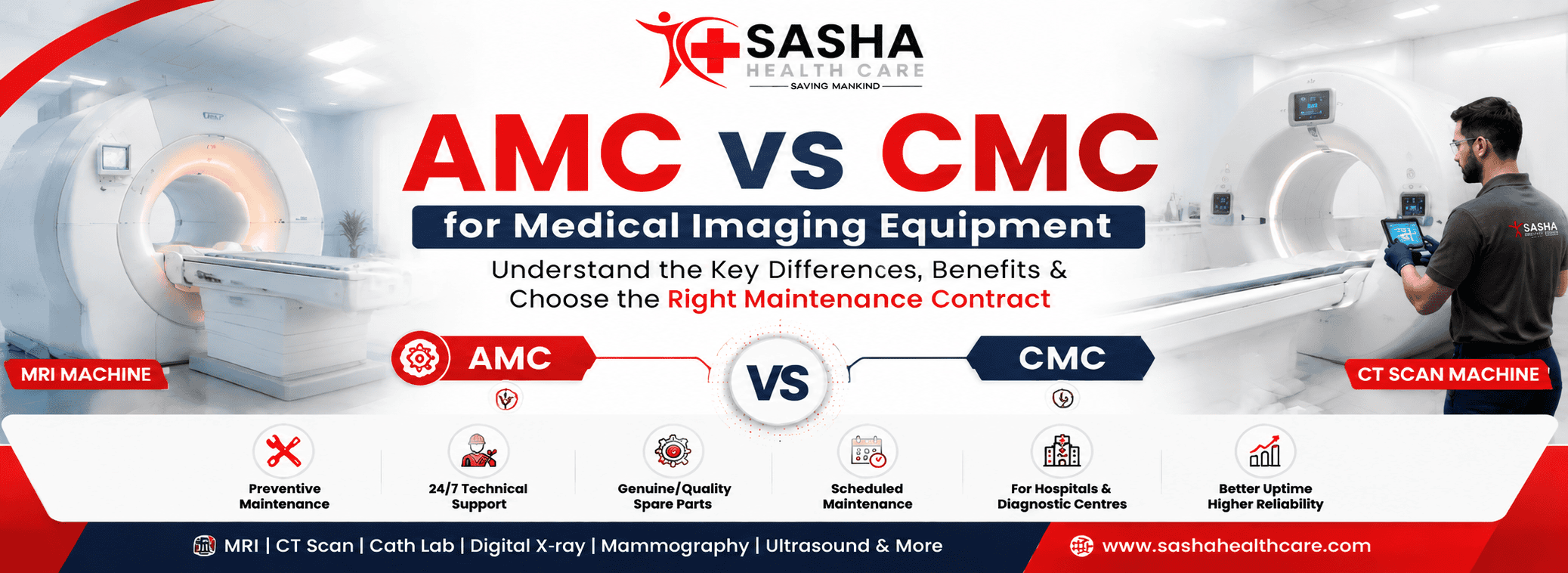
AMC vs CMC for Medical Imaging Equipment: What’s the Difference & Which One Should You Choose?
Medical imaging equipment such as MRI machines, CT scanners, Cath Labs, Digital X-ray systems, Mammography units, and Ultrasound machines represent significant investments for hospitals and diagnostic centres. These systems require regular maintenance to ensure accurate diagnoses, minimize downtime, and extend equipment lifespan.
Two of the most common maintenance options available are the Annual Maintenance Contract (AMC) and the Comprehensive Maintenance Contract (CMC). While both help keep equipment operational, they differ in terms of service coverage, spare parts, repair costs, and overall maintenance responsibilities.
In simple terms:
- AMC (Annual Maintenance Contract) covers preventive maintenance and labour charges, while spare parts are generally billed separately.
- CMC (Comprehensive Maintenance Contract) includes preventive maintenance, labour, repairs, and most spare parts under a fixed annual cost.
For hospitals with high patient volumes or mission-critical imaging systems, choosing the right maintenance contract can significantly reduce equipment downtime and unexpected repair expenses.
This guide explains the differences between AMC and CMC, their advantages, costs, and how to determine the best option for your MRI, CT scanner, or other medical imaging equipment.
Why Maintenance Contracts Are Essential for Medical Imaging Equipment
Medical imaging systems operate in demanding clinical environments where reliability is essential. Even a few hours of downtime can delay patient care, disrupt hospital operations, and result in financial losses.
Regular maintenance helps healthcare providers:
- Improve equipment reliability
- Reduce unexpected breakdowns
- Enhance image quality
- Increase equipment lifespan
- Meet manufacturer-recommended maintenance schedules
- Improve patient safety
- Lower long-term operating costs
- Ensure compliance with quality and safety standards
Whether your facility uses a refurbished MRI machine or a brand-new CT scanner, investing in a suitable maintenance contract is critical for maximizing return on investment.
What is an Annual Maintenance Contract (AMC)?
An Annual Maintenance Contract (AMC) is a service agreement between the equipment owner and the service provider for routine maintenance of medical equipment over a fixed period, usually one year.
Under an AMC, the service provider performs scheduled preventive maintenance, inspections, calibration, cleaning, and labour for repairs. However, replacement parts and consumables are usually charged separately.
Typical AMC Services Include
- Preventive maintenance visits
- Equipment inspection
- Cleaning and calibration
- Performance testing
- Software checks (where applicable)
- Labour charges for repairs
- Technical support
- Maintenance reports
- Basic troubleshooting
- Equipment health assessment
What Is Usually Not Covered?
Most AMC agreements do not include:
- Replacement spare parts
- X-ray tubes
- MRI coils
- CT detector components
- Helium refilling
- Cryogenic repairs
- Major electronic boards
- High-value consumables
These components are billed separately whenever replacement is required.
Advantages of AMC
Many hospitals choose AMC because it offers a cost-effective way to maintain imaging equipment while retaining flexibility over replacement parts.
Lower Annual Cost
AMC contracts generally cost less than CMC agreements since they exclude expensive spare parts.
Preventive Maintenance
Regular inspections help identify potential problems before they become major failures.
Improved Equipment Performance
Routine servicing keeps imaging systems operating efficiently, reducing the likelihood of performance issues.
Flexible Repair Costs
Hospitals only pay for parts when replacements are actually required, which can be economical for newer equipment with low failure rates.
Better Equipment Lifespan
Scheduled maintenance reduces wear and tear, helping extend the service life of MRI and CT systems.
Limitations of AMC
Although AMC offers several benefits, it also has limitations that hospitals should consider.
Spare Parts Are Extra
If expensive components fail, repair costs can become substantial.
Budget Uncertainty
Unexpected failures may lead to higher maintenance expenses than originally planned.
Longer Approval Process
Hospitals often need administrative approval before purchasing replacement parts, which may delay repairs.
Higher Financial Risk
Facilities operating older imaging systems may experience frequent failures, increasing annual maintenance costs beyond expectations.
Who Should Choose an AMC?
An Annual Maintenance Contract is often suitable for:
- Newly installed MRI machines
- New CT scanners
- Hospitals with limited maintenance budgets
- Diagnostic centres with low patient volume
- Facilities where equipment failures are infrequent
- Organizations with separate budgets for spare parts
If the equipment is relatively new and major component failures are unlikely, AMC can provide excellent value.
What is a Comprehensive Maintenance Contract (CMC)?
A Comprehensive Maintenance Contract (CMC) is a complete maintenance solution that covers preventive maintenance, labour, repairs, and most replacement spare parts under a fixed annual fee.
Unlike AMC, CMC minimizes unexpected maintenance expenses by including many of the high-cost components that are commonly excluded from standard maintenance contracts.
This makes CMC particularly valuable for hospitals that rely heavily on imaging equipment for daily patient care.
Typical Services Included in a CMC
A Comprehensive Maintenance Contract generally includes:
- Scheduled preventive maintenance
- Unlimited breakdown visits
- Labour charges
- Replacement of covered spare parts
- System calibration
- Performance verification
- Emergency service support
- Software updates
- Technical inspections
- Equipment optimization
- Priority response
- Service documentation
Depending on the agreement, some high-value items (such as MRI helium refills or X-ray tubes) may still have exclusions, so hospitals should always review contract terms carefully.
Advantages of CMC
Hospitals often prefer CMC because it provides predictable maintenance costs and reduces operational risk.
Fixed Annual Budget
Maintenance expenses remain predictable throughout the contract period.
Reduced Downtime
Since spare parts are covered, repairs can usually begin immediately without waiting for purchase approvals.
Better Equipment Availability
Critical imaging equipment remains operational for longer periods, improving patient scheduling and service quality.
Lower Long-Term Risk
Unexpected component failures have less financial impact because covered parts are included in the contract.
Priority Technical Support
Many CMC providers offer faster response times and priority service for contract customers.
AMC vs CMC: Side-by-Side Comparison
Choosing between an Annual Maintenance Contract (AMC) and a Comprehensive Maintenance Contract (CMC) depends on your equipment’s age, usage, maintenance budget, and the level of operational risk your healthcare facility can accept.
The following comparison highlights the key differences.
| Feature | AMC (Annual Maintenance Contract) | CMC (Comprehensive Maintenance Contract) |
|---|---|---|
| Preventive Maintenance | ✔ Included | ✔ Included |
| Breakdown Service | ✔ Included | ✔ Included |
| Labour Charges | ✔ Included | ✔ Included |
| Spare Parts | ✘ Usually Extra | ✔ Usually Included |
| Software Updates | Sometimes | Usually Included |
| Emergency Support | Limited | Priority Support |
| Annual Cost | Lower | Higher |
| Budget Predictability | Medium | High |
| Equipment Downtime | Moderate | Low |
| Best For | New Equipment | Older & High-Usage Equipment |
Key Differences Between AMC and CMC
Although both contracts aim to keep medical imaging equipment in optimal working condition, their scope of coverage differs significantly.
1. Spare Parts Coverage
This is the biggest difference.
With an AMC, if a major component such as an MRI power supply, CT detector board, or electronic module fails, the hospital bears the replacement cost.
With a CMC, these components are generally covered under the agreement (subject to contract terms), reducing unexpected expenses.
2. Maintenance Cost
AMC has a lower annual fee because it excludes expensive spare parts.
CMC costs more initially but helps avoid large, unplanned repair bills during the contract period.
3. Equipment Downtime
When equipment breaks down under an AMC, hospitals may need to approve quotations before replacement parts are ordered.
This approval process can delay repairs.
Under a CMC, replacement parts are typically supplied immediately, allowing engineers to restore equipment faster and reduce downtime.
4. Financial Planning
Hospitals often prefer CMC because maintenance costs remain predictable throughout the year.
With AMC, annual expenses may fluctuate depending on equipment failures.
5. Risk Management
AMC transfers only part of the maintenance responsibility to the service provider.
CMC transfers most maintenance risks, making it a more comprehensive solution for mission-critical imaging systems.
Which Is Better for MRI Machines?
MRI systems are among the most sophisticated and expensive diagnostic imaging devices in healthcare. They contain complex electronic assemblies, cooling systems, gradient amplifiers, RF components, and precision hardware that require expert maintenance.
For new MRI machines with low operating hours, an AMC can be a cost-effective option because the likelihood of major component failure is relatively low.
However, for refurbished MRI machines or systems that have been in service for several years, a CMC is generally the better choice. It provides broader protection against unexpected failures, reduces downtime, and helps hospitals manage maintenance costs more effectively.
Recommendation:
- 0–5 years old: AMC may be sufficient if equipment is in excellent condition.
- 5+ years old or refurbished: CMC is recommended for greater reliability and financial predictability.
Which Is Better for CT Scan Machines?
CT scanners operate under high workloads, especially in busy hospitals and diagnostic centres. Components such as X-ray tubes, detectors, and cooling systems experience significant wear over time.
For facilities with low daily scan volumes, an AMC may provide adequate maintenance support while keeping annual costs lower.
For high-volume diagnostic centres performing dozens of scans each day, a CMC is often the smarter investment. Comprehensive coverage helps minimize downtime, ensuring uninterrupted patient services and avoiding costly emergency repairs.
Recommendation:
- Low patient volume: AMC
- High patient volume: CMC
Factors That Influence Maintenance Costs
The cost of an AMC or CMC depends on several factors.
| Factor | Impact on Cost |
|---|---|
| Equipment Age | Older equipment usually costs more to maintain. |
| Brand | Premium brands may have higher service costs. |
| Daily Usage | Higher usage increases wear and maintenance needs. |
| Availability of Spare Parts | Rare or imported parts can increase costs. |
| Equipment Condition | Poorly maintained systems require more servicing. |
| Installation Location | Remote locations may involve higher travel costs. |
| Service Response Time | Faster response commitments can increase contract pricing. |
Rather than choosing solely based on price, hospitals should evaluate the total cost of ownership over the equipment’s lifecycle.
When Should You Choose an AMC?
An Annual Maintenance Contract is generally the better option when:
- Your equipment is relatively new.
- Major components are still under warranty.
- Equipment usage is moderate.
- You have a limited maintenance budget.
- Your biomedical engineering team can manage minor repairs.
- Spare part failures are expected to be infrequent.
AMC offers a practical balance between preventive maintenance and cost savings for facilities with lower operational risk.
When Should You Choose a CMC?
A Comprehensive Maintenance Contract is often the preferred choice when:
- Equipment is older or refurbished.
- Daily patient volume is high.
- Downtime would significantly impact hospital operations.
- Predictable annual maintenance costs are important.
- Rapid service response is required.
- The hospital wants to reduce the financial risk of unexpected component failures.
For critical imaging systems that support emergency departments, trauma centres, and high-volume diagnostic facilities, a CMC provides greater operational security.
Common Mistakes When Choosing a Maintenance Contract
Selecting the wrong maintenance agreement can lead to unnecessary costs and increased equipment downtime. Avoid these common mistakes:
Choosing Based Only on Price
A lower annual fee may seem attractive, but expensive spare part replacements under an AMC can quickly outweigh the initial savings.
Ignoring Equipment Age
Older imaging systems are more likely to experience component failures. Choosing an AMC for aging equipment may result in higher overall expenses.
Not Reviewing Contract Exclusions
Always read the agreement carefully to understand which parts and services are included—and which are excluded.
Overlooking Service Response Time
Fast response is critical for hospitals where every hour of downtime affects patient care and revenue.
Selecting an Inexperienced Service Provider
Medical imaging equipment requires specialized expertise. Work with providers that have trained engineers, access to genuine or high-quality compatible spare parts, and experience across multiple imaging modalities.
Expert Recommendation
There is no one-size-fits-all answer when choosing between AMC and CMC. The right decision depends on your equipment profile and operational priorities.
- Choose AMC if your equipment is new, usage is moderate, and you can budget separately for spare parts.
- Choose CMC if your equipment is older, heavily used, or critical to daily patient care, and you want predictable costs with minimal downtime.
For hospitals managing multiple imaging systems, it may even be beneficial to use a combination of AMC and CMC based on the age, condition, and utilization of each machine.
Why Choose Sasha Healthcare for AMC & CMC Services?
At Sasha Healthcare, we understand that reliable medical imaging equipment is essential for delivering uninterrupted patient care. Our experienced service engineers provide maintenance solutions for a wide range of diagnostic imaging systems, including MRI machines, CT scanners, Cath Labs, Digital X-ray systems, Mammography units, Ultrasound machines, and other medical equipment.
Our Services Include:
- Annual Maintenance Contracts (AMC)
- Comprehensive Maintenance Contracts (CMC)
- Preventive Maintenance Programs
- Equipment Installation & Commissioning
- Equipment Relocation Services
- Breakdown Maintenance
- Calibration & Performance Checks
- Spare Parts Support
- Technical Consultation
- Equipment Lifecycle Management
Our focus is on maximizing equipment uptime, extending system lifespan, and helping hospitals and diagnostic centres maintain high operational efficiency through dependable maintenance services.
Conclusion
Medical imaging equipment is a significant investment, and protecting that investment requires a well-planned maintenance strategy. Both Annual Maintenance Contracts (AMC) and Comprehensive Maintenance Contracts (CMC) offer valuable benefits, but the right choice depends on your equipment’s age, usage patterns, operational requirements, and budget.
For healthcare facilities seeking lower upfront maintenance costs, AMC may be the right option. For those prioritizing predictable expenses, faster repairs, and minimal downtime, CMC provides greater long-term value.
By partnering with an experienced service provider, hospitals and diagnostic centres can ensure reliable equipment performance, improve patient care, and maximize the return on their imaging technology investments.
Contact Sasha Healthcare
Looking for reliable AMC or CMC services for your medical imaging equipment?
Whether you operate an MRI machine, CT scanner, Cath Lab, Digital X-ray, Mammography, or Ultrasound system, Sasha Healthcare offers tailored maintenance solutions designed to keep your equipment running at peak performance.
Contact our team today to discuss your maintenance requirements and discover how our expert service engineers can help reduce downtime, extend equipment life, and support uninterrupted patient care.
An Annual Maintenance Contract (AMC) is a service agreement that covers routine preventive maintenance, inspections, calibration, and labour charges for medical equipment. However, replacement spare parts are generally billed separately, making AMC suitable for newer equipment with a lower risk of major component failures.
A Comprehensive Maintenance Contract (CMC) includes preventive maintenance, labour, repairs, and most replacement spare parts under a fixed annual fee. It helps hospitals control maintenance costs and reduce unexpected equipment downtime.
The primary difference is spare parts coverage. AMC covers maintenance services and labour, while CMC generally includes both labour and replacement parts (subject to contract terms). This makes CMC a more comprehensive maintenance solution.
For newer MRI systems, an AMC may be sufficient if the equipment is in excellent condition. However, for older or refurbished MRI machines, a CMC is often the better choice because it minimizes repair costs and reduces downtime.
Yes. Many refurbished MRI, CT, and other imaging systems can be covered under AMC or CMC agreements, depending on their condition and service provider policies.
Professional maintenance ensures reliable equipment performance, minimizes downtime, supports regulatory compliance, enhances patient care, and extends the operational life of valuable medical imaging systems.