
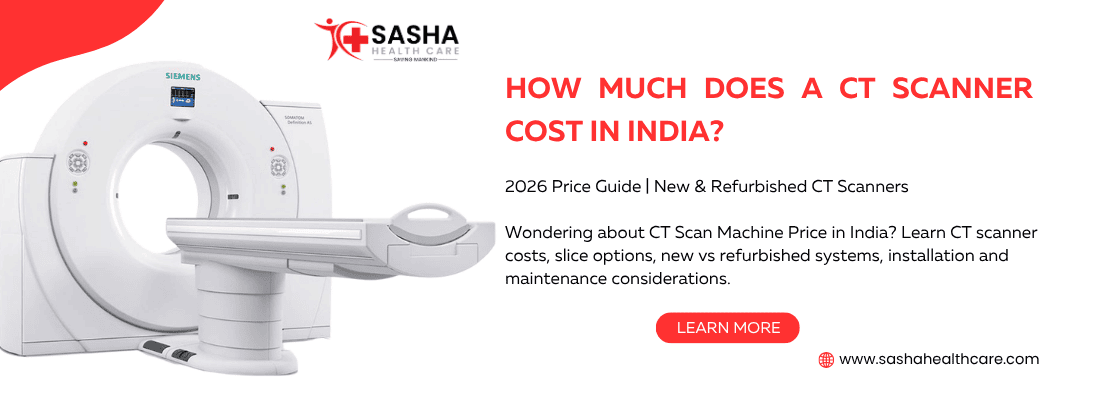
How much does a CT Scanner Cost in India?
If you are planning to purchase a CT scanner for a hospital or diagnostic centre, one of the first questions is: How much does a CT scanner cost in India? The CT Scan Machine Price in India varies significantly depending on the number of slices, manufacturer, model, equipment condition, software, tube condition, installation requirements, warranty and service support.
As a broad market consideration, entry-level and lower-slice CT systems generally require a lower investment than advanced 64-slice, 128-slice and higher-end systems. A refurbished CT scanner can also cost considerably less than a comparable new system, depending on its age, configuration, tube condition and refurbishment quality.
However, the purchase price is only one part of the investment. Transportation, room preparation, radiation shielding, electrical infrastructure, installation, software, workstation, maintenance and CT tube replacement can all affect the CT Scan Machine cost in India.
For this reason, hospitals and diagnostic centres should compare the complete equipment package and total cost of ownership rather than choosing a CT scanner based only on its quoted purchase price.
CT Scan Machine Price in India: What Does a CT Scanner Cost?
There is no single price applicable to every CT scanner. The final CT scanner cost depends on the equipment specification and the scope of the supplier’s quotation.
An indicative way to understand the market is:
| CT Scanner Category | Typical Application | Price Considerations |
|---|---|---|
| Entry-level CT | General diagnostic imaging | Lower investment; configuration is important |
| 16-slice CT | Routine diagnostic imaging | Suitable for many general applications |
| 32-slice CT | General and higher-volume imaging | Higher capability and investment |
| 64-slice CT | Advanced routine imaging and angiography | Higher specification and software options |
| 128-slice CT | Advanced imaging and higher workloads | Generally higher investment |
| Refurbished CT | Budget-conscious hospitals and diagnostic centres | Depends heavily on model, age, tube condition and refurbishment |
These are categories rather than fixed prices. A 64-slice CT scanner from one model year can have a substantially different price from another 64-slice system because of differences in detector technology, tube capacity, software, workstation, scan speed, warranty and equipment condition.
Therefore, when searching for CT Scan Machine Price, buyers should first define their clinical requirements and then request a configuration-specific quotation.
What Determines CT Scan Machine Cost in India?
Several factors influence the CT Scan Machine cost in India. Understanding these factors can help hospitals and diagnostic centres make a more informed purchasing decision.
1. Number of Slices
The number of slices is one of the most commonly discussed specifications when comparing CT scanners.
Systems may be available in configurations such as:
- 16-slice
- 32-slice
- 64-slice
- 128-slice
- Higher-slice configurations
Generally, more advanced configurations can support faster and more sophisticated imaging workflows. However, slice count alone should not determine the purchase decision.
Detector design, gantry rotation speed, X-ray tube capability, reconstruction technology, software and clinical applications also matter.
For example, a diagnostic centre primarily performing routine CT examinations may have different requirements from a tertiary-care hospital performing advanced cardiac or vascular imaging.
2. Brand and Model
The manufacturer and specific model can have a significant impact on the CT scanner price in India.
Well-established medical imaging manufacturers such as Siemens Healthineers, GE HealthCare, Philips and Canon Medical offer CT systems across different technology generations and configurations.
Two machines with a similar slice count can have different values because of:
- Model generation
- Detector technology
- Tube specifications
- Software
- Workstation
- Applications
- Scan speed
- System condition
- Service availability
Consequently, buyers should compare complete specifications instead of comparing machines only by brand or slice count.
3. New vs Refurbished CT Scanner
One of the most important decisions affecting CT Scan Machine Price is whether to purchase a new or refurbished system.
A new CT scanner generally offers newer technology and may come with manufacturer-specific warranty and support arrangements. However, the initial investment can be significantly higher.
A professionally refurbished CT scanner can provide an alternative for hospitals and diagnostic centres that need to control capital expenditure.
A refurbished system should be evaluated based on:
- Original manufacturer and model
- Year of manufacture
- Equipment history
- Scan hours
- Tube usage
- Detector condition
- Image quality
- Software
- Workstation
- Preventive maintenance history
- Availability of replacement parts
- Warranty
- Installation support
The cheapest refurbished CT scanner is not necessarily the most economical choice. Equipment reliability and future serviceability are equally important.
CT Scanner Cost by Slice Count
Slice count is useful as an initial comparison point, but it should not be treated as a complete pricing formula.
16-Slice CT Scanner
A 16-slice CT scanner can be considered for routine diagnostic applications where the clinical workload does not require the capabilities of higher-end systems.
The 16-slice CT machine price depends on the manufacturer, model, condition, tube, software, workstation and included services.
32-Slice CT Scanner
A 32-slice system can provide additional capabilities for facilities with broader diagnostic requirements.
When comparing 32-slice systems, buyers should examine detector configuration, tube condition, software applications, reconstruction capabilities and service support rather than focusing solely on the slice count.
64-Slice CT Scanner
A 64-slice CT scanner is commonly considered by facilities requiring more advanced imaging capabilities and potentially higher patient throughput.
The 64-slice CT scanner price can vary substantially depending on the exact model and configuration.
For a hospital or diagnostic centre considering a 64-slice system, important factors include tube capacity, rotation speed, detector design, cardiac capabilities, angiography applications, workstation and software.
128-Slice CT Scanner
A 128-slice CT scanner generally represents a higher-end investment. Such systems may be considered for hospitals and advanced diagnostic centres with higher patient volumes and broader clinical requirements.
The cost can vary considerably depending on technology generation and configuration.
Does More Slices Always Mean a Better CT Scanner?
Not necessarily.
The correct CT scanner depends on the clinical applications, patient volume, infrastructure and budget.
A facility should consider the complete technical specification rather than purchasing the highest slice count available.
New vs Refurbished CT Scanner: Which Should You Choose?
There is no universal answer. The appropriate option depends on the facility’s budget, workload and clinical requirements.
| Factor | New CT Scanner | Refurbished CT Scanner |
|---|---|---|
| Initial investment | Generally higher | Generally lower |
| Technology | Latest/current generation options | Depends on model and generation |
| Equipment age | New | Previously used |
| Warranty | Typically available | Depends on supplier/package |
| Availability | Depends on model | Can be available sooner |
| Service | Manufacturer/dealer dependent | Supplier/service-provider dependent |
| ROI considerations | Higher capital requirement | Potentially lower capital investment |
| Suitability | New projects and advanced requirements | Budget-conscious facilities |
A professionally refurbished CT scanner may be attractive when capital expenditure is limited, but buyers should perform proper technical due diligence before purchasing.
Additional Costs When Buying a CT Scanner
The equipment quotation is not necessarily the complete project cost.
A hospital or diagnostic centre may need to budget for additional expenses such as:
Transportation
The CT scanner must be safely transported from the supplier’s location to the installation site. Transportation requirements can vary depending on equipment dimensions, location and logistics.
Installation
Professional installation is essential for bringing the equipment into operational condition.
The quotation should clearly state whether installation is included.
De-installation
If a facility is replacing an existing CT scanner, de-installation and removal of the old equipment may create an additional cost.
Site Preparation
CT rooms may require appropriate:
- Electrical infrastructure
- HVAC
- Flooring
- Radiation shielding
- Network connectivity
- Equipment space
- Control-room setup
The actual requirements should be assessed for the selected system and facility.
UPS and Power Infrastructure
Reliable electrical infrastructure is important for CT operations. Depending on the installation, UPS and related electrical work may need to be considered separately.
Workstation and Software
Advanced visualization and clinical applications may require specific software and workstation configurations.
These may include capabilities related to:
- 3D visualization
- CT angiography
- Cardiac imaging
- Advanced reconstruction
- Image processing
The exact software package should be confirmed in the quotation.
Maintenance
Maintenance is another important component of the overall CT machine cost.
Hospitals should consider:
- Preventive maintenance
- AMC
- CMC
- Breakdown support
- Genuine spare parts
- CT tube replacement
- Software support
A lower initial purchase price can become less attractive if maintenance and downtime costs are significantly higher.
How to Choose a CT Scanner for a Hospital or Diagnostic Centre
Before purchasing a CT scanner, define the facility’s requirements.
1. Assess Patient Volume
Estimate the expected number of CT examinations per day and month.
A high-volume diagnostic centre may require a different configuration from a smaller facility.
2. Identify Clinical Applications
Determine which examinations will be performed.
For example:
- Routine head CT
- Chest CT
- Abdomen CT
- Trauma imaging
- CT angiography
- Cardiac CT
- 3D imaging
The intended applications influence the appropriate system configuration.
3. Evaluate Infrastructure
Check whether the facility can accommodate:
- CT room
- Control room
- Electrical requirements
- HVAC
- Radiation shielding
- Networking
- Patient access
- Equipment transportation
4. Consider Service Support
CT scanners are complex systems. Reliable technical support can be just as important as the initial equipment price.
Ask the supplier about:
- Installation
- Preventive maintenance
- Breakdown response
- Spare parts
- Tube support
- Warranty
- AMC/CMC options
5. Compare Total Cost of Ownership
Instead of asking only:
“What is the CT Scan Machine Price?”
also ask:
“What will this CT scanner cost us over its expected operating period?”
This approach provides a more realistic picture of the investment.
What Should You Check Before Buying a Refurbished CT Scanner?
A refurbished CT scanner should undergo appropriate technical and operational evaluation before purchase.
Important checks include:
- Manufacturer and model
- Year of manufacture
- Scan hours
- Tube usage
- Tube condition
- Detector condition
- Gantry condition
- Generator
- Patient table
- Workstation
- Software
- Image quality
- Error history
- Service history
- Preventive maintenance records
- Availability of spare parts
- Warranty
- Installation scope
- Acceptance testing
- Supplier support
Buyers should request relevant equipment documentation and understand exactly what has been inspected, replaced, repaired or refurbished.
How to Compare CT Scanner Quotations
When comparing quotations from multiple suppliers, avoid comparing only the headline equipment price.
Create a comparison checklist covering:
| Item | What to Check |
|---|---|
| CT Scanner | Exact make and model |
| Slice configuration | 16/32/64/128 etc. |
| Tube | Condition and warranty |
| Detector | Configuration and condition |
| Software | Included applications |
| Workstation | Included or additional |
| Installation | Included or excluded |
| Transportation | Included or excluded |
| Warranty | Duration and scope |
| Spare parts | Availability |
| AMC/CMC | Optional or included |
| Breakdown support | Response and coverage |
| Training | Included or additional |
| Site preparation | Responsibility of buyer/supplier |
This helps prevent situations where a lower initial quotation eventually becomes more expensive because important components were excluded.
CT Scanner ROI and Total Cost of Ownership
Buying a CT scanner is a significant capital investment. Therefore, hospital owners and diagnostic centre operators should evaluate the expected return on investment as part of the purchasing process.
Important considerations include:
- Expected patient volume
- Average utilization
- Clinical applications
- Operating hours
- Service costs
- Maintenance
- CT tube replacement
- Downtime
- Spare parts
- Staff requirements
- Equipment lifespan
For example, a facility with a high patient volume may justify investing in a more capable CT scanner, while a smaller diagnostic centre may prioritize a reliable refurbished system with appropriate specifications and service support.
The right decision should balance purchase price, clinical capability, reliability and long-term operating costs.
Why the Cheapest CT Scanner May Not Be the Best Choice
When comparing CT Scan Machine Price in India, it can be tempting to select the lowest quotation.
However, several questions should be asked before making that decision:
- What is the exact model?
- How old is the equipment?
- What is the tube condition?
- What software is included?
- Is the workstation included?
- Is installation included?
- What warranty is provided?
- Are spare parts available?
- Who will provide service?
- What happens if the scanner develops a major fault?
- Is preventive maintenance included?
- Is AMC or CMC available?
A slightly higher purchase price may represent better value if it includes stronger warranty coverage, reliable service support, better equipment condition and a more complete installation package.
CT Scanner Buying Checklist
Before finalizing a CT scanner purchase, consider this checklist:
Clinical requirements
- What examinations will be performed?
- What is the expected patient volume?
- Are advanced applications required?
Equipment
- Manufacturer
- Model
- Slice configuration
- Tube condition
- Detector
- Gantry
- Patient table
- Workstation
Software
- Reconstruction
- 3D visualization
- Angiography
- Cardiac applications, if required
Installation
- Transportation
- Installation
- De-installation
- Site preparation
- Electrical requirements
- HVAC
- Radiation shielding
After-sales support
- Warranty
- Preventive maintenance
- AMC/CMC
- Breakdown support
- Spare parts
- Tube support
Conclusion:
The CT Scan Machine Price in India depends on much more than the number of slices. Brand, model, technology generation, equipment condition, tube, detector, software, workstation, installation, warranty and service support all contribute to the final investment.
For hospitals and diagnostic centres, the best CT scanner is not necessarily the most expensive or the cheapest system. The right choice is the one that matches the facility’s clinical requirements, patient volume, infrastructure and budget while providing dependable long-term support.
When evaluating a new or refurbished CT scanner, compare the complete quotation, including equipment, installation, warranty, maintenance, spare parts and service support. This helps you understand the true CT scanner cost and make a more informed investment decision.
Looking for a CT scanner for your hospital or diagnostic centre? Sasha HealthCare can help you evaluate CT equipment options based on your clinical requirements, patient volume, infrastructure and budget.