September 2026 - SashaHealthCare
Search for:
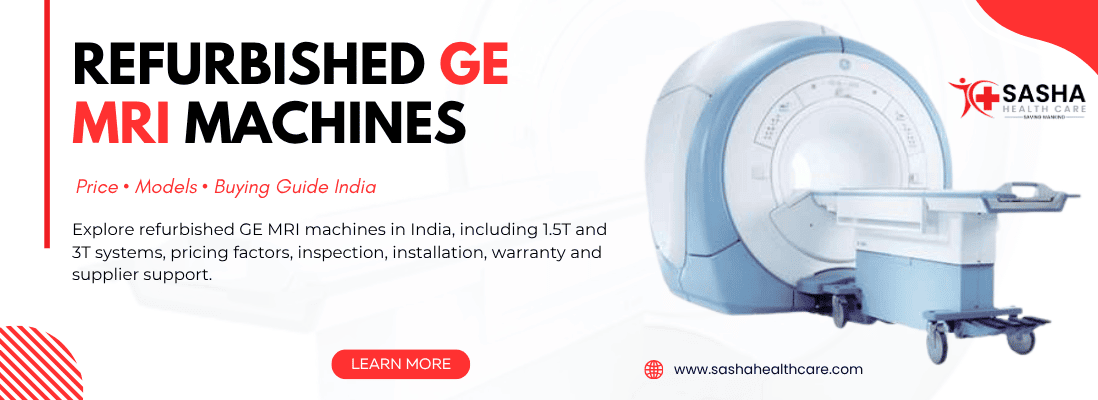
Refurbished GE MRI Machines in India - 1.5T and 3T MRI systems
Refurbished GE MRI Machines: Price & Buying Guide in India

When hospitals and diagnostic centres plan to add or upgrade MRI imaging capability, the equipment investment is only one part of the decision. Buyers also need to consider system configuration, installation, transportation, site requirements, warranty, technical support, maintenance and long-term operating costs.

Refurbished GE MRI machines can be considered by healthcare facilities looking for established MRI technology while managing their capital expenditure. The actual condition, model, configuration, refurbishment scope and included services can vary significantly between systems.

This guide explains what to look for when purchasing a refurbished GE MRI machine in India, what influences the MRI machine price in India, how to evaluate MRI scanner cost beyond the equipment itself, and how to select a reliable refurbished MRI machine supplier.

Refurbished GE MRI Machines: At a Glance

A refurbished GE MRI machine is a previously installed GE MRI system that has been inspected, serviced, tested and prepared for another clinical installation. The exact refurbishment process depends on the machine, configuration, age and supplier.

Before purchasing, buyers should consider:

  • MRI field strength, such as 1.5T or 3T
  • Machine model and configuration
  • Software and available applications
  • Coil package
  • Magnet and cryogenic-system condition, where applicable
  • Gradient and RF-system condition
  • Patient table and accessories
  • Image-quality testing
  • Refurbishment scope
  • Warranty
  • Installation and transportation
  • Availability of technical support and spare parts
  • AMC or CMC options

The purchase decision should therefore be based on the complete equipment and service package, rather than the machine price alone.

What Is a Refurbished GE MRI Machine?

A refurbished GE MRI machine is a pre-owned magnetic resonance imaging system that has undergone a defined inspection, servicing, repair or replacement process before being supplied to another healthcare facility.

Refurbishment may involve technical inspection, component testing, preventive maintenance, replacement of selected parts, cleaning, system checks and image-quality verification. However, the scope is not identical for every machine.

This is why buyers should ask the supplier for documentation describing exactly what has been inspected, serviced or replaced.

A refurbished MRI system should also be evaluated according to its intended clinical use. A system planned for a diagnostic centre may have different requirements from one intended for a hospital with a broader range of MRI examinations.

Why Consider Refurbished GE MRI Machines?

The decision to purchase refurbished equipment can involve several factors.

Capital expenditure

A refurbished system can provide an alternative to purchasing a new MRI system when a healthcare facility has a defined equipment budget.

However, buyers should compare the complete project cost, including installation, transportation, site preparation, warranty and service support.

Established MRI technology

GE Healthcare has a broad history in medical imaging. Refurbished GE MRI systems may therefore provide healthcare facilities with access to previously deployed GE platforms and configurations.

The suitability of a particular system depends on its model, configuration, condition, software and intended applications.

Different configuration options

Refurbished GE MRI machines can be available in different field strengths and configurations. Buyers may encounter 1.5T GE MRI machines and 3T GE MRI machines, depending on market availability and the equipment being offered.

Service and support

MRI equipment requires specialist installation and ongoing technical support. Therefore, purchasing from a supplier that can assist with transportation, installation, commissioning and maintenance can be important.


1.5T vs 3T GE MRI Machines

One of the first technical decisions for an MRI buyer is the required field strength.

1.5T GE MRI Machines

A 1.5T GE MRI machine uses a 1.5 Tesla magnetic field and is widely associated with general MRI applications.

Depending on configuration, a 1.5T system can be considered for examinations involving areas such as:

  • Brain
  • Spine
  • Musculoskeletal imaging
  • Abdomen
  • Pelvis
  • Joints
  • Routine neurological imaging

The exact capabilities depend on the individual system, coils, software and clinical requirements.

3T GE MRI Machines

A 3T GE MRI machine operates at a higher magnetic field strength and can provide different imaging characteristics and capabilities compared with 1.5T systems.

Depending on the system configuration and clinical applications, 3T MRI may be considered for advanced neurological, musculoskeletal, vascular, prostate and other specialized imaging applications.

Higher field strength does not automatically mean that every healthcare facility should choose a 3T system. The decision should consider clinical workload, patient volume, available infrastructure, budget, applications and technical requirements.

Factor1.5T GE MRI3T GE MRI
Magnetic field1.5 Tesla3 Tesla
Common useGeneral MRI applicationsGeneral and selected advanced applications
InfrastructureDepends on systemMay involve additional site considerations
Clinical applicationsBroadBroad, with potential advantages for selected applications
Operating considerationsSystem-dependentSystem-dependent
Suitable choiceDepends on clinical requirementsDepends on clinical requirements

The appropriate field strength should be determined according to the facility’s clinical and operational requirements rather than field strength alone.

Refurbished GE MRI Machine Price in India

The refurbished GE MRI machine price in India does not have one fixed value. Two machines from the same manufacturer can have substantially different prices because of differences in model, age, configuration, software, coils, system condition and refurbishment scope.

Important factors include:

  • MRI model
  • 1.5T or 3T configuration
  • Manufacturing year
  • System age and usage history
  • Software configuration
  • Available imaging applications
  • Gradient configuration
  • RF system
  • Coil package
  • Magnet condition
  • Cold head condition, where applicable
  • Cryogenic system
  • Patient table
  • Refurbishment work completed
  • Warranty
  • Installation
  • Transportation
  • Technical support
  • Spare-parts availability
  • AMC or CMC

Therefore, buyers searching for MRI Machine Price in India should avoid comparing quotations based only on the headline equipment price.

A quotation should clearly identify what is included and excluded.

What Affects MRI Machine Price in India?

The overall MRI Machine Price is influenced by several technical and commercial factors.

1. Tesla strength

A 1.5T and 3T MRI system can have different configurations and project requirements.

2. Model and generation

The specific GE MRI model and technology generation can affect availability, configuration and service considerations.

3. Software and applications

Software packages and clinical applications can influence the functionality of an MRI system.

4. Coils

The number and type of coils supplied with the system are important because coils are directly related to the examinations the system can support.

5. Refurbishment scope

A system that has undergone extensive inspection and component replacement may have a different commercial value from a system supplied with limited refurbishment.

6. Warranty and support

Warranty terms and technical support can affect the overall value of a quotation.

7. Installation and transportation

MRI transportation, lifting, installation and commissioning can represent a significant part of an equipment project.

For this reason, buyers should evaluate the total project cost, not simply the machine purchase price.

What Does an MRI Scanner Cost Beyond the Machine Price?

When researching MRI scanner cost, healthcare buyers should account for expenses beyond the MRI equipment itself.

Depending on the project, additional requirements can include:

  • Equipment transportation
  • Crane or lifting arrangements
  • Site preparation
  • MRI room preparation
  • RF shielding
  • Electrical infrastructure
  • HVAC requirements
  • Cooling/chiller infrastructure where applicable
  • Quench pipe requirements where applicable
  • Installation
  • Testing and commissioning
  • Additional accessories
  • Preventive maintenance
  • AMC or CMC
  • Spare parts
  • Technical support

The actual requirements vary by MRI system and site.

A supplier should therefore assess the installation location and equipment configuration before providing a final project quotation.

What Should You Check Before Buying a Refurbished GE MRI Machine?

A refurbished MRI machine should be evaluated from both technical and commercial perspectives.

Machine details

Ask for:

  • Manufacturer
  • Model
  • Tesla strength
  • Manufacturing year
  • Software version
  • Configuration
  • Service history
  • Previous installation information, where available
Magnet and cryogenic system

For systems where applicable, buyers should review:

  • Magnet condition
  • Helium status
  • Cold head condition
  • Cryogenic-system condition
  • Previous service records

The supplier should explain the current condition and any relevant maintenance requirements.

RF coils

Check the available coils and their condition.

Depending on the configuration, buyers may require coils for areas such as:

  • Head
  • Spine
  • Knee
  • Shoulder
  • Body
  • Other clinical applications

The actual coil package should be documented in the quotation.

Image quality

Image quality should be assessed through appropriate technical testing and, where applicable, phantom testing.

Buyers should also check for:

  • Image artifacts
  • System errors
  • Coil performance
  • Gradient performance
  • RF-system performance
Patient table and accessories

The patient table, positioning accessories and other supplied components should be inspected before finalizing the purchase.

How to Choose a Refurbished MRI Machine Supplier

Choosing a refurbished MRI machine supplier involves more than comparing equipment prices.

Ask the supplier about:

Refurbishment process

Understand what inspection, servicing, testing and component replacement are included.

Installation capability

MRI installation requires specialized technical planning. Confirm whether the supplier handles installation and commissioning.

Transportation and lifting

MRI equipment is large and heavy. Ask whether the supplier can coordinate transportation, lifting and safe positioning at the destination site.

Warranty

Review the warranty period, covered components, exclusions and service response process.

Technical support

MRI systems require specialized support. Ask about engineer availability, troubleshooting and preventive maintenance.

Spare parts

Availability of genuine or compatible service parts can influence long-term equipment operation.

AMC / CMC

If required, ask whether annual maintenance contracts or comprehensive maintenance contracts are available after the warranty period.

Installation, Transportation and Technical Support

The successful delivery of an MRI machine does not end when the equipment reaches the hospital.

An MRI project may involve:

  1. Equipment inspection
  2. De-installation at the source location
  3. Packing and preparation
  4. Transportation
  5. Lifting and positioning
  6. Site readiness verification
  7. Installation
  8. System connection
  9. Testing
  10. Image-quality verification
  11. Commissioning
  12. Handover

Site planning should be completed before transportation. Infrastructure requirements can vary according to the MRI model and configuration.

Sasha HealthCare provides medical imaging equipment support covering MRI transportation, installation, de-installation and technical support, subject to the specific project requirements.

Refurbished GE MRI Machines for Hospitals and Diagnostic Centres

Refurbished GE MRI systems can be considered by different healthcare facilities depending on their imaging requirements.

Hospitals

Hospitals may evaluate MRI systems based on:

  • Patient volume
  • Clinical departments
  • Required applications
  • Operating schedule
  • Available infrastructure
  • Service requirements
Diagnostic centres

Diagnostic centres may evaluate:

  • Expected scan volume
  • Examination mix
  • Available space
  • Capital budget
  • Required field strength
  • Long-term maintenance costs
  • Local technical support

The right MRI configuration is therefore determined by the facility’s clinical and business requirements.

Why After-Sales Service Matters

An MRI system is a complex medical imaging platform. Equipment downtime can affect patient scheduling and facility operations.

A supplier should therefore provide a clear post-sale support structure.

Important support areas include:

  • Preventive maintenance
  • Breakdown support
  • Technical troubleshooting
  • Spare parts
  • Coil-related support
  • Cryogenic-system support where applicable
  • Cold head replacement where applicable
  • AMC / CMC
  • Installation support

Before purchasing, buyers should understand who will provide technical support and how service requests will be handled.

Refurbished GE MRI Machine Buying Checklist

Use this checklist before finalizing a purchase:

Equipment

  • Manufacturer and model verified
  • 1.5T or 3T confirmed
  • Manufacturing year documented
  • Configuration documented
  • Software information provided

Technical condition

  • Magnet inspected
  • Cold head checked where applicable
  • Cryogenic system checked where applicable
  • RF system tested
  • Gradient system checked
  • Patient table inspected
  • Coils tested

Image quality

  • Image-quality testing completed
  • Phantom testing reviewed where applicable
  • Artifacts checked
  • System errors reviewed

Commercial

  • Equipment price confirmed
  • Installation cost confirmed
  • Transportation cost confirmed
  • Warranty documented
  • AMC/CMC options reviewed
  • Spare-parts support discussed

Site

  • MRI room assessed
  • RF shielding requirements reviewed
  • Electrical requirements reviewed
  • HVAC/cooling requirements reviewed
  • Lifting and transportation route assessed
  • Other model-specific infrastructure requirements confirmed
Conclusion

Choosing a refurbished GE MRI machine requires more than comparing the advertised machine price. Buyers should evaluate the complete system, including field strength, model, software, coils, magnet condition, refurbishment scope, image quality, warranty, installation and long-term technical support.

When researching MRI Machine Price in India, MRI Machine Price, MRI scanner cost or Refurbished MRI machine price, compare complete quotations and understand what is included.

For hospitals and diagnostic centres considering refurbished MRI equipment, Sasha HealthCare can support the project with medical imaging equipment supply along with transportation, installation, de-installation and technical support based on project requirements.

For information about available refurbished GE MRI machines in India, contact Sasha HealthCare to discuss your required MRI configuration, clinical applications, site requirements and project scope.

What is a refurbished GE MRI machine?

A refurbished GE MRI machine is a previously used GE MRI system that has undergone inspection, servicing, testing or component replacement before being supplied to another healthcare facility. The exact refurbishment scope depends on the individual machine and supplier.

How much does a refurbished GE MRI machine cost in India?

There is no single fixed price. Refurbished GE MRI machine price depends on the model, Tesla strength, age, software, coils, system condition, refurbishment scope, warranty, installation, transportation and support services. Buyers should request a detailed quotation based on their required configuration.

Is a refurbished GE MRI scanner suitable for a diagnostic centre?

It can be suitable when the system’s configuration, clinical applications, image quality, infrastructure requirements, budget and technical support meet the diagnostic centre’s needs. The specific machine should be evaluated before purchase.

What services should an MRI machine supplier provide?

Depending on the project, services may include equipment supply, transportation, lifting, installation, de-installation, commissioning, technical support, preventive maintenance, spare parts and AMC/CMC support.
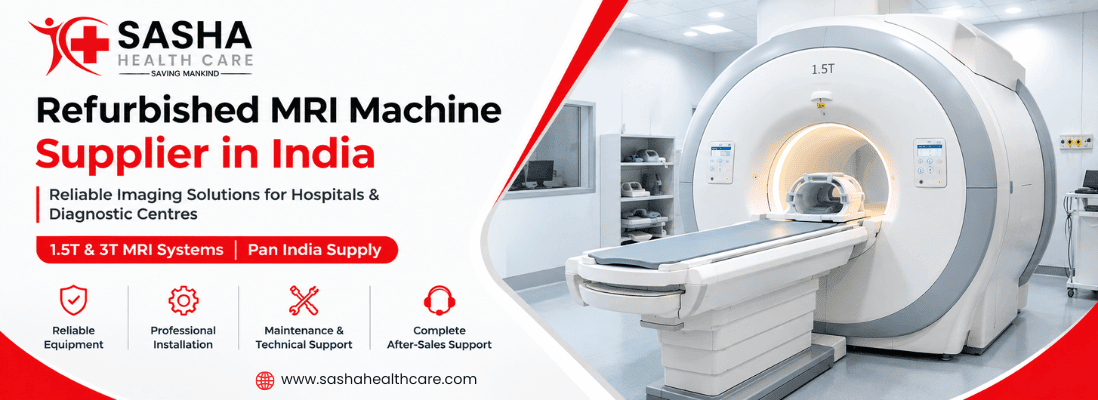
Refurbished MRI machine supplier in India – Sasha HealthCare
Refurbished MRI Machine Supplier in India: Complete Buying Guide

Choosing a reliable refurbished MRI machine supplier in India is an important decision for hospitals, diagnostic centres, and healthcare investors planning to establish or expand medical imaging services. A refurbished MRI scanner can provide access to established imaging technology at a potentially lower initial investment than a comparable new system, depending on its configuration, condition, and refurbishment scope.

However, purchasing an MRI machine involves more than comparing equipment prices. Buyers should evaluate the scanner’s technical condition, magnetic field strength, software configuration, warranty terms, installation requirements, and long-term service support.

Sasha HealthCare, based in Hyderabad, India, supplies medical imaging equipment and supports healthcare facilities with MRI and CT equipment services, including installation, transportation, and maintenance.

Whether you are exploring a 1.5T MRI machine for a diagnostic centre or a 3T MRI system for a hospital, understanding the equipment, pricing factors, and supplier evaluation process can help you make an informed purchasing decision.

In this guide, we explain how to evaluate refurbished MRI machines, understand MRI scanner costs in India, and select a supplier that aligns with your facility’s clinical, technical, and financial requirements.


What Is a Refurbished MRI Machine?

A refurbished MRI machine is a previously used magnetic resonance imaging system that has undergone inspection, servicing, repair, testing, or component replacement, depending on the refurbishment scope.

Unlike equipment sold strictly on an as-is basis, a refurbished MRI scanner is generally prepared for resale through a defined refurbishment process. However, the term “refurbished” does not represent a universal technical standard. The actual work performed can vary significantly between suppliers.

Before purchasing a refurbished MRI machine, buyers should request information about:

  • Equipment manufacturer, model, and manufacturing year
  • Previous usage and available service history
  • Refurbishment and component replacement details
  • System software and hardware configuration
  • Testing and inspection documentation
  • Warranty coverage and service conditions

Understanding these details helps hospitals and diagnostic centres evaluate the condition and suitability of the equipment before making a purchase.

Why Choose a Refurbished MRI Machine for Your Hospital?

MRI systems represent a significant investment for healthcare facilities. Refurbished equipment may provide an alternative for buyers who want to establish or expand MRI services while managing their initial capital expenditure.

1. Potentially Lower Initial Investment

The refurbished MRI machine price may be lower than that of a comparable new system. The difference depends on the scanner’s age, configuration, condition, refurbishment scope, and commercial terms.

For healthcare investors, this may create an opportunity to evaluate MRI equipment options within a defined project budget.

2. Access to Established MRI Technology

Refurbished MRI systems from established manufacturers may offer imaging capabilities suitable for a range of clinical applications.

However, buyers should evaluate the specific system’s software, available sequences, coils, and technical configuration rather than relying solely on the manufacturer’s brand name.

3. Options for Different Healthcare Facilities

Refurbished MRI machines are available in different configurations, including 1.5T and 3T systems.

The appropriate choice depends on clinical requirements, expected patient volume, infrastructure, budget, and the availability of qualified technical support.

4. Opportunity to Expand Diagnostic Services

For an established diagnostic centre planning to introduce MRI services, a refurbished scanner may be one equipment option to evaluate alongside new systems.

Buyers should consider the complete project cost, including installation, infrastructure, staffing, maintenance, and operating expenses.

Types of Refurbished MRI Machines Available in India

When exploring a refurbished MRI machine supplier in India, buyers should understand the differences between available MRI configurations.

1.5T Refurbished MRI Machine

A 1.5 Tesla MRI scanner is commonly used across a wide range of clinical imaging applications.

Healthcare facilities evaluating a 1.5T refurbished MRI machine should review its imaging capabilities, software package, coil configuration, patient throughput requirements, and compatibility with their clinical services.

A 1.5T system may be suitable for facilities seeking a versatile MRI platform, provided the specific configuration meets their requirements.

3T Refurbished MRI Machine

A 3 Tesla MRI scanner offers a higher magnetic field strength than a 1.5T system and may support certain advanced imaging applications.

However, a 3T system is not automatically the right choice for every diagnostic centre. Clinical needs, patient population, infrastructure, acquisition cost, and operating requirements should guide the decision.

Popular MRI Machine Brands

Buyers researching refurbished MRI scanners in India may encounter systems from manufacturers such as:

  • Siemens Healthineers
  • GE HealthCare
  • Philips
  • Canon Medical
  • Hitachi

The suitability of a particular system depends on its model, condition, configuration, available service support, and intended clinical applications.

Refurbished MRI Machine Price in India

One of the most common questions among healthcare investors is: What is the refurbished MRI machine price in India?

The answer depends on the specific MRI system being considered. There is no single price applicable to all refurbished MRI machines because equipment configurations, refurbishment standards, and commercial inclusions can vary substantially.

A refurbished 1.5T MRI scanner and a refurbished 3T MRI scanner may have significantly different acquisition costs. Similarly, two scanners with the same magnetic field strength may differ in price because of their model, software, coils, refurbishment scope, and warranty arrangements.

Factors Affecting MRI Machine Price in India

Pricing FactorHow It Affects Cost
Magnetic field strength1.5T and 3T systems may have different acquisition costs
Manufacturer and modelDifferent system generations and configurations have different market values
Manufacturing yearEquipment age and technology generation influence pricing
Software configurationIncluded software packages and imaging capabilities can affect cost
Coil packagesThe number and type of included coils influence the overall configuration
Refurbishment scopeInspection, repairs, replacement components, and testing affect the offering
WarrantyCoverage, duration, and exclusions influence the commercial package
InstallationTransportation, installation, commissioning, and site requirements affect total project cost

MRI Scanner Cost vs. Total Project Cost

When comparing MRI scanner cost, buyers should distinguish between the equipment price and the complete project investment.

The total cost of establishing an MRI facility may include:

  • MRI scanner purchase
  • Transportation and equipment handling
  • Installation and commissioning
  • RF shielding and room preparation
  • Electrical and HVAC requirements
  • Quench pipe installation, where applicable
  • Additional accessories and coils
  • Staff training and operational preparation
  • Maintenance and service agreements

Not every project will require the same scope of work. Requesting an itemized quotation helps buyers understand what is included and identify any additional costs.

For an accurate refurbished MRI machine price, contact a supplier with your preferred magnetic field strength, clinical requirements, location, and infrastructure details.

Refurbished MRI Machine vs. New MRI Machine

Both new and refurbished MRI systems can be evaluated when planning a medical imaging project. The right option depends on the facility’s clinical requirements, budget, infrastructure, and expectations for technology and service support.

Comparison FactorRefurbished MRI MachineNew MRI Machine
Initial investmentMay have a lower purchase priceGenerally involves a higher initial investment
Equipment conditionPreviously used and refurbished to a stated scopeNew equipment supplied under the manufacturer’s commercial terms
TechnologyDepends on model and system generationDepends on the newly purchased configuration
WarrantyDepends on supplier and agreementDepends on manufacturer and purchase agreement
InstallationRequires system-specific planning and installationRequires system-specific planning and installation
MaintenanceDepends on system condition and service arrangementsDepends on warranty and service arrangements
SuitabilityDepends on clinical and technical requirementsDepends on clinical and technical requirements

Buyers should compare the actual system configurations and total ownership costs rather than relying only on the new-versus-refurbished distinction.

A detailed quotation, equipment inspection, and review of service terms can help clarify the differences between available options.

How to Choose a Refurbished MRI Machine Supplier in India

Selecting a refurbished MRI scanner supplier is a critical part of the purchasing process. The supplier should be able to explain the equipment’s condition, configuration, refurbishment scope, and support arrangements clearly.

Here are key factors to evaluate before placing an order.

1. Verify the Equipment’s History

Ask for the manufacturer’s name, model, manufacturing year, available service records, and details about previous usage.

Where available, review the system’s maintenance history and documentation of major component replacements.

2. Understand the Refurbishment Process

Ask what refurbishment actually includes. This may involve inspection, repairs, replacement of selected components, software checks, and system testing.

Request supporting documentation and clarify whether the machine will undergo testing before dispatch or installation.

3. Review Warranty Terms

Warranty conditions can vary between refurbished MRI systems and suppliers.

Before purchasing, confirm the warranty duration, covered components, exclusions, response process, and any additional charges. Obtain the agreed terms in writing.

4. Evaluate Installation and Technical Support

MRI installation requires specialized expertise, site preparation, and coordination.

Choose a supplier that can clearly explain the installation scope and available technical support. Discuss transportation, equipment handling, commissioning, and post-installation service requirements before finalizing the purchase.

5. Compare Complete Quotations

Do not compare suppliers based on the MRI scanner price alone.

Review the included accessories, refurbishment details, installation scope, warranty, transportation, and service terms. An itemized quotation makes it easier to compare different systems on a consistent basis.

Why Consider Sasha HealthCare for Refurbished MRI Machines?

Sasha HealthCare is a Hyderabad-based medical imaging equipment supplier serving hospitals and diagnostic centres across India.

The company supplies medical imaging equipment, including refurbished MRI systems from established manufacturers such as Siemens, GE HealthCare, Philips, Canon, and Hitachi, subject to availability and configuration.

MRI Equipment and Related Services

Sasha HealthCare supports healthcare facilities with medical imaging equipment and related technical services, including:

  • MRI machine supply
  • MRI installation and de-installation
  • MRI equipment transportation
  • Preventive maintenance
  • Annual Maintenance Contracts (AMC) and Comprehensive Maintenance Contracts (CMC)
  • MRI liquid helium filling and top-up
  • MRI cold head replacement
  • Genuine spare parts and technical support

For hospitals and diagnostic centres evaluating refurbished MRI equipment, discussing the machine configuration and project requirements with a supplier can help clarify the equipment and services needed.

Looking for a refurbished MRI machine supplier in India? Contact Sasha HealthCare to discuss your requirements, explore available MRI systems, and request a customized quotation.

MRI Installation and Infrastructure Requirements

Before purchasing a refurbished MRI scanner, healthcare facilities should evaluate whether their site can accommodate the selected system.

MRI installation involves specialized infrastructure and safety considerations. Requirements vary according to the manufacturer, model, magnetic field strength, and system configuration.

Important considerations include:

  • MRI room dimensions and equipment layout
  • RF shielding requirements
  • Magnetic field containment and safety zones
  • Electrical power supply and grounding
  • HVAC and cooling requirements
  • Quench pipe requirements, where applicable
  • Equipment transportation and access routes
  • Patient safety and controlled access
  • Installation, testing, and commissioning

A site assessment before finalizing the purchase can help identify infrastructure modifications and potential project costs.

Buyers should obtain system-specific installation requirements and coordinate with qualified MRI installation professionals before preparing the facility.

Conclusion: Find the Right Refurbished MRI Machine Supplier in India

Investing in a refurbished MRI machine requires careful evaluation of equipment condition, imaging capabilities, refurbishment quality, installation requirements, and long-term technical support.

Understanding the factors affecting MRI machine price in India can help hospitals and diagnostic centres compare available systems and plan their equipment investments more effectively.

Whether you are looking for a 1.5T or 3T refurbished MRI scanner, selecting a supplier that provides transparent equipment information and clearly defined service arrangements is an important part of the purchasing process.

Looking for a Refurbished MRI Machine in India?

Connect with Sasha HealthCare to discuss your MRI equipment requirements, explore available system configurations, and request a customized quotation.

Sasha HealthCare — Your Trusted Partner in Medical Imaging Solutions

Who is a refurbished MRI machine supplier in India?

A refurbished MRI machine supplier in India provides previously used MRI systems that have undergone a stated refurbishment process. Buyers should evaluate the supplier’s equipment documentation, refurbishment scope, warranty terms, installation capabilities, and technical support before purchasing. Sasha HealthCare supplies medical imaging equipment and supports healthcare facilities across India.

What is the price of a refurbished MRI machine in India?

The refurbished MRI machine price in India depends on the manufacturer, model, magnetic field strength, equipment condition, software, coils, refurbishment scope, and warranty. Installation and transportation may also affect the total investment. Request an itemized quotation based on your preferred MRI configuration and project requirements.

Is a refurbished MRI machine suitable for a diagnostic centre?

A refurbished MRI machine may be suitable for a diagnostic centre if its clinical capabilities, technical condition, infrastructure requirements, and service support meet the facility’s needs. Buyers should review the machine’s documentation, testing records, configuration, and warranty before making a purchasing decision.

What is the difference between a used and refurbished MRI machine?

A used MRI machine is previously operated equipment that may be sold as-is or with limited servicing. A refurbished MRI machine has undergone a stated process of inspection, servicing, repairs, or component replacement. The exact scope varies by supplier, so buyers should verify the refurbishment work and testing documentation.

Do refurbished MRI machines come with a warranty?

Some refurbished MRI machines are offered with a supplier warranty, but coverage and duration vary by equipment and commercial agreement. Buyers should confirm the warranty period, covered components, exclusions, service response process, and any additional charges in writing before purchasing.

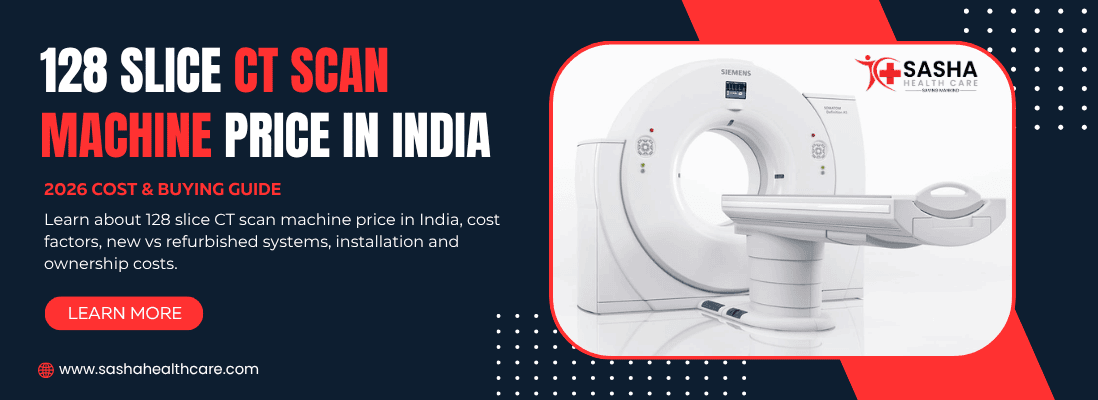
128 Slice CT Scan Machine Price in India
128 Slice CT Scan Machine Price in India: Complete 2026 Cost Guide

The 128 Slice CT Scan Machine Price in India varies depending on the manufacturer, model, technology generation, tube condition, software, detector system, equipment age, warranty, installation requirements, and whether the machine is new or refurbished. Buyers should evaluate the complete investment—including installation, infrastructure, maintenance and major-component costs—rather than comparing equipment prices alone.

Key Takeaways
  • A 128-slice CT scanner is a high-capability system used for routine and advanced diagnostic imaging.
  • The CT Scan Machine Price in India varies considerably between models and configurations.
  • New and refurbished CT scanners can have significantly different purchase costs.
  • X-ray tube condition, detector performance, software and service history are important when evaluating a refurbished system.
  • Installation and site preparation can add substantially to the overall investment.
  • The lowest purchase price does not necessarily represent the lowest total cost of ownership.
  • Hospitals and diagnostic centres should compare specifications, condition, warranty, service support and long-term operating costs before purchasing.

What Is a 128 Slice CT Scanner?

A 128-slice CT scanner is a computed tomography system capable of acquiring a large amount of anatomical information during a CT examination. The term “128 slice” generally refers to the system’s detector configuration and its ability to acquire multiple image sections during a rotation, although the exact meaning can vary by manufacturer and system architecture.

Compared with lower-capacity CT systems, 128-slice scanners can provide faster data acquisition and are commonly used for a broad range of examinations.

Depending on the specific model and software configuration, applications may include:

  • Routine head and brain imaging
  • Chest and abdomen examinations
  • Trauma imaging
  • CT angiography
  • Vascular imaging
  • Whole-body examinations
  • Cardiac CT applications
  • Pulmonary imaging
  • Orthopaedic imaging
  • Oncology-related imaging

However, slice count alone does not determine image quality or clinical capability. Detector technology, gantry design, X-ray tube performance, reconstruction technology, software, dose-management features and the specific clinical configuration all need to be considered.


128 Slice CT Scan Machine Price in India

The price of a 128-slice CT scanner in India can vary significantly because CT systems are available in different generations, configurations and conditions.

A new, current-generation 128-slice CT system can have a substantially different investment requirement from an older or professionally refurbished system. Similarly, two scanners with the same nominal slice configuration can have different values because of differences in software, tube condition, detector technology, workstation configuration, warranty and service support.

When assessing CT Scan Machine Price in India, buyers should therefore separate the following costs:

Cost ComponentWhat It Can Include
CT equipmentGantry, table, generator, tube and detector system
SoftwareReconstruction and clinical application software
WorkstationOperator console and image-processing workstation
InstallationDelivery, positioning, installation and commissioning
Site preparationRoom preparation, electrical work and radiation shielding
CoolingHVAC/chiller requirements depending on system
Power infrastructureUPS, stabilizer and electrical modifications where required
ServiceAMC/CMC and technical support
Major componentsFuture tube or other component replacement
UpgradesSoftware or hardware upgrades where applicable

For this reason, a supplier quotation should clearly identify what is included and what is excluded.


What Factors Affect CT Scan Machine Price in India?

Several factors influence the CT Scan Machine Cost in India. Understanding these factors helps hospitals and diagnostic centres compare quotations more accurately.

1. Manufacturer and Model

Major manufacturers such as Siemens Healthineers, GE HealthCare, Philips and Canon Medical Systems offer CT scanners with different technologies and configurations.

The manufacturer’s reputation is relevant, but the exact model and generation are equally important. A buyer should compare the specifications of the actual system rather than relying only on the brand name.

2. Technology Generation

A newer-generation CT scanner may incorporate improvements in reconstruction, dose management, detector technology, workflow and clinical applications.

Older systems may be more economical to purchase, but buyers need to consider long-term software support, spare-parts availability and serviceability.

3. X-Ray Tube Condition

The X-ray tube is one of the most important components of a CT scanner.

When evaluating a used or refurbished system, ask about:

  • Tube age
  • Tube usage
  • Exposure information where available
  • Previous replacement history
  • Tube warranty
  • Expected service support
  • Availability and cost of replacement

A lower equipment purchase price can become less attractive if a major component requires replacement soon after installation.

4. Detector System

Detector performance is critical to CT image acquisition. The condition and technology of the detector system should be assessed carefully, particularly when purchasing refurbished equipment.

5. Software and Clinical Applications

The installed software package can have a significant effect on the value and usefulness of a CT scanner.

Depending on the model, applications may include advanced reconstruction, angiography, cardiac imaging, 3D processing and other specialized capabilities.

Buyers should verify which software licenses are actually included in the quotation.

6. Equipment Condition

For refurbished equipment, condition is a major pricing factor.

Two scanners of the same model may have different values depending on:

  • Operating history
  • Service records
  • Tube condition
  • Detector condition
  • Error history
  • Replacement components
  • Preventive maintenance
  • Software configuration
  • Physical condition
7. Installation Requirements

CT installation is not simply a matter of placing the scanner in a room.

The facility may need to address:

  • Room dimensions
  • Radiation shielding
  • Electrical supply
  • Earthing
  • HVAC
  • Cooling
  • UPS or power protection
  • Patient access
  • Operator-room requirements
  • Network connectivity

These requirements can affect the overall CT scanner cost.

8. Warranty and Service Support

Warranty coverage can significantly affect the overall value of a quotation.

A buyer should check:

  • Warranty duration
  • Parts coverage
  • Tube coverage
  • Labour coverage
  • Breakdown response
  • Preventive maintenance
  • Remote technical support
  • Spare-parts availability

New vs Refurbished 128 Slice CT Scanner

One of the most important decisions for a hospital or diagnostic centre is whether to purchase a new or refurbished CT scanner.

FactorNew CT ScannerRefurbished CT Scanner
Initial investmentGenerally higherGenerally lower
Equipment ageNewPreviously used
TechnologyUsually newer generationDepends on model
ConditionFactory-newDepends on refurbishment quality
WarrantyManufacturer/supplier dependentSupplier dependent
Service historyNew equipmentShould be reviewed
Budget suitabilitySuitable for larger capital budgetsCan suit budget-conscious buyers
Evaluation requirementStandard specification reviewDetailed technical inspection recommended
Spare partsDepends on model lifecycleModel lifecycle should be checked
Long-term supportDepends on manufacturerDepends on model and supplier

A refurbished CT scanner can be a practical option when it has been properly inspected, tested and supported.

However, buyers should never evaluate refurbished equipment solely on its lower purchase price.


128 Slice CT Scanner Cost in India: What Is Included?

When comparing quotations, ask the supplier to provide a detailed scope of supply.

A CT scanner quotation may include some or all of the following:

  • CT gantry
  • Patient table
  • X-ray tube
  • High-voltage generator
  • Detector system
  • Operator console
  • Reconstruction workstation
  • Standard software
  • Clinical application software
  • Installation
  • Calibration
  • Testing
  • Commissioning
  • User training
  • Warranty

The exact inclusions differ from one supplier and model to another.

For example, installation may be included while site preparation is excluded. Similarly, a software package shown in a product description may not necessarily be included in a particular commercial quotation.

Always request a written scope of supply.


Additional Costs to Consider When Buying a CT Scanner

The CT Scan Machine Price is only one part of the overall investment.

Site Preparation

Depending on the facility, room modifications may be required before installation.

Radiation Shielding

The CT room may require appropriate radiation protection designed according to applicable requirements and the facility’s specific setup.

Electrical Infrastructure

The hospital may need electrical modifications, suitable power capacity, earthing and power-conditioning equipment.

HVAC and Cooling

Some CT systems have specific temperature and environmental requirements. Appropriate HVAC or cooling infrastructure may be necessary.

Transportation

Transportation from the supplier’s location to the hospital or diagnostic centre should be considered separately if it is not included in the quotation.

Installation and Commissioning

Professional installation and commissioning are important for ensuring that the system is correctly installed and operational.

AMC/CMC

After the warranty period, the facility may require an Annual Maintenance Contract or Comprehensive Maintenance Contract.

X-Ray Tube and Major Components

Major components such as the X-ray tube can represent significant future expenditure. Buyers should understand replacement arrangements before purchasing.

Software Upgrades

Software upgrades or additional application packages may involve additional costs depending on the manufacturer and system.


Popular 128 Slice CT Scanner Manufacturers

Several major medical imaging manufacturers offer CT systems in the 128-slice segment.

Siemens Healthineers

Siemens offers CT systems across multiple configurations and technology generations. Buyers should compare the specific model, software, tube condition and service history.

GE HealthCare

GE HealthCare has a broad range of CT systems. Configuration and generation can significantly influence system capabilities and price.

Philips

Philips CT systems are available in different configurations and application areas. The actual model and software package should be reviewed when comparing quotations.

Canon Medical Systems

Canon Medical Systems offers CT technologies across different clinical requirements. Buyers should assess the specific scanner configuration rather than using slice count alone.

Important: There is no universally “best” 128-slice CT scanner for every facility. The right system depends on patient volume, clinical requirements, budget, infrastructure and service support.


How to Choose the Right 128 Slice CT Scanner

Before purchasing, hospital and diagnostic-centre decision makers should evaluate the following:

Patient Volume

Estimate current and expected patient throughput. A higher-capacity system may be appropriate for facilities with significant imaging demand, but the decision should be based on actual workflow requirements.

Clinical Applications

Determine whether the facility needs routine CT, angiography, cardiac imaging, trauma imaging or other advanced applications.

Equipment Age

For refurbished equipment, verify the manufacturing year and technology generation.

X-Ray Tube

Ask for tube usage information, replacement history and warranty details.

Detector

Check detector condition and available technical documentation.

Software

Confirm exactly which clinical and reconstruction software packages are included.

Service Support

Ask about response time, preventive maintenance, spare parts and technical support.

Warranty

Review warranty coverage carefully, particularly for expensive components.

Installation

Confirm who is responsible for transportation, installation, commissioning and site readiness.

Total Cost of Ownership

Consider purchase price plus future maintenance, components, upgrades and operational expenses.


Is a 128 Slice CT Scanner Right for a Hospital or Diagnostic Centre?

A 128-slice CT scanner may be suitable for facilities that require a versatile CT system for routine and advanced examinations.

It can be particularly relevant for hospitals and diagnostic centres that need capabilities extending beyond basic CT imaging.

However, the correct scanner should be selected according to:

  • Patient volume
  • Clinical workload
  • Required applications
  • Budget
  • Available infrastructure
  • Service availability
  • Future expansion plans

A facility should not purchase a 128-slice system simply because a higher slice count sounds better. The system should match the facility’s actual clinical and operational requirements.


How to Evaluate a Refurbished 128 Slice CT Scanner

If you are considering a refurbished CT scanner, use a structured evaluation process.

Refurbished CT Scanner Checklist

Before purchasing, ask for information about:

  • Manufacturer and exact model
  • Manufacturing year
  • System generation
  • Previous installation
  • Service history
  • Scan/exposure information where available
  • X-ray tube condition
  • Tube replacement history
  • Detector condition
  • Gantry operation
  • Patient table movement
  • Generator condition
  • Error logs
  • Image quality testing
  • Software configuration
  • Workstation
  • Preventive maintenance records
  • Replaced components
  • Warranty
  • Installation scope
  • Commissioning process
  • Spare-parts availability
  • Future technical support

A professional inspection and testing process can help identify potential risks before the purchase is finalized.


CT Scanner Cost vs Total Cost of Ownership

When comparing CT Scanner Cost, it is important to look beyond the initial purchase price.

A simple way to think about total cost of ownership is:

Total Cost of Ownership = Purchase Price + Installation + Infrastructure + Maintenance + Major Components + Upgrades + Downtime Considerations

For example, a scanner with a lower purchase price may require significant investment in site modifications or major components. Another system may have a higher initial price but include stronger warranty and service coverage.

Therefore, buyers should compare the complete commercial and technical package, not just the equipment price.


Questions to Ask a CT Scanner Supplier Before Buying

Before finalizing a purchase, ask:

  1. What is the exact manufacturer and model?
  2. What year was the CT scanner manufactured?
  3. Is the system new or refurbished?
  4. What is the current condition of the X-ray tube?
  5. Is tube warranty included?
  6. What software and clinical applications are included?
  7. Is installation included?
  8. Is transportation included?
  9. What site preparation is required?
  10. What warranty is provided?
  11. Are spare parts available?
  12. Is AMC/CMC support available?
  13. What is the preventive maintenance schedule?
  14. Are image-quality tests available?
  15. What components have been replaced or refurbished?
  16. What are the power and cooling requirements?
  17. What is the expected installation and commissioning process?
  18. What technical support is available after installation?

These questions can help hospitals and diagnostic centres make a more informed purchasing decision.

Conclusion

The 128 Slice CT Scan Machine Price in India depends on much more than the number of slices. Manufacturer, model, technology generation, X-ray tube condition, detector system, software, equipment age, warranty, installation and service support can all influence the final investment.

For hospitals and diagnostic centres, comparing the headline CT Scan Machine Price alone can lead to an incomplete purchasing decision. A better approach is to evaluate the complete system, its condition, included components, infrastructure requirements, warranty and expected total cost of ownership.

Whether you are considering a new or refurbished CT scanner, obtain a detailed technical and commercial quotation and verify the equipment condition before making the final decision.

A well-evaluated CT scanner can provide a practical balance between clinical capability, investment and long-term operational requirements.

How much does a CT scanner cost in India
How much does a CT Scanner Cost in India?

If you are planning to purchase a CT scanner for a hospital or diagnostic centre, one of the first questions is: How much does a CT scanner cost in India? The CT Scan Machine Price in India varies significantly depending on the number of slices, manufacturer, model, equipment condition, software, tube condition, installation requirements, warranty and service support.

As a broad market consideration, entry-level and lower-slice CT systems generally require a lower investment than advanced 64-slice, 128-slice and higher-end systems. A refurbished CT scanner can also cost considerably less than a comparable new system, depending on its age, configuration, tube condition and refurbishment quality.

However, the purchase price is only one part of the investment. Transportation, room preparation, radiation shielding, electrical infrastructure, installation, software, workstation, maintenance and CT tube replacement can all affect the CT Scan Machine cost in India.

For this reason, hospitals and diagnostic centres should compare the complete equipment package and total cost of ownership rather than choosing a CT scanner based only on its quoted purchase price.

CT Scan Machine Price in India: What Does a CT Scanner Cost?

There is no single price applicable to every CT scanner. The final CT scanner cost depends on the equipment specification and the scope of the supplier’s quotation.

An indicative way to understand the market is:

CT Scanner CategoryTypical ApplicationPrice Considerations
Entry-level CTGeneral diagnostic imagingLower investment; configuration is important
16-slice CTRoutine diagnostic imagingSuitable for many general applications
32-slice CTGeneral and higher-volume imagingHigher capability and investment
64-slice CTAdvanced routine imaging and angiographyHigher specification and software options
128-slice CTAdvanced imaging and higher workloadsGenerally higher investment
Refurbished CTBudget-conscious hospitals and diagnostic centresDepends heavily on model, age, tube condition and refurbishment

These are categories rather than fixed prices. A 64-slice CT scanner from one model year can have a substantially different price from another 64-slice system because of differences in detector technology, tube capacity, software, workstation, scan speed, warranty and equipment condition.

Therefore, when searching for CT Scan Machine Price, buyers should first define their clinical requirements and then request a configuration-specific quotation.

What Determines CT Scan Machine Cost in India?

Several factors influence the CT Scan Machine cost in India. Understanding these factors can help hospitals and diagnostic centres make a more informed purchasing decision.

1. Number of Slices

The number of slices is one of the most commonly discussed specifications when comparing CT scanners.

Systems may be available in configurations such as:

  • 16-slice
  • 32-slice
  • 64-slice
  • 128-slice
  • Higher-slice configurations

Generally, more advanced configurations can support faster and more sophisticated imaging workflows. However, slice count alone should not determine the purchase decision.

Detector design, gantry rotation speed, X-ray tube capability, reconstruction technology, software and clinical applications also matter.

For example, a diagnostic centre primarily performing routine CT examinations may have different requirements from a tertiary-care hospital performing advanced cardiac or vascular imaging.

2. Brand and Model

The manufacturer and specific model can have a significant impact on the CT scanner price in India.

Well-established medical imaging manufacturers such as Siemens Healthineers, GE HealthCare, Philips and Canon Medical offer CT systems across different technology generations and configurations.

Two machines with a similar slice count can have different values because of:

  • Model generation
  • Detector technology
  • Tube specifications
  • Software
  • Workstation
  • Applications
  • Scan speed
  • System condition
  • Service availability

Consequently, buyers should compare complete specifications instead of comparing machines only by brand or slice count.

3. New vs Refurbished CT Scanner

One of the most important decisions affecting CT Scan Machine Price is whether to purchase a new or refurbished system.

A new CT scanner generally offers newer technology and may come with manufacturer-specific warranty and support arrangements. However, the initial investment can be significantly higher.

A professionally refurbished CT scanner can provide an alternative for hospitals and diagnostic centres that need to control capital expenditure.

A refurbished system should be evaluated based on:

  • Original manufacturer and model
  • Year of manufacture
  • Equipment history
  • Scan hours
  • Tube usage
  • Detector condition
  • Image quality
  • Software
  • Workstation
  • Preventive maintenance history
  • Availability of replacement parts
  • Warranty
  • Installation support

The cheapest refurbished CT scanner is not necessarily the most economical choice. Equipment reliability and future serviceability are equally important.

CT Scanner Cost by Slice Count

Slice count is useful as an initial comparison point, but it should not be treated as a complete pricing formula.

16-Slice CT Scanner

A 16-slice CT scanner can be considered for routine diagnostic applications where the clinical workload does not require the capabilities of higher-end systems.

The 16-slice CT machine price depends on the manufacturer, model, condition, tube, software, workstation and included services.

32-Slice CT Scanner

A 32-slice system can provide additional capabilities for facilities with broader diagnostic requirements.

When comparing 32-slice systems, buyers should examine detector configuration, tube condition, software applications, reconstruction capabilities and service support rather than focusing solely on the slice count.

64-Slice CT Scanner

A 64-slice CT scanner is commonly considered by facilities requiring more advanced imaging capabilities and potentially higher patient throughput.

The 64-slice CT scanner price can vary substantially depending on the exact model and configuration.

For a hospital or diagnostic centre considering a 64-slice system, important factors include tube capacity, rotation speed, detector design, cardiac capabilities, angiography applications, workstation and software.

128-Slice CT Scanner

A 128-slice CT scanner generally represents a higher-end investment. Such systems may be considered for hospitals and advanced diagnostic centres with higher patient volumes and broader clinical requirements.

The cost can vary considerably depending on technology generation and configuration.

Does More Slices Always Mean a Better CT Scanner?

Not necessarily.

The correct CT scanner depends on the clinical applications, patient volume, infrastructure and budget.

A facility should consider the complete technical specification rather than purchasing the highest slice count available.

New vs Refurbished CT Scanner: Which Should You Choose?

There is no universal answer. The appropriate option depends on the facility’s budget, workload and clinical requirements.

FactorNew CT ScannerRefurbished CT Scanner
Initial investmentGenerally higherGenerally lower
TechnologyLatest/current generation optionsDepends on model and generation
Equipment ageNewPreviously used
WarrantyTypically availableDepends on supplier/package
AvailabilityDepends on modelCan be available sooner
ServiceManufacturer/dealer dependentSupplier/service-provider dependent
ROI considerationsHigher capital requirementPotentially lower capital investment
SuitabilityNew projects and advanced requirementsBudget-conscious facilities

A professionally refurbished CT scanner may be attractive when capital expenditure is limited, but buyers should perform proper technical due diligence before purchasing.

Additional Costs When Buying a CT Scanner

The equipment quotation is not necessarily the complete project cost.

A hospital or diagnostic centre may need to budget for additional expenses such as:

Transportation

The CT scanner must be safely transported from the supplier’s location to the installation site. Transportation requirements can vary depending on equipment dimensions, location and logistics.

Installation

Professional installation is essential for bringing the equipment into operational condition.

The quotation should clearly state whether installation is included.

De-installation

If a facility is replacing an existing CT scanner, de-installation and removal of the old equipment may create an additional cost.

Site Preparation

CT rooms may require appropriate:

  • Electrical infrastructure
  • HVAC
  • Flooring
  • Radiation shielding
  • Network connectivity
  • Equipment space
  • Control-room setup

The actual requirements should be assessed for the selected system and facility.

UPS and Power Infrastructure

Reliable electrical infrastructure is important for CT operations. Depending on the installation, UPS and related electrical work may need to be considered separately.

Workstation and Software

Advanced visualization and clinical applications may require specific software and workstation configurations.

These may include capabilities related to:

  • 3D visualization
  • CT angiography
  • Cardiac imaging
  • Advanced reconstruction
  • Image processing

The exact software package should be confirmed in the quotation.

Maintenance

Maintenance is another important component of the overall CT machine cost.

Hospitals should consider:

  • Preventive maintenance
  • AMC
  • CMC
  • Breakdown support
  • Genuine spare parts
  • CT tube replacement
  • Software support

A lower initial purchase price can become less attractive if maintenance and downtime costs are significantly higher.

How to Choose a CT Scanner for a Hospital or Diagnostic Centre

Before purchasing a CT scanner, define the facility’s requirements.

1. Assess Patient Volume

Estimate the expected number of CT examinations per day and month.

A high-volume diagnostic centre may require a different configuration from a smaller facility.

2. Identify Clinical Applications

Determine which examinations will be performed.

For example:

  • Routine head CT
  • Chest CT
  • Abdomen CT
  • Trauma imaging
  • CT angiography
  • Cardiac CT
  • 3D imaging

The intended applications influence the appropriate system configuration.

3. Evaluate Infrastructure

Check whether the facility can accommodate:

  • CT room
  • Control room
  • Electrical requirements
  • HVAC
  • Radiation shielding
  • Networking
  • Patient access
  • Equipment transportation
4. Consider Service Support

CT scanners are complex systems. Reliable technical support can be just as important as the initial equipment price.

Ask the supplier about:

  • Installation
  • Preventive maintenance
  • Breakdown response
  • Spare parts
  • Tube support
  • Warranty
  • AMC/CMC options
5. Compare Total Cost of Ownership

Instead of asking only:

“What is the CT Scan Machine Price?”

also ask:

“What will this CT scanner cost us over its expected operating period?”

This approach provides a more realistic picture of the investment.

What Should You Check Before Buying a Refurbished CT Scanner?

A refurbished CT scanner should undergo appropriate technical and operational evaluation before purchase.

Important checks include:

  • Manufacturer and model
  • Year of manufacture
  • Scan hours
  • Tube usage
  • Tube condition
  • Detector condition
  • Gantry condition
  • Generator
  • Patient table
  • Workstation
  • Software
  • Image quality
  • Error history
  • Service history
  • Preventive maintenance records
  • Availability of spare parts
  • Warranty
  • Installation scope
  • Acceptance testing
  • Supplier support

Buyers should request relevant equipment documentation and understand exactly what has been inspected, replaced, repaired or refurbished.

How to Compare CT Scanner Quotations

When comparing quotations from multiple suppliers, avoid comparing only the headline equipment price.

Create a comparison checklist covering:

ItemWhat to Check
CT ScannerExact make and model
Slice configuration16/32/64/128 etc.
TubeCondition and warranty
DetectorConfiguration and condition
SoftwareIncluded applications
WorkstationIncluded or additional
InstallationIncluded or excluded
TransportationIncluded or excluded
WarrantyDuration and scope
Spare partsAvailability
AMC/CMCOptional or included
Breakdown supportResponse and coverage
TrainingIncluded or additional
Site preparationResponsibility of buyer/supplier

This helps prevent situations where a lower initial quotation eventually becomes more expensive because important components were excluded.

CT Scanner ROI and Total Cost of Ownership

Buying a CT scanner is a significant capital investment. Therefore, hospital owners and diagnostic centre operators should evaluate the expected return on investment as part of the purchasing process.

Important considerations include:

  • Expected patient volume
  • Average utilization
  • Clinical applications
  • Operating hours
  • Service costs
  • Maintenance
  • CT tube replacement
  • Downtime
  • Spare parts
  • Staff requirements
  • Equipment lifespan

For example, a facility with a high patient volume may justify investing in a more capable CT scanner, while a smaller diagnostic centre may prioritize a reliable refurbished system with appropriate specifications and service support.

The right decision should balance purchase price, clinical capability, reliability and long-term operating costs.

Why the Cheapest CT Scanner May Not Be the Best Choice

When comparing CT Scan Machine Price in India, it can be tempting to select the lowest quotation.

However, several questions should be asked before making that decision:

  • What is the exact model?
  • How old is the equipment?
  • What is the tube condition?
  • What software is included?
  • Is the workstation included?
  • Is installation included?
  • What warranty is provided?
  • Are spare parts available?
  • Who will provide service?
  • What happens if the scanner develops a major fault?
  • Is preventive maintenance included?
  • Is AMC or CMC available?

A slightly higher purchase price may represent better value if it includes stronger warranty coverage, reliable service support, better equipment condition and a more complete installation package.

CT Scanner Buying Checklist

Before finalizing a CT scanner purchase, consider this checklist:

Clinical requirements

  • What examinations will be performed?
  • What is the expected patient volume?
  • Are advanced applications required?

Equipment

  • Manufacturer
  • Model
  • Slice configuration
  • Tube condition
  • Detector
  • Gantry
  • Patient table
  • Workstation

Software

  • Reconstruction
  • 3D visualization
  • Angiography
  • Cardiac applications, if required

Installation

  • Transportation
  • Installation
  • De-installation
  • Site preparation
  • Electrical requirements
  • HVAC
  • Radiation shielding

After-sales support

  • Warranty
  • Preventive maintenance
  • AMC/CMC
  • Breakdown support
  • Spare parts
  • Tube support
Conclusion:

The CT Scan Machine Price in India depends on much more than the number of slices. Brand, model, technology generation, equipment condition, tube, detector, software, workstation, installation, warranty and service support all contribute to the final investment.

For hospitals and diagnostic centres, the best CT scanner is not necessarily the most expensive or the cheapest system. The right choice is the one that matches the facility’s clinical requirements, patient volume, infrastructure and budget while providing dependable long-term support.

When evaluating a new or refurbished CT scanner, compare the complete quotation, including equipment, installation, warranty, maintenance, spare parts and service support. This helps you understand the true CT scanner cost and make a more informed investment decision.

Looking for a CT scanner for your hospital or diagnostic centre? Sasha HealthCare can help you evaluate CT equipment options based on your clinical requirements, patient volume, infrastructure and budget.

How much does a CT scanner cost in India?

The CT Scan Machine Price in India varies according to slice count, brand, model, equipment condition, tube condition, software, workstation, installation and service support. New and refurbished systems can have substantially different investment requirements, so buyers should obtain a configuration-specific quotation.

Is a refurbished CT scanner cheaper than a new CT scanner?

Generally, a refurbished CT scanner requires a lower initial investment than a comparable new system. However, the value depends on the equipment’s age, condition, tube usage, refurbishment quality, warranty, software and availability of technical support.

How much does a 16-slice CT scanner cost?

The cost of a 16-slice CT scanner depends on whether it is new or refurbished, its manufacturer and model, equipment condition, tube usage, software and included services. A buyer should compare complete specifications rather than relying only on the slice count.

How much does a 64-slice CT scanner cost?

A 64-slice CT scanner can vary substantially in price depending on manufacturer, model generation, tube condition, detector configuration, software, workstation, warranty and installation. Refurbished and new systems can have significantly different investment levels.

1-5t-mri-machine-cost-2026-price-guide-india
1.5T MRI Machine Cost: 2026 Price Guide

If you are planning to purchase an MRI system for a hospital or diagnostic centre, understanding the 1.5T MRI machine cost in India is an important first step. A 1.5 Tesla MRI remains one of the most widely used MRI configurations because it offers a practical balance between image quality, clinical applications, patient throughput, infrastructure requirements and investment.

In India, the 1.5T MRI machine price can vary significantly depending on whether you choose a new, refurbished or pre-owned system. Brand, model, manufacturing year, magnet condition, gradient performance, coils, software, warranty, installation and after-sales support can all affect the final quotation.

How Much Does a 1.5T MRI Machine Cost in India in 2026?

The approximate 1.5T MRI machine cost in India in 2026 can vary broadly depending on equipment condition, configuration and included services.

MRI System TypeIndicative Price Range in India*Suitable For
New 1.5T MRI₹4 crore–₹7 crore+Large hospitals and premium diagnostic centres
Refurbished 1.5T MRI₹1.5 crore–₹3.5 crore+Hospitals and diagnostic centres seeking value
Pre-owned 1.5T MRI₹80 lakh–₹2 crore+Budget-focused facilities, subject to condition

*These are indicative market ranges, not fixed quotations. Actual prices can vary considerably based on manufacturer, model, system age, configuration, refurbishment level, coils, software, warranty, installation, transportation and site requirements.

For many buyers, a refurbished 1.5T MRI machine can offer a significantly lower initial investment than a new system while still providing clinically useful imaging capabilities. However, the condition of the magnet, gradients, RF coils, electronics, cooling system and software should be carefully evaluated before purchase.


What is a 1.5T MRI Machine?

A 1.5T MRI machine is a magnetic resonance imaging system that operates at a magnetic field strength of 1.5 Tesla. MRI uses a strong magnetic field, radiofrequency energy and computer processing to create detailed images of internal body structures.

Unlike X-ray and CT imaging, MRI does not use ionizing radiation.

A 1.5T MRI system can be used for a wide range of examinations, including:

  • Brain and neurological imaging
  • Spine imaging
  • Musculoskeletal studies
  • Knee and shoulder examinations
  • Abdomen and pelvis imaging
  • Cardiac applications on appropriately configured systems
  • Angiography
  • Whole-body imaging
  • Oncology imaging
  • Joint and soft-tissue studies

The popularity of 1.5T MRI systems comes from their established clinical performance and broad application range.


1.5T MRI Machine Price in India

There is no single MRI machine price in India because MRI systems are available in many configurations.

A new system from a leading international manufacturer can command a substantially higher price than an older pre-owned system. Similarly, two refurbished MRI machines of the same brand can have different prices because of differences in model year, coils, software, magnet condition and refurbishment quality.

New 1.5T MRI

A new 1.5T MRI system generally has the latest available technology, manufacturer-supported software and a new equipment warranty. However, the initial investment is considerably higher.

New systems may be appropriate for:

  • High-volume hospitals
  • Corporate hospitals
  • Premium diagnostic centres
  • Institutions requiring newer applications
  • Facilities planning long-term operation with manufacturer support

Refurbished 1.5T MRI

A professionally refurbished MRI system can provide an attractive balance between MRI machine cost and clinical capability.

Refurbishment may include inspection, replacement of selected components, testing, cleaning, calibration and performance checks, depending on the supplier and system.

However, buyers should not assume that every machine advertised as “refurbished” has undergone the same level of work.

Pre-Owned 1.5T MRI

Pre-owned equipment can have the lowest initial purchase price, but its actual value depends heavily on condition and serviceability.

A low purchase price may not be economical if the system subsequently requires expensive repairs, replacement coils, cooling-system work or other major components.

Therefore, the purchase decision should consider total cost of ownership rather than only the advertised MRI scanner cost.


What Factors Affect 1.5T MRI Machine Cost?

Several factors determine the final 1.5T MRI machine cost in India.

1. Manufacturer and Model

Major manufacturers such as Siemens, GE, Philips, Canon and Hitachi/Fujifilm-related MRI systems are available in different configurations and generations.

The brand alone does not determine value. The specific model and its technical configuration are equally important.

2. Manufacturing Year

Newer systems generally command higher prices, while older systems can be more affordable.

However, an older MRI with good maintenance history and strong serviceability may be more attractive than a poorly maintained newer system.

3. Magnet Condition

The magnet is one of the most important components of an MRI system.

Buyers should assess magnet performance, helium status where applicable, cooling performance and maintenance history before purchasing a used or refurbished MRI.

4. Gradient Performance

Gradient specifications influence imaging performance and examination capabilities.

The gradient system should be evaluated according to the clinical applications required by the facility.

5. RF Coils

The number and type of coils included in the quotation can significantly affect the effective value of an MRI system.

Common coils may include:

  • Head coils
  • Spine coils
  • Body coils
  • Knee coils
  • Shoulder coils
  • Flexible coils
  • Specialized application coils

Always compare quotations based on the complete coil package, not just the scanner price.

6. Software and Applications

Software packages can affect the functionality of an MRI system.

Depending on the model and configuration, applications may include advanced neurological, angiography, musculoskeletal, cardiac or oncology capabilities.

7. Refurbishment Quality

For a refurbished MRI, the extent of refurbishment is extremely important.

Ask the supplier exactly what components have been inspected, repaired or replaced.

8. Warranty

A warranty provides protection against certain equipment failures after installation.

When comparing quotations, examine:

  • Warranty duration
  • Covered components
  • Response time
  • Labour coverage
  • Parts coverage
  • Exclusions
9. Installation and Transportation

The quoted MRI machine price may not always include transportation, de-installation, installation and commissioning.

These should be clearly separated in the quotation.

10. Site Infrastructure

An MRI room requires appropriate infrastructure, which can include RF shielding, HVAC, electrical systems, cooling equipment and other site-specific requirements.

These expenses should be included when calculating the complete project budget.


Popular 1.5T MRI Brands in India

Hospitals and diagnostic centres may encounter 1.5T MRI systems from manufacturers including:

  • Siemens
  • GE Healthcare
  • Philips
  • Canon
  • Hitachi/Fujifilm-related systems

Each manufacturer offers different generations and configurations.

Instead of asking only, “Which brand is best?”, buyers should consider:

  • Clinical requirements
  • Budget
  • Patient volume
  • Software applications
  • Coil configuration
  • Service availability
  • Spare-parts availability
  • Local technical support
  • Expected operating costs
  • Long-term system reliability

The right MRI system is the one that fits the facility’s clinical and business requirements.


Refurbished 1.5T MRI Machine Cost

For facilities with a limited capital budget, a refurbished 1.5T MRI machine can be an alternative to purchasing a new system.

Refurbished equipment can potentially reduce the initial capital investment, but buyers should conduct proper technical due diligence.

Before purchasing, ask for information about:

  • Exact model number
  • Manufacturing year
  • Installation history
  • Previous usage
  • Maintenance history
  • Magnet condition
  • Gradient performance
  • RF coil condition
  • Patient table condition
  • Software configuration
  • Error history
  • Cooling system
  • Cold head condition
  • Helium status where applicable
  • Refurbishment performed
  • Warranty offered
  • Service support

A professionally inspected and serviced MRI system with appropriate warranty and technical support can be substantially more valuable than a cheaper machine with an uncertain service history.


New vs Refurbished 1.5T MRI

FactorNew 1.5T MRIRefurbished 1.5T MRI
Initial investmentHigherLower
Technology generationLatest/newDepends on model
Equipment conditionNewProfessionally restored/serviced
WarrantyUsually manufacturer warrantyDepends on supplier
Budget suitabilityHigher-budget facilitiesCost-conscious facilities
AvailabilityMay involve longer lead timesDepends on stock
ServiceManufacturer/dealer supportSupplier/service network
ROI considerationHigher initial investmentPotentially attractive capital efficiency

Neither option is automatically better for every facility.

A diagnostic centre with a constrained capital budget may find refurbished equipment attractive, while a new hospital with high patient volumes and specific advanced imaging requirements may prefer a new system.


Total Cost of Installing a 1.5T MRI

One of the biggest mistakes buyers make is looking only at the MRI scanner cost.

The complete project budget can include several additional expenses.

Potential additional costs include:
  • MRI equipment
  • Transportation
  • De-installation of existing equipment
  • Installation
  • Site preparation
  • RF shielding
  • Electrical infrastructure
  • HVAC
  • Chiller/cooling requirements
  • Quench pipe where applicable
  • Calibration and testing
  • Helium-related services where applicable
  • AMC or CMC
  • Insurance
  • Staff training
  • Civil and interior work

Therefore, a facility should request a complete project quotation rather than comparing equipment prices alone.


MRI Machine Operating Cost

The initial MRI machine price in India is only one part of the investment.

Over its operating life, an MRI system can generate recurring expenses related to:

  • Electricity
  • Cooling
  • Preventive maintenance
  • AMC/CMC
  • Spare parts
  • Software and service
  • Helium-related requirements where applicable
  • Technical support
  • Unexpected breakdowns
  • Downtime

Maintenance planning is particularly important for hospitals and diagnostic centres because extended equipment downtime can affect patient scheduling and revenue.

A reliable service partner can help reduce avoidable downtime through preventive maintenance and timely technical support.


1.5T MRI vs 3T MRI

Both 1.5T and 3T MRI systems have important clinical applications.

Feature1.5T MRI3T MRI
Magnetic field1.5 Tesla3 Tesla
InvestmentGenerally lowerGenerally higher
Clinical applicationsBroadBroad with additional advanced applications
Image characteristicsStrong clinical performanceHigher field strength can support higher signal in many applications
InfrastructureOften more manageableCan require additional considerations
Suitable facilitiesMost general MRI centresFacilities requiring advanced/high-field applications

A 3T MRI is not automatically the best choice for every hospital.

For many facilities, a well-configured 1.5T MRI machine can provide an excellent combination of clinical versatility, investment and operational practicality.


How to Choose the Right 1.5T MRI Machine

Before purchasing, consider the following checklist.

1. Determine Patient Volume

Estimate the number of MRI examinations expected each day and month.

2. Identify Clinical Applications

Determine whether the facility primarily requires neurological, spine, musculoskeletal, abdominal, oncology, cardiac or other applications.

3. Set the Complete Budget

Do not allocate the entire budget to the scanner alone. Include infrastructure, installation and service.

4. Compare Equivalent Configurations

When comparing suppliers, make sure quotations include similar:

  • Coils
  • Software
  • Accessories
  • Warranty
  • Installation
  • Service
5. Evaluate Equipment Condition

For refurbished and pre-owned systems, request technical inspection and maintenance information.

6. Check Service Support

A competitively priced machine is less useful if qualified technical support and spare parts are difficult to obtain.

7. Consider Long-Term Costs

Evaluate AMC/CMC, spare parts, maintenance and downtime risk.


Questions to Ask an MRI Equipment Supplier

Before finalizing an MRI purchase, ask:

  1. What is the exact MRI model?
  2. What is the manufacturing year?
  3. Is the machine new, refurbished or pre-owned?
  4. What refurbishment work has been completed?
  5. What coils are included?
  6. What software applications are included?
  7. What is the magnet condition?
  8. What warranty is provided?
  9. Is installation included?
  10. Is transportation included?
  11. What site requirements are necessary?
  12. Are spare parts available?
  13. What AMC/CMC options are available?
  14. What technical support is provided?
  15. What is included and excluded from the final quotation?

These questions help buyers compare the actual value of an MRI machine rather than simply comparing headline prices.


MRI Machine Price vs Total MRI Project Cost

A supplier quotation should clearly distinguish between equipment cost and the complete project cost.

Cost ComponentWhat It Covers
MRI equipmentScanner, magnet and specified configuration
Coils/accessoriesPatient and imaging coils included in package
InstallationInstallation and commissioning
TransportationMovement of equipment to the site
InfrastructureRF shielding, electrical, HVAC and related work
ServiceAMC/CMC and preventive maintenance
Additional requirementsSite-specific equipment and technical services

This approach makes it easier for hospital owners and diagnostic centre operators to calculate the actual investment.


Is a Refurbished 1.5T MRI Machine Worth Buying?

A refurbished 1.5T MRI can be worth considering when the buyer wants to control capital expenditure without compromising on essential imaging capabilities.

However, the decision should not be based on price alone.

A good evaluation should consider:

System condition + configuration + warranty + service support + spare parts + expected operating cost.

If a refurbished machine has been properly inspected, serviced and tested and is supported by a reliable technical team, it may offer strong value.

On the other hand, a very low-cost machine with poor maintenance history or limited technical support can become expensive over time.


How to Get the Best MRI Machine Price in India

Getting the best price does not necessarily mean selecting the lowest quotation.

Instead:

  • Compare equivalent MRI configurations.
  • Request a detailed quotation.
  • Verify the exact model and year.
  • Check all included coils.
  • Review the warranty.
  • Confirm installation and transportation.
  • Inspect refurbished equipment properly.
  • Ask about spare-parts availability.
  • Compare AMC/CMC options.
  • Consider expected downtime.
  • Calculate total cost of ownership.
  • Negotiate based on configuration and included services.

This approach can help hospitals and diagnostic centres make a more informed MRI investment decision.


Why Choose Sasha HealthCare for MRI Equipment?

Sasha HealthCare provides medical imaging equipment solutions for hospitals, diagnostic centres and healthcare facilities.

Its MRI-related services can include:

  • MRI equipment supply
  • Refurbished MRI systems
  • Installation
  • De-installation
  • Transportation
  • AMC services
  • CMC services
  • Preventive maintenance
  • MRI breakdown support
  • Genuine spare parts
  • Helium filling/top-up services
  • Cold head-related services
  • Technical support

When evaluating an MRI system, buyers should consider not only the initial MRI machine cost in India, but also installation, maintenance and long-term service requirements.

If you are looking for a 1.5T MRI machine in India, contact Sasha HealthCare to discuss available systems, configurations, pricing and service support.

Conclusion:

The 1.5T MRI machine cost in India in 2026 depends on far more than the scanner itself. New, refurbished and pre-owned systems can have substantially different prices, while configuration, magnet condition, coils, software, warranty and technical support can significantly affect the overall investment.

For hospitals and diagnostic centres, the best approach is to compare the complete MRI project cost and total cost of ownership, rather than selecting a machine solely because it has the lowest purchase price.

A properly evaluated 1.5T MRI machine can provide broad diagnostic capabilities and may be a practical investment for facilities seeking a balance between clinical performance and capital expenditure.

If you are planning to buy a new, refurbished or pre-owned 1.5T MRI system, obtain a detailed quotation based on your required configuration, clinical applications, installation requirements and long-term service needs.

How much does a 1.5T MRI machine cost in India?

The indicative 2026 price of a 1.5T MRI machine in India can range from around ₹80 lakh for certain pre-owned systems to ₹7 crore or more for new systems, depending on brand, model, configuration, condition and included services.

What is the price of a 1.5 Tesla MRI machine?

The price of a 1.5 Tesla MRI depends on whether it is new, refurbished or pre-owned. Refurbished systems can offer a lower capital investment, while new systems generally cost substantially more.

What is the MRI machine price in India?

MRI machine prices in India vary widely according to magnetic field strength, manufacturer, model, age, configuration and condition. A complete quotation should also account for installation, infrastructure, warranty and service.

What factors affect MRI machine cost?

Major factors include manufacturer, model, magnetic field strength, manufacturing year, magnet condition, gradients, coils, software, refurbishment quality, warranty, installation and after-sales support.

0