
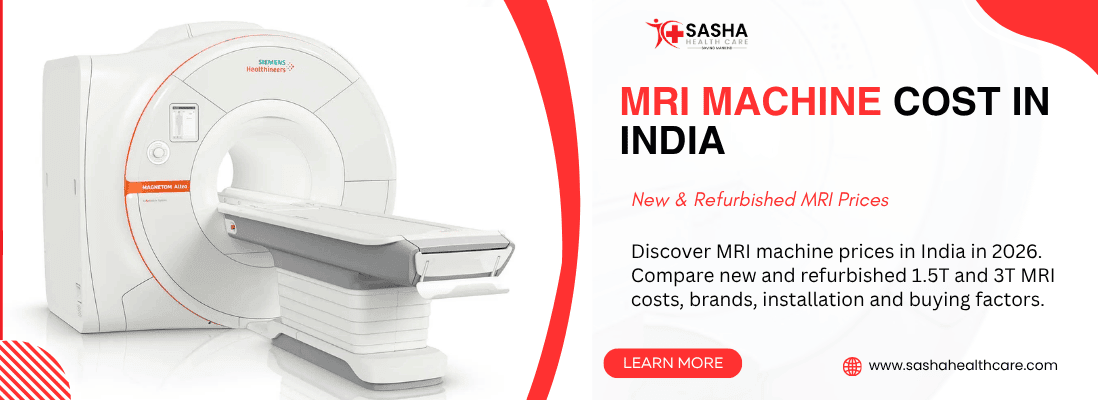
MRI Machine Prices in India: The Complete 2026 Guide to New & Refurbished MRI Costs
The MRI machine price in India can range from approximately ₹1 crore to more than ₹20 crore, depending on the magnetic field strength, manufacturer, model, software configuration, year of manufacture, clinical applications, accessories, installation requirements, and whether the system is new or refurbished.
For hospitals, diagnostic centres, imaging centres, and healthcare investors, choosing an MRI system is a major capital investment. The purchase price of the scanner is only one part of the total project cost. Site preparation, RF shielding, electrical infrastructure, HVAC, quench-pipe requirements, coils, software, installation, warranty, service contracts, and future maintenance can significantly affect the final investment.
In this 2026 MRI machine price guide, we compare the expected cost of new and refurbished MRI systems in India, explain the difference between 1.5 Tesla and 3 Tesla MRI machines, examine the major brands and models, and provide a practical checklist for buyers.
MRI Machine Price in India in 2026
There is no single fixed price for an MRI machine because configurations vary significantly. Current market references show substantial differences between new, used, and professionally refurbished systems.
| MRI Machine Type | Approximate Price in India |
|---|---|
| Low-field / Open MRI | ₹80 lakh – ₹2.5 crore+ |
| Refurbished 1.5T MRI | ₹1.2 crore – ₹4 crore+ |
| Refurbished 3T MRI | ₹4 crore – ₹8 crore+ |
| New 1.5T MRI | ₹5 crore – ₹10 crore+ |
| New 3T MRI | ₹8 crore – ₹22 crore+ |
These figures should be treated as indicative planning ranges rather than fixed quotations. A particular MRI model may be priced substantially higher or lower depending on its configuration and what is included in the supplier’s quotation.
For example, current Indian market listings show refurbished 1.5T systems from different manufacturers at significantly different prices, while premium 3T systems can command substantially higher investments.
How Much Does a 1.5 Tesla MRI Machine Cost in India?
A 1.5 Tesla MRI machine remains one of the most practical choices for hospitals and diagnostic centres because it provides a broad range of clinical applications without the investment level of many 3T systems.
A refurbished 1.5T MRI can typically fall in the range of approximately ₹1.2 crore to ₹4 crore or more, depending on the manufacturer, model, age, software, coils, gradient performance, refurbishment quality, and warranty.
New 1.5T systems can cost approximately ₹5 crore to ₹10 crore or more depending on the configuration and manufacturer.
Popular 1.5T MRI systems in the Indian market include models from:
- GE HealthCare
- Siemens Healthineers
- Philips
- Canon Medical Systems
- Hitachi / Fujifilm Healthcare
Some commonly encountered refurbished systems include GE SIGNA HDxt, Siemens MAGNETOM Avanto, Siemens MAGNETOM Essenza, Philips Achieva and other comparable 1.5T platforms.
For routine brain, spine, musculoskeletal, abdomen, pelvis and many other examinations, a properly configured 1.5T system can provide a strong balance between clinical capability, acquisition cost and operating economics.
How Much Does a 3 Tesla MRI Machine Cost in India?
A 3 Tesla MRI machine offers a higher magnetic field strength than a 1.5T system and is generally positioned as a premium imaging solution.
Refurbished 3T MRI machines can commonly range from approximately ₹4 crore to ₹8 crore or more, while new premium 3T systems can reach ₹12 crore, ₹15 crore, ₹20 crore or more, depending on configuration and clinical requirements. Current market references demonstrate the wide range of pricing available for 3T systems.
A 3T MRI may be particularly attractive for facilities handling significant volumes of:
- Advanced neurological imaging
- Musculoskeletal imaging
- High-resolution vascular studies
- Advanced cardiac imaging
- Prostate imaging
- Functional MRI
- Diffusion and perfusion studies
- Research and specialist applications
However, higher Tesla does not automatically mean that a 3T system is the right investment for every diagnostic centre. Patient volume, referral patterns, radiologist requirements, local competition, available infrastructure and expected return on investment should all be evaluated.
Refurbished MRI Machine Price in India
For hospitals and diagnostic centres working with a controlled capital budget, a refurbished MRI machine can provide a significantly lower entry cost than purchasing a new system.
Current Indian market references place many refurbished 1.5T systems around ₹1.2 crore–₹4 crore, while refurbished 3T systems can range from approximately ₹4 crore–₹8 crore or higher.
The term refurbished should not simply mean “used.”
A professionally refurbished MRI system should undergo an engineering evaluation covering critical components such as:
- Magnet condition
- Gradient system
- RF system
- Patient table
- Cooling system
- Computer and reconstruction hardware
- RF coils
- Software
- Workstation
- System calibration
- Image quality
- Safety systems
- Preventive maintenance requirements
The exact refurbishment process differs between suppliers. Therefore, buyers should ask for a clear refurbishment report and equipment history rather than relying only on the word “refurbished.”
New vs Refurbished MRI Machine: Which Is Better?
The right choice depends on the business model and clinical requirements of the facility.
| Factor | New MRI | Refurbished MRI |
|---|---|---|
| Initial investment | Higher | Lower |
| Technology | Latest generation | Depends on model |
| Equipment age | New | Pre-owned |
| Warranty | Usually comprehensive | Depends on supplier |
| Software | Latest available configuration | Depends on system |
| Capital requirement | High | More manageable |
| ROI potential | Depends on utilization | Often attractive for budget-focused centres |
| Availability | Usually order-based | Can be faster depending on stock |
| Service requirements | OEM/service contract | Supplier/OEM/service provider dependent |
For a newly established diagnostic centre, a well-selected refurbished 1.5T MRI can sometimes provide a more practical starting point than investing in a premium new 3T system.
On the other hand, a high-volume tertiary-care hospital may prioritize the latest technology, advanced applications, higher throughput and comprehensive OEM support.
What Determines MRI Machine Price in India?
Several factors influence the final quotation.
1. Magnetic Field Strength
The Tesla rating is one of the most important factors.
A 0.2T or 0.3T system is generally positioned very differently from a 1.5T superconducting MRI, while a 3T system represents a higher-end configuration.
2. Brand and Model
Major manufacturers such as GE HealthCare, Siemens Healthineers, Philips and Canon Medical Systems have multiple product families.
Two 1.5T machines can therefore have very different prices because of their generation, software, gradients, coils, patient table, bore design and applications.
3. Manufacturing Year
For refurbished MRI machines, the manufacturing year and system generation can have a major impact on price.
A newer-generation system with modern software, stronger gradients and a better coil package will generally command a higher price than an older platform.
4. Software Configuration
MRI performance is not determined only by the magnet.
Clinical applications, reconstruction software, automation, motion correction, cardiac packages, diffusion techniques and other software options can substantially influence the value of a system.
5. MRI Coils
The coil package should always be evaluated carefully.
Depending on the intended applications, a facility may require:
- Head coil
- Spine coil
- Body coil
- Knee coil
- Shoulder coil
- Breast coil
- Cardiac coil
- Flexible coils
- Other specialized coils
A low-priced MRI quotation may become significantly more expensive once the required coils and software are added.
6. Gradient Performance
Gradient amplitude and slew rate influence imaging performance, sequence capability and scan efficiency.
When comparing two MRI machines, buyers should evaluate the complete technical specification rather than comparing Tesla strength alone.
7. Bore Size and Patient Comfort
The bore design can affect patient experience.
For centres expecting a high volume of patients, particularly elderly, claustrophobic or larger-body patients, bore size and patient comfort should be considered alongside technical specifications.
8. Installation and Site Requirements
The MRI scanner itself is not the complete project.
Depending on the system, the site may require:
- RF shielding
- Magnetic shielding
- HVAC
- Electrical infrastructure
- UPS
- Chiller
- Quench pipe
- Control room
- Equipment room
- Patient preparation area
- Safety systems
- Civil modifications
Installation and infrastructure costs can therefore add a substantial amount to the overall project investment.
MRI Machine Installation Cost in India
One of the most common mistakes when calculating an MRI project budget is considering only the equipment purchase price.
The complete investment may include:
MRI scanner + coils + workstation + software + transportation + de-installation + installation + RF cage + electrical work + HVAC + commissioning + warranty/service support.
Depending on the building and site conditions, installation and infrastructure requirements can add tens of lakhs of rupees to the project cost. Current market estimates commonly place site-related installation work in the broad range of approximately ₹30 lakh–₹80 lakh, although actual requirements vary considerably.
A professional site survey should therefore be completed before finalizing the MRI machine.
Best MRI Machine Brands in India
The major MRI manufacturers commonly considered by Indian hospitals and diagnostic centres include:
GE HealthCare
GE MRI systems are widely used for routine and advanced diagnostic imaging. Refurbished GE systems can be attractive for facilities seeking established platforms at a lower capital cost.
Siemens Healthineers
Siemens MAGNETOM systems are widely used across different clinical environments. Models such as Avanto, Essenza, Aera and other MAGNETOM platforms can be found in the refurbished market.
Philips
Philips MRI systems are used across a wide range of clinical applications, with different platforms offering different workflow and imaging technologies.
Canon Medical Systems
Canon offers MRI systems focused on image quality, patient comfort and workflow efficiency.
Hitachi / Fujifilm Healthcare
Hitachi MRI systems, now associated with Fujifilm Healthcare, include both open and superconducting platforms used in different clinical settings.
The best MRI machine is not necessarily the most expensive machine. The appropriate choice depends on the clinical workload, budget, site, patient demographics, available service support and expected revenue.
How to Choose a Refurbished MRI Machine
Before purchasing a refurbished MRI scanner, we recommend checking the following:
Machine History
Ask for:
- Manufacturing year
- Previous installation location
- De-installation history
- Usage history where available
- Service history
- Major component replacement history
Magnet Condition
The magnet is one of the most important components of a superconducting MRI system.
Buyers should understand the magnet’s condition and history and determine whether there have been any significant incidents such as a quench.
Gradient System
Check gradient performance and service history.
Coils
Verify exactly which coils are included in the quotation and test their condition.
Software
Confirm the installed software version and the clinical applications included.
Image Quality
A demonstration scan or image-quality evaluation can help the buyer understand the actual performance of the system.
Warranty
Do not compare refurbished MRI quotations without comparing warranty coverage.
A lower machine price with minimal warranty may ultimately prove more expensive than a slightly higher-priced system with meaningful service support.
Service and AMC/CMC
Long-term service availability is critical because an MRI scanner represents a significant revenue-generating asset.
Ask about:
- Preventive maintenance
- Breakdown support
- Spare parts
- Response time
- Engineer availability
- AMC
- CMC
- Emergency support
How Much Does an MRI Machine Cost Including Installation?
A realistic project budget should not be based only on the equipment price.
For example, a diagnostic centre purchasing a ₹2 crore refurbished 1.5T MRI may have additional expenses for site modification, RF shielding, electrical infrastructure, HVAC, transportation, installation, accessories and commissioning.
Similarly, a ₹5 crore MRI machine does not necessarily mean that the total project investment will be ₹5 crore.
The final project cost should therefore be calculated as:
Total MRI Investment = Machine + Accessories + Installation + Infrastructure + Commissioning + Initial Service/Warranty + Other Project Costs
This approach gives hospitals and diagnostic centres a much more realistic financial picture.
Is Buying a Refurbished MRI Machine Worth It in 2026?
For many healthcare facilities, the answer can be yes—provided the machine is selected carefully.
A professionally refurbished MRI can reduce the initial capital requirement while giving a diagnostic centre access to established high-field imaging technology.
The important distinction is between a cheap used MRI and a properly refurbished MRI.
The cheapest quotation should not automatically be considered the best quotation.
Instead, compare:
Machine condition + technical specifications + coils + software + refurbishment quality + warranty + installation + service support + spare parts availability + total cost of ownership.
This approach can help prevent unexpected expenses after installation.
Final Thoughts: Choosing the Right MRI Machine in India
The MRI machine price in India in 2026 varies significantly because MRI systems are not commodities with one standard price.
A refurbished 1.5T system may be an attractive option for a new diagnostic centre looking to control capital expenditure, while a new 1.5T or 3T system may make more sense for a hospital seeking the latest technology, advanced applications and long-term OEM support.
Before making a purchase decision, we recommend evaluating the complete cost of ownership, not just the machine’s advertised price.
The right MRI investment should combine:
- Appropriate Tesla strength
- Reliable MRI platform
- Suitable clinical applications
- Required coils and software
- Strong image quality
- Professional installation
- Comprehensive warranty
- Reliable service support
- Spare-parts availability
- AMC/CMC options
- A realistic return-on-investment plan
For hospitals and diagnostic centres comparing new and refurbished MRI machines in India, obtaining a detailed quotation based on the exact clinical and infrastructure requirements is the best way to determine the actual project cost.
For many diagnostic centres, a properly configured 1.5T MRI provides a practical balance of clinical applications and capital investment. However, high-volume or advanced imaging centres may benefit from a 3T system.
Refurbished 3T MRI systems can commonly fall around ₹4 crore–₹8 crore or higher, while new 3T systems may range from approximately ₹8 crore to ₹20 crore+, depending on the system and configuration.
The price varies widely. A refurbished MRI can start at around ₹1 crore or more, while premium new 3T MRI systems can cost ₹20 crore or more, depending on configuration and project requirements.
A refurbished 1.5T MRI may typically cost around ₹1.2 crore–₹4 crore, while new 1.5T systems can range around ₹5 crore–₹10 crore or more depending on manufacturer and configuration.