CT Scan Machine Price Archives - SashaHealthCare
Search for:
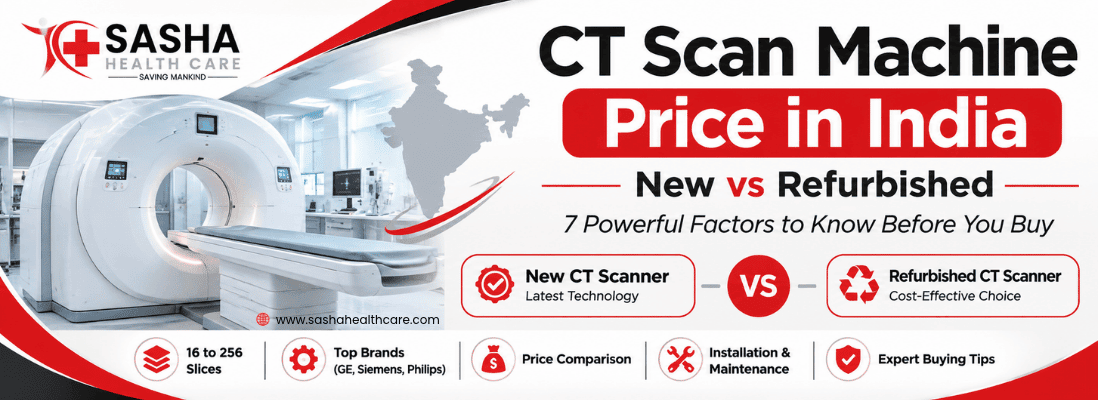
CT Scan Machine Price in India – New vs Refurbished CT Scanners
CT Scan Machine Price in India: Complete Guide to New vs Refurbished CT Scanners

Introduction:

1. Understanding the CT Scan Machine Investment in India

Medical imaging technology plays an important role in modern healthcare. Hospitals and diagnostic centres depend on advanced imaging equipment to identify diseases, support treatment decisions and improve patient care. Among these technologies, Computed Tomography (CT) scanners are essential diagnostic systems used across multiple medical specialties.

If you’re planning to establish a diagnostic centre, expand an existing hospital or upgrade your imaging department, understanding the CT Scan Machine Price in India is an important first step.

However, purchasing a CT scanner involves more than comparing equipment quotations. The final investment depends on several factors, including the number of slices, manufacturer, detector technology, X-ray tube condition, software configuration, installation requirements and after-sales service.

Healthcare providers generally have two purchasing options:

  • New CT scanners: Brand-new systems supplied with the manufacturer’s warranty and the latest available technology.
  • Refurbished CT scanners: Previously used systems that have undergone inspection, servicing, testing and refurbishment before being supplied again.

Both options can be suitable, depending on the hospital’s requirements and investment capacity.

For example, a small diagnostic centre performing routine examinations may find a refurbished 16-slice or 32-slice CT scanner suitable. In contrast, a large multispecialty hospital handling cardiac imaging, trauma cases and advanced diagnostic procedures may require a 64-slice or 128-slice system.

The objective isn’t simply to purchase the cheapest machine. It’s to select equipment that delivers the required clinical capabilities, dependable performance and long-term operational value.

This guide explores CT scanner pricing, new versus refurbished equipment, popular manufacturers, installation costs and important purchasing considerations.

2. What Is a CT Scan Machine and How Does It Work?

A Computed Tomography scanner is a medical imaging system that uses X-rays and computer processing to produce detailed cross-sectional images of the human body.

Unlike conventional X-ray equipment, which generally produces two-dimensional images, a CT scanner captures multiple image slices from different angles. Computer software processes these images to create detailed views of internal organs, bones, blood vessels and other structures.

2.1 Main Components of a CT Scanner

A CT scanner contains several important components that work together to produce diagnostic images.

Gantry: The circular structure containing the X-ray tube and detector assembly. It rotates around the patient during scanning.

X-ray tube: Generates X-rays that pass through the patient’s body. Tube capacity and condition are important considerations when evaluating equipment.

Detector system: Captures the X-rays after they pass through the body and converts the information into electrical signals.

Patient table: Moves the patient through the gantry during the examination.

Computer workstation: Processes scan data and allows radiologists to review and analyse images.

Imaging software: Supports image reconstruction, measurement and specialised applications such as angiography and cardiac imaging, depending on the system configuration.

2.2 Common Applications of CT Scanners

CT scanners support a wide range of clinical examinations.

  • Brain and neurological imaging
  • Chest and lung examinations
  • Abdominal and pelvic imaging
  • Bone and orthopaedic examinations
  • Trauma and emergency imaging
  • CT angiography
  • Cardiac CT examinations, where supported
  • Oncology diagnosis and follow-up

These applications make CT scanners valuable investments for hospitals and diagnostic centres serving different patient populations.

3. CT Scan Machine Price in India: New vs Refurbished

The CT Scan Machine Price in India varies considerably depending on the machine’s configuration, manufacturer, condition and clinical capabilities.

As a broad purchasing guide, refurbished CT scanners may start at approximately ₹35 lakh, while advanced new systems can exceed ₹5 crore. Premium configurations and specialised systems may cost considerably more.

The following table provides indicative market estimates for planning purposes.

3.1 Estimated CT Scanner Price Comparison
CT Scanner ConfigurationNew CT Scanner PriceRefurbished CT Scanner Price
16 Slice CT₹1.2–1.8 Crore₹35–60 Lakhs
32 Slice CT₹1.5–2.5 Crore₹55–85 Lakhs
64 Slice CT₹2–4 Crore₹80 Lakhs–₹1.6 Crore
128 Slice CT₹3–5+ Crore₹1.3–2.5 Crore
256 Slice CT₹5 Crore+₹2 Crore+

Note: These are indicative budget estimates, not fixed manufacturer prices or confirmed live quotations. Actual prices depend on the brand, model, year, software, tube condition, detector performance, refurbishment quality, warranty, accessories and installation scope. Obtain a model-specific quotation before making a purchase.

3.2 Why Do CT Scanner Prices Vary?

Two CT scanners with the same slice configuration can have significantly different prices.

For example, a refurbished 64-slice scanner from one manufacturer may cost more than another 64-slice model because of differences in:

  • Year of manufacture
  • X-ray tube usage and remaining life
  • Detector technology
  • Image reconstruction software
  • Clinical applications
  • System condition
  • Warranty coverage
  • Availability of spare parts
  • Service support

Therefore, buyers should compare complete technical specifications rather than relying only on the slice count.

3.3 Which CT Scanner Is Suitable for Different Healthcare Facilities?
Healthcare FacilityPotentially Suitable Configuration
Small diagnostic centre16 Slice
Growing diagnostic centre16 or 32 Slice
Medium-sized hospital32 or 64 Slice
Multispecialty hospital64 or 128 Slice
Advanced cardiac imaging centre128 Slice or higher, depending on clinical requirements

The final selection should depend on the expected patient volume, clinical services, radiologist requirements and available budget.

4. CT Scanner Price Based on Slice Count

Slice count is one of the most commonly considered factors when comparing CT scanners. However, a higher slice count doesn’t automatically mean a better purchasing decision.

Each configuration offers different imaging capabilities and is designed for different clinical requirements.

4.1 16 Slice CT Scan Machine

A 16-slice CT scanner is commonly considered by smaller hospitals and diagnostic centres that primarily perform routine examinations.

It can support several general imaging applications, including:

  • Brain CT
  • Chest CT
  • Abdomen and pelvis
  • Spine imaging
  • Bone examinations
  • Emergency imaging

Why consider a 16-slice CT scanner?

  • Lower initial investment compared with advanced configurations.
  • Suitable for routine diagnostic requirements.
  • Can be appropriate for facilities with moderate patient volumes.
  • May provide an affordable entry point into CT imaging services.

A professionally refurbished 16-slice CT scanner can be a practical choice for healthcare providers seeking to establish or expand imaging services with controlled capital expenditure.

4.2 32 Slice CT Scan Machine

A 32-slice CT scanner provides additional imaging capabilities compared with many entry-level systems.

It may be suitable for hospitals and diagnostic centres handling moderate patient volumes and requiring a broader range of imaging examinations.

Key considerations include:

  • Image acquisition speed
  • Reconstruction capabilities
  • Patient throughput
  • Detector performance
  • Software availability
  • Cardiac imaging capabilities of the specific model

The 32-slice configuration can provide a balance between investment and clinical requirements.

4.3 64 Slice CT Scan Machine

A 64-slice CT scanner is a popular consideration for multispecialty hospitals and established diagnostic centres.

Depending on the model and software, it can support advanced applications such as CT angiography and cardiac imaging.

Important advantages include:

  • Faster image acquisition on suitable systems.
  • Support for advanced diagnostic applications.
  • High patient throughput.
  • Detailed anatomical imaging.
  • Suitability for a wider range of clinical examinations.

Hospitals should evaluate cardiac capabilities, temporal resolution and available software rather than assuming that every 64-slice scanner offers identical performance.

4.4 128 Slice CT Scan Machine

A 128-slice CT scanner is designed for facilities requiring advanced imaging capabilities and higher patient throughput.

Depending on its configuration, it may support:

  • Advanced cardiac imaging
  • CT angiography
  • Oncology imaging
  • Neurological examinations
  • Trauma imaging
  • Detailed vascular studies

These systems are generally considered by larger hospitals and specialised diagnostic centres.

4.5 256 Slice CT Scan Machine

A 256-slice CT scanner is a high-end imaging solution intended for specialised clinical requirements.

Certain systems offer advanced wide-area detector coverage and specialised cardiac imaging capabilities.

They may be appropriate for:

  • Tertiary care hospitals
  • Advanced cardiac centres
  • High-volume imaging facilities
  • Specialised research and diagnostic institutions

The decision should be based on actual clinical requirements and projected patient demand rather than the highest available specification.

5. New vs Refurbished CT Scan Machines: Which Is Better?

One of the most important decisions when purchasing medical imaging equipment is choosing between a new and refurbished CT scanner.

Both options offer advantages. However, the right choice depends on the healthcare facility’s financial position, expected patient volume, clinical requirements and maintenance capabilities.

5.1 New CT Scan Machines

A new CT scanner is supplied directly by the manufacturer or its authorised distribution channel.

It generally includes manufacturer-supported installation, training, warranty and service arrangements, depending on the purchase agreement.

Advantages of purchasing a new CT scanner:

  1. Access to newer imaging technology.
  2. Manufacturer-backed warranty arrangements.
  3. New components and equipment.
  4. Access to available software upgrades.
  5. Manufacturer-supported technical services.
  6. Greater flexibility in selecting configurations.

Limitations:

  • Higher initial investment.
  • Higher capital expenditure.
  • Potentially longer procurement timelines for certain configurations.
  • Additional costs for software, infrastructure and service agreements.

New CT scanners may be suitable for large hospitals, established diagnostic networks and facilities requiring specific advanced imaging technologies.

5.2 Refurbished CT Scan Machines

Refurbished CT scanners are previously installed systems that undergo technical inspection, servicing, testing and refurbishment before being offered for resale.

The scope of refurbishment differs between suppliers. Therefore, buyers should understand exactly which components have been inspected, repaired, replaced or upgraded.

Advantages of refurbished CT scanners:

  • Lower initial investment compared with many new systems.
  • Access to established international medical imaging brands.
  • Potentially faster project implementation, depending on equipment availability.
  • Suitable configurations for different hospital budgets.
  • Opportunity to expand imaging services without purchasing the latest premium system.

Limitations:

  • Equipment age and usage history must be evaluated.
  • Certain software versions may have limitations.
  • Spare parts availability must be verified.
  • X-ray tube replacement can create significant future expenses.
  • Warranty and service coverage may differ between suppliers.
5.3 New vs Refurbished CT Scanner Comparison
ParameterNew CT ScannerRefurbished CT Scanner
Initial investmentHigherGenerally lower
Equipment conditionBrand newPreviously used and refurbished
TechnologyLatest available configurationDepends on model and upgrades
WarrantyManufacturer termsSupplier-specific terms
InstallationManufacturer or authorised teamQualified installation team
MaintenanceManufacturer service optionsSupplier or service-agency options
Budget suitabilityHigher capital budgetCost-conscious investment
Best suited forNew large hospitals and advanced centresHospitals and diagnostic centres seeking lower upfront investment
5.4 Is a Refurbished CT Scanner Worth Buying?

Yes, a professionally refurbished CT scanner can be a worthwhile investment when it meets the facility’s clinical requirements and passes the necessary technical and regulatory checks.

However, buyers shouldn’t select a machine based on price alone.

Before purchasing, verify:

  • Original equipment model and manufacturing year.
  • Previous service and maintenance records.
  • X-ray tube usage and condition.
  • Detector performance.
  • Gantry and table movement.
  • Image quality and reconstruction performance.
  • Software licences and available applications.
  • Spare parts availability.
  • Warranty and after-sales support.

A transparent refurbishment process and reliable technical support can make a significant difference to the long-term value of the investment.

6. Popular CT Scanner Brands Available in India

Several international manufacturers supply CT imaging systems to hospitals and diagnostic centres in India.

Each brand offers different scanner models, configurations, software capabilities and service arrangements.

6.1 GE Healthcare

GE Healthcare offers CT scanners designed for routine and advanced imaging applications.

Some commonly encountered product families include:

  • GE BrightSpeed
  • GE Optima CT
  • GE Revolution CT
  • GE LightSpeed

When evaluating a GE CT scanner, consider the model generation, tube condition, detector configuration, software and service history.

6.2 Siemens Healthineers

Siemens Healthineers is a recognised manufacturer of medical imaging equipment.

Its SOMATOM product family includes systems designed for different clinical requirements.

Examples include:

  • SOMATOM Emotion
  • SOMATOM Definition
  • SOMATOM Perspective
  • SOMATOM go.

Buyers should compare individual models based on clinical applications, image reconstruction technology, operating condition and available service support.

6.3 Philips Healthcare

Philips offers CT imaging systems for routine and advanced diagnostic applications.

Examples include:

  • Philips Brilliance CT
  • Philips Ingenuity CT
  • Philips Incisive CT
  • Philips iCT

The final purchase decision should consider system specifications, software options, tube performance and component availability.

6.4 Canon Medical Systems

Canon Medical Systems, formerly Toshiba Medical Systems, offers CT scanners for different clinical environments.

Its Aquilion product family includes systems designed for routine, advanced and specialised imaging.

When comparing brands, remember that the manufacturer name alone doesn’t determine the quality or value of a refurbished system. The exact model, technical condition and service support are equally important.

7. Seven Important Factors Affecting CT Scan Machine Price in India

Understanding pricing factors can help buyers avoid unexpected expenses and select suitable equipment.

7.1 Number of Slices

The slice configuration influences image acquisition capabilities, clinical applications and system pricing.

Higher configurations may support advanced examinations, but the required specification depends on the facility’s clinical workload.

7.2 Manufacturer and Model

Different manufacturers offer different technologies, detector designs, software features and equipment configurations.

Even within the same brand, two models can have significantly different prices.

7.3 X-Ray Tube Condition

The X-ray tube is one of the most important components of a CT scanner.

Its usage, remaining life, cooling system and operating condition can influence the equipment’s value.

Before purchasing refurbished equipment, request tube usage records and technical assessment reports.

7.4 Detector Technology

Detector performance influences image acquisition and overall imaging capabilities.

Buyers should evaluate detector condition, specifications and compatibility with the scanner’s intended clinical applications.

7.5 Software and Advanced Applications

CT scanners may offer different software packages for:

  • Cardiac imaging
  • CT angiography
  • Bone reconstruction
  • Lung imaging
  • Multiplanar reconstruction
  • 3D volume rendering
  • Iterative image reconstruction

Some applications require additional licences or upgrades, which can increase the overall investment.

7.6 Installation and Infrastructure

A CT scanner requires a properly prepared installation environment.

Room dimensions, radiation shielding, electrical infrastructure, cooling arrangements and equipment access should be evaluated before delivery.

7.7 Warranty and After-Sales Support

Warranty coverage and service availability are important purchasing considerations.

A slightly cheaper CT scanner may become expensive if spare parts, technical support or maintenance services are difficult to obtain.

Always compare the complete service package before finalising a quotation.

8. Benefits of Choosing Refurbished CT Scanners

Refurbished medical imaging equipment has become an important purchasing option for healthcare facilities looking to manage capital expenditure.

A professionally refurbished system can help hospitals expand their diagnostic capabilities while controlling initial investment.

Major Benefits

1. Lower initial investment

Refurbished systems generally cost less than comparable new systems, depending on configuration and condition.

2. Access to established brands

Hospitals may be able to consider established manufacturers and higher configurations within their available budgets.

3. Improved budget flexibility

The capital saved may be allocated towards infrastructure, staffing, patient services and other diagnostic equipment.

4. Suitable for expanding facilities

Growing hospitals and diagnostic centres can evaluate refurbished systems when expanding imaging services.

5. Availability of different configurations

Depending on market availability, buyers can explore different models, slice configurations and clinical applications.

Important Consideration

Refurbishment quality is more important than the label itself.

Ask the supplier for a detailed inspection report, service history, component assessment, installation scope and written warranty terms.

9. Advantages of Investing in a New CT Scanner

Although refurbished systems offer cost advantages, new CT scanners can provide benefits that are important for certain healthcare facilities.

Key Advantages
  • Access to the manufacturer’s latest available technology.
  • New equipment components.
  • Manufacturer warranty arrangements.
  • Availability of newer software platforms.
  • Access to manufacturer training and technical support.
  • Configuration choices based on clinical requirements.

New equipment may be particularly suitable for hospitals planning long-term investments in specialised diagnostic services.

However, the purchase decision should also account for the total cost of ownership, including installation, service contracts and future operating expenses.

10. Additional Costs Beyond the CT Scanner Purchase Price

One common mistake made by first-time buyers is considering only the machine’s purchase price.

In reality, establishing a CT imaging facility requires additional investment.

ExpenseWhat to Consider
Site preparationRoom construction and civil modifications
Radiation shieldingShielding designed for the room and approved requirements
Electrical infrastructureDedicated power supply and electrical protection
HVACTemperature and environmental control
InstallationTransportation, positioning and commissioning
SoftwareClinical applications and licences
Regulatory complianceApplicable approvals and documentation
MaintenancePreventive servicing and repairs
Staff trainingRadiographer and technical staff training
10.1 Radiation Shielding

CT scanner rooms require appropriate radiation protection.

Shielding design should be based on the equipment specifications, room layout, workload and applicable radiation safety requirements.

10.2 Electrical Requirements

CT scanners require suitable electrical infrastructure to operate reliably.

The electrical system should be evaluated by qualified professionals before installation.

10.3 Air Conditioning and Cooling

Temperature control is important for maintaining the operating environment of the CT scanner and associated electronics.

Cooling requirements should follow the manufacturer’s installation specifications.

10.4 Installation and Commissioning

Installation includes equipment positioning, system connections, calibration, acceptance testing and commissioning.

The supplier should clearly explain which activities are included in the quotation and which are additional.

11. AERB Requirements for CT Scanner Procurement and Installation in India

Radiation safety and regulatory compliance are essential when purchasing and operating CT scanners in India.

The Atomic Energy Regulatory Board (AERB) oversees radiation safety requirements associated with diagnostic X-ray equipment.

Hospitals and diagnostic centres must follow applicable regulatory requirements for procurement, installation and operation.

For pre-owned CT scanners, buyers should pay particular attention to procurement permissions and supplier eligibility.

According to AERB guidance:

  • Pre-owned CT scanners must meet applicable regulatory requirements.
  • Procurement permission may be required.
  • Installation and use require the relevant regulatory consent.
  • Radiation safety must be evaluated.
  • Equipment must satisfy applicable type-approval and other regulatory requirements.

Official reference: Atomic Energy Regulatory Board (AERB) – India.

You can also review the AERB guidance on pre-owned diagnostic X-ray equipment.

Before purchasing, confirm the latest requirements directly with AERB or an appropriately authorised service agency. Don’t assume that a machine can be installed and operated simply because it is available for sale.

12. How to Choose the Right CT Scan Machine for Your Hospital

Selecting a CT scanner requires a clear understanding of your clinical, technical and financial requirements.

Use the following checklist before making a purchasing decision.

12.1 Evaluate Patient Volume

Estimate the number of examinations your facility expects to perform each day.

A smaller diagnostic centre may not require a premium high-slice scanner, while a high-volume multispecialty hospital may need faster and more advanced imaging capabilities.

12.2 Identify Clinical Requirements

Discuss your imaging requirements with radiologists and clinical specialists.

Consider whether you need routine CT examinations, angiography, cardiac imaging or specialised applications.

12.3 Compare Technical Specifications

Review the following details:

  • Slice configuration
  • Detector specifications
  • X-ray tube model and condition
  • Gantry rotation speed
  • Image reconstruction technology
  • Software applications
  • Patient table capacity
  • Workstation configuration
12.4 Inspect Refurbished Equipment

If you’re considering a refurbished CT scanner, request a technical demonstration and inspection.

The equipment should undergo appropriate quality checks before dispatch and commissioning.

12.5 Verify Service Availability

Check whether the supplier can provide:

  • Installation support
  • Preventive maintenance
  • Breakdown support
  • Spare parts
  • AMC or CMC
  • Technical assistance
12.6 Compare Complete Quotations

Ask suppliers to provide detailed quotations covering equipment, accessories, transportation, installation, warranty and service arrangements.

This makes it easier to compare different options fairly.

13. CT Scanner Maintenance: AMC and CMC Services

Regular maintenance is essential for maintaining CT scanner performance and reducing unexpected equipment downtime.

Hospitals should consider the availability of Annual Maintenance Contracts (AMC) and Comprehensive Maintenance Contracts (CMC).

13.1 What Is AMC?

An Annual Maintenance Contract generally covers agreed preventive maintenance and technical service activities.

The exact coverage depends on the supplier’s agreement.

13.2 What Is CMC?

A Comprehensive Maintenance Contract generally provides broader maintenance coverage and may include selected spare parts and components, subject to the contract terms.

13.3 Why Is Maintenance Important?

Proper maintenance helps:

  • Reduce unexpected downtime.
  • Identify potential equipment issues.
  • Maintain system performance.
  • Support consistent imaging operations.
  • Improve equipment availability.
  • Plan maintenance expenses.

Before signing a contract, check response times, exclusions, spare parts coverage, tube coverage and service conditions.

14. Return on Investment: Is a CT Scanner a Good Business Investment?

Purchasing a CT scanner can create additional revenue opportunities for hospitals and diagnostic centres.

However, profitability depends on several factors, including patient volume, examination pricing, operating expenses, competition and equipment financing.

14.1 Factors That Influence ROI

Patient volume: Higher patient throughput can improve revenue potential when supported by sufficient demand.

Examination charges: Revenue depends on the types of examinations performed and the local market.

Operating expenses: Electricity, staffing, contrast materials, maintenance and administrative expenses affect profitability.

Equipment downtime: Unexpected breakdowns can reduce the number of examinations performed.

Initial investment: Lower capital expenditure can improve the financial position of a new diagnostic centre.

14.2 Example of CT Scanner Revenue Planning

Consider a hypothetical diagnostic centre performing 15 CT examinations per day.

ParameterIllustrative Value
Average examinations per day15
Average revenue per examination₹3,000
Operating days per month26
Monthly gross revenue₹11,70,000
Annual gross revenue₹1,40,40,000

Illustrative calculation only. Actual examination charges and patient volumes vary by location, clinical services and competition. This is gross revenue, not profit.

From this amount, the centre must deduct salaries, electricity, contrast materials, maintenance, rent, financing costs, taxes and other operational expenses.

A proper feasibility study should be completed before purchasing the equipment.

15. Why Choose a Trusted CT Scanner Supplier?

Choosing the right supplier is just as important as selecting the right CT scanner.

A reliable supplier should understand equipment specifications, installation requirements, refurbishment standards and ongoing technical support.

When evaluating a medical equipment supplier, look for:

  • Experience with CT and MRI systems.
  • Transparent equipment specifications.
  • Documented refurbishment procedures.
  • Installation and commissioning support.
  • Appropriate regulatory documentation.
  • Warranty arrangements.
  • AMC and CMC services.
  • Availability of technical support.
  • Spare parts and maintenance capabilities.
Sasha Healthcare: Medical Imaging Equipment Solutions

Sasha Healthcare provides medical imaging equipment solutions for hospitals and diagnostic centres.

Its equipment portfolio includes refurbished CT scanners, MRI machines and other diagnostic imaging systems.

For healthcare providers evaluating CT scanner investments, Sasha Healthcare can help explore suitable equipment configurations based on clinical requirements and budget considerations.

The company also focuses on equipment refurbishment, reassembly, installation support and after-sales services.

Whether you’re establishing a new diagnostic centre or upgrading an existing imaging department, selecting the right configuration and service partner is important for long-term operational performance.

Conclusion: Make the Right CT Scanner Investment

Purchasing a CT scanner is an important decision for any hospital or diagnostic centre. The right equipment can strengthen diagnostic capabilities, improve patient services and create opportunities for business growth.

When evaluating the CT Scan Machine Price in India, consider more than the initial purchase quotation. Slice configuration, manufacturer, tube condition, detector technology, software, installation, regulatory compliance and after-sales support all influence the overall investment.

New CT scanners can be suitable for facilities seeking the latest available technology and manufacturer support. On the other hand, professionally refurbished CT scanners can offer a more affordable alternative when they meet the required technical and regulatory standards.

Before making your decision, compare multiple configurations, evaluate your expected patient volume and calculate the total cost of ownership.

Looking for a refurbished CT scanner for your hospital or diagnostic centre?

Sasha Healthcare can help you explore medical imaging equipment solutions based on your clinical requirements and investment budget.

Contact Sasha Healthcare to discuss CT scanner configurations, pricing, installation support and AMC/CMC services.

  • Website: www.sashahealthcare.com
  • Equipment: CT Scanners | MRI Machines | PET-CT | Mammography | Digital X-ray
  • Services: Refurbishment | Installation Support | AMC | CMC
What is the CT Scan Machine Price in India?

The CT Scan Machine Price in India varies according to slice configuration, brand, technology and equipment condition.
Refurbished CT scanners may start at approximately ₹35 lakh, while new advanced CT scanners can cost ₹5 crore or more. The actual price depends on the specific model and configuration.

Is buying a refurbished CT scanner a good investment?

Yes. A professionally refurbished CT scanner can be a good investment for hospitals and diagnostic centres seeking to reduce their initial capital expenditure.
However, buyers should verify equipment condition, service history, refurbishment quality, regulatory requirements and warranty coverage before purchasing.

What should I check before purchasing a refurbished CT scanner?

Check the manufacturing year, tube usage, detector condition, service history, image quality, software licences, spare parts availability, warranty and installation support.
Also request a technical inspection report and confirm applicable regulatory documentation.
CT scanner machine buying guide for a new diagnostic centre in India
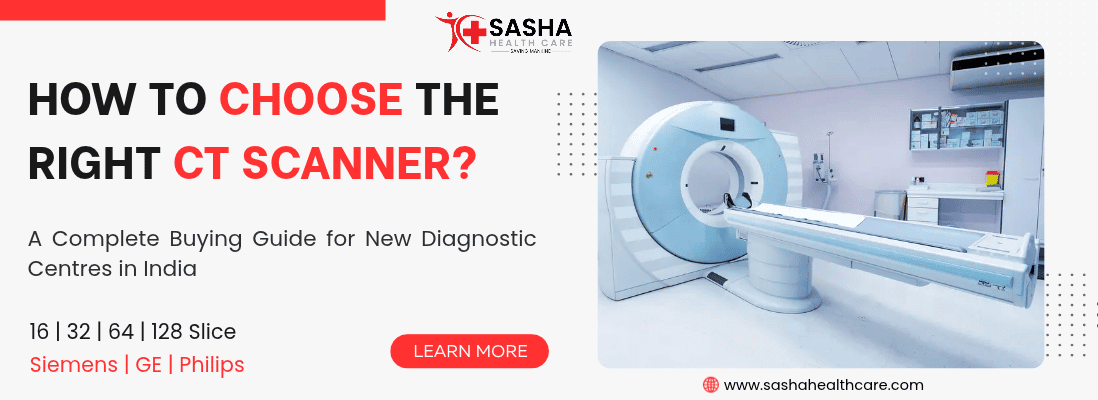
How to Choose a CT Scanner for a New Diagnostic Centre in India: Complete Buying Guide

Starting a new diagnostic centre is a significant investment in the healthcare industry. One of the most important decisions is selecting the right CT scanner that meets patient requirements, diagnostic needs, budget, and future business growth. Choosing the right CT scanner for a diagnostic centre can improve operational efficiency, support accurate imaging, and help build long-term relationships with referring doctors and hospitals.

However, with different scanner configurations, manufacturers, technologies, and pricing options available, selecting the right machine can be challenging.

In this guide, we explain how to choose a CT scanner for a new diagnostic centre in India, including slice configurations, leading brands, technical specifications, infrastructure requirements, pricing factors, and the benefits of purchasing refurbished CT scanners.

1. Understand Your Diagnostic Centre’s Requirements

Before purchasing a CT scanner, understand the clinical and business requirements of your diagnostic centre. The ideal CT scanner depends on the expected patient volume, types of examinations, available investment, and referral network.

Consider the following factors:

  • Expected patient volume: Estimate the number of patients you expect daily.
  • Types of examinations: Identify whether you will primarily perform routine CT scans, trauma imaging, angiography, or advanced cardiac studies.
  • Location: Evaluate the demand for diagnostic imaging services in your target area.
  • Referral network: Consider relationships with hospitals, physicians, radiologists, and specialists.
  • Future expansion: Select equipment that can accommodate your expected growth.

For example, a diagnostic centre in a growing town with moderate patient volume may find a 16-slice or 32-slice CT scanner suitable for its initial requirements. A high-volume centre planning advanced imaging services may consider 64-slice or 128-slice systems.

The best choice should balance clinical requirements, affordability, and long-term business potential.

2. Choose the Right CT Scanner Slice Configuration

CT scanner slice configuration is one of the most important factors when purchasing imaging equipment. Different configurations support different imaging applications, scan speeds, and clinical requirements.

Here is a general comparison of popular CT scanner configurations.

CT ScannerTypical applicationsPotential suitability
16 Slice CTRoutine diagnostic imaging, brain, chest, abdomenSmall diagnostic centres
32 Slice CTRoutine imaging and broader examination requirementsGrowing diagnostic centres
64 Slice CTAdvanced imaging, angiography and selected cardiac applicationsMedium to high-volume centres
128 Slice CTAdvanced imaging, cardiac CT and complex examinationsLarge diagnostic centres and hospitals

Actual capabilities depend on the scanner model, detector design, software, acquisition technology, and available applications. Slice count alone does not determine clinical performance.

16 Slice CT Scanner

A 16-slice CT scanner is commonly considered by smaller diagnostic centres and hospitals starting their imaging services.

It can support routine examinations such as:

  • Brain CT
  • Chest CT
  • Abdomen and pelvis CT
  • Bone and joint imaging
  • Selected contrast-enhanced studies

It can be a practical starting option for facilities with moderate patient volumes and a focus on routine diagnostic imaging.

32 Slice CT Scanner

A 32-slice CT scanner offers additional imaging capabilities compared with many entry-level systems.

It may be suitable for diagnostic centres looking to expand their examination portfolio while maintaining a reasonable investment.

Before purchasing, evaluate its software capabilities, image reconstruction technology, detector specifications, and clinical applications.

64 Slice CT Scanner

A 64-slice CT scanner is widely considered by diagnostic centres and hospitals that require broader clinical applications.

Depending on the model and configuration, it can support:

  • CT angiography
  • Advanced chest and abdominal imaging
  • Trauma imaging
  • Selected cardiac CT examinations
  • Detailed vascular studies

It can be a suitable option for centres planning to serve a larger referral network.

128 Slice CT Scanner

A 128-slice CT scanner is designed for facilities seeking advanced imaging capabilities.

Depending on the system, it may offer advanced cardiac imaging, faster acquisition, improved workflow, and sophisticated image reconstruction technologies.

It is worth considering for high-volume diagnostic centres and hospitals with advanced imaging requirements.

Buying tip: Do not select a CT scanner based only on its slice count. Compare the actual scanner model, detector configuration, software, clinical applications, tube condition, and reconstruction technology.

3. Evaluate CT Scanner Brands

Selecting a reliable manufacturer is another important part of purchasing a CT scanner. Different brands offer different technologies, software packages, scanner configurations, and service requirements.

Some established CT scanner manufacturers in India include:

Siemens Healthineers

Siemens offers CT scanner systems across different configurations, with technologies for routine and advanced diagnostic imaging. Evaluate the specific model, software, and available applications.

GE HealthCare

GE HealthCare offers CT systems designed for various clinical applications. Consider detector technology, image reconstruction, software availability, and serviceability.

Philips

Philips CT scanners are available in different configurations for routine and advanced imaging. Compare the specific system’s clinical capabilities and maintenance requirements.

When evaluating brands, consider:

  • Availability of genuine spare parts.
  • Software and application support.
  • Equipment service history.
  • Technical support availability.
  • Compatibility with your diagnostic workflow.

The right model matters more than choosing a brand name alone.

4. New vs Refurbished CT Scanner: Which Is Better?

One of the biggest decisions for a new diagnostic centre is whether to purchase a new or refurbished CT scanner.

Both options have advantages depending on the available budget and business requirements.

FactorNew CT ScannerRefurbished CT Scanner
Initial investmentGenerally higherGenerally lower
Equipment conditionNew equipmentDepends on refurbishment and inspection
TechnologyLatest available configurationDepends on model and manufacturing year
Budget flexibilityMay require higher capitalCan offer more affordable options
WarrantyManufacturer or supplier termsDepends on supplier agreement
AvailabilityDepends on manufacturer deliveryDepends on available inventory
Benefits of refurbished CT scanners

A refurbished CT scanner can be a practical investment for diagnostic centres that want to establish imaging services with controlled capital expenditure.

Potential benefits include:

  • Lower initial equipment investment.
  • Access to established manufacturers and models.
  • More flexibility in selecting scanner configurations.
  • Opportunity to allocate additional funds towards infrastructure and operations.

However, buyers should verify the equipment’s condition, manufacturing year, tube usage, service history, software licenses, refurbishment scope, and warranty terms before purchasing.

A professionally inspected and appropriately refurbished CT scanner can be considered when it meets the centre’s clinical and operational requirements.

5. Understand CT Scanner Price and Investment in India

The CT scanner machine price in India varies significantly depending on its configuration, manufacturer, model, condition, and technical specifications.

There is no single price applicable to all CT scanners.

The major factors affecting CT scanner prices include:

  1. Slice configuration: Different configurations have different technical capabilities and investment requirements.
  2. Brand and model: Siemens, GE, and Philips systems differ in specifications and pricing.
  3. Manufacturing year: Equipment age can influence market value.
  4. Tube condition: Tube usage, remaining life, and replacement requirements affect ownership costs.
  5. Software packages: Advanced applications and licensed software can influence the overall investment.
  6. Installation costs: Transportation, installation, commissioning, and infrastructure expenses should be considered.
  7. Warranty and support: Supplier warranty and maintenance arrangements influence total ownership costs.

Before finalizing a purchase, request a detailed quotation covering the equipment, installation, applicable taxes, warranty, and after-sales support.

6. Check Important CT Scanner Technical Specifications

Technical specifications help buyers understand the actual performance and capabilities of a CT scanner.

Before purchasing, review these important parameters:

SpecificationWhy it matters
Gantry aperturePatient comfort and positioning
Detector technologyImage acquisition capabilities
X-ray tubeScan performance and operating condition
Rotation timeAcquisition speed
Image reconstructionImage quality and processing
Dose optimizationRadiation dose management
Software applicationsAvailable clinical examinations
WorkstationImage processing and reporting workflow

Ask the supplier for the original equipment specifications and available technical documentation.

For refurbished CT scanners, request a demonstration and verify that the major components are functioning correctly.

7. Evaluate Space and Infrastructure Requirements

A CT scanner requires proper infrastructure before installation. Planning the room and supporting facilities in advance can help avoid unnecessary project delays.

Important infrastructure requirements include:

  • CT scanner room: Adequate space for equipment installation and patient positioning.
  • Electrical supply: Appropriate power capacity, grounding, and electrical protection.
  • HVAC: Suitable temperature and humidity control.
  • Radiation shielding: Shielding designed according to applicable radiation safety requirements.
  • Patient preparation area: Space for patient registration, preparation, and observation where required.
  • Control room: A suitable area for the CT operator and imaging workstation.

In India, buyers must also consider applicable Atomic Energy Regulatory Board (AERB) requirements, including relevant approvals, licensing, and radiation safety provisions.

Consult qualified professionals and the relevant authorities before finalizing the CT scanner room design.

8. Consider Installation and Maintenance Requirements

Installation and after-sales support are important for uninterrupted diagnostic centre operations.

Before purchasing a CT scanner, confirm that the supplier can coordinate the required installation and technical support.

Important services to consider include:

  • CT scanner transportation and installation.
  • Equipment testing and commissioning.
  • Preventive maintenance.
  • Breakdown maintenance.
  • Genuine spare parts availability.
  • Technical support.
  • Annual Maintenance Contract (AMC) or Comprehensive Maintenance Contract (CMC), where available.

Also check the availability and cost of critical components such as X-ray tubes and detector-related parts.

A reliable maintenance arrangement can help reduce unexpected downtime and support long-term equipment performance.

9. How to Choose a Reliable CT Scanner Supplier in India

Selecting the right CT scanner supplier is just as important as selecting the equipment.

A reliable supplier should provide transparent equipment details, technical information, and support throughout the purchase and installation process.

Before choosing a supplier, consider the following:

1. Verify equipment details: Check the manufacturer, model, manufacturing year, configuration, and technical specifications.

2. Request equipment inspection: Review the machine condition and available testing reports.

3. Understand warranty terms: Confirm what components and services are covered.

4. Check installation support: Discuss transportation, site readiness, installation, and commissioning arrangements.

5. Confirm spare parts availability: Ensure that essential components can be sourced when required.

6. Evaluate after-sales support: Understand the supplier’s maintenance capabilities and technical response arrangements.

Why Consider Sasha HealthCare?

Sasha HealthCare provides medical imaging equipment solutions for hospitals and diagnostic centres across India.

For healthcare facilities planning to purchase CT scanners, Sasha HealthCare offers equipment sourcing solutions focused on helping buyers evaluate suitable machine options based on their requirements.

Whether you are establishing a new diagnostic centre or expanding an existing imaging facility, selecting the right equipment and supplier can make an important difference to your investment.

Explore: Sasha HealthCare – Medical Imaging Equipment Supplier

10. Common Mistakes to Avoid When Buying a CT Scanner

First-time diagnostic centre investors should avoid these common purchasing mistakes:

  • Choosing a CT scanner based only on its purchase price.
  • Selecting a higher slice configuration without assessing actual patient demand.
  • Ignoring X-ray tube condition and replacement costs.
  • Not checking software licenses and available applications.
  • Overlooking installation and infrastructure expenses.
  • Purchasing refurbished equipment without proper inspection.
  • Ignoring warranty and after-sales support.
  • Not evaluating future spare parts availability.

A detailed technical and financial evaluation before purchasing can help prevent unnecessary expenses.

Conclusion

Choosing the right CT scanner for a new diagnostic centre requires careful consideration of clinical requirements, patient volume, scanner configuration, equipment condition, budget, infrastructure, and after-sales support.

A 16-slice or 32-slice CT scanner may suit centres focusing on routine imaging, while 64-slice and 128-slice systems may be appropriate for facilities planning broader and more advanced imaging services.

Both new and refurbished CT scanners can be considered depending on investment capacity and operational requirements. The important thing is to evaluate the actual machine specifications, condition, warranty, and technical support before making a decision.

Planning to establish a new diagnostic centre or upgrade your existing imaging facility?

Contact Sasha HealthCare to discuss your CT scanner requirements and explore suitable medical imaging equipment options.

CT scan machine for hospitals and diagnostic centres in India
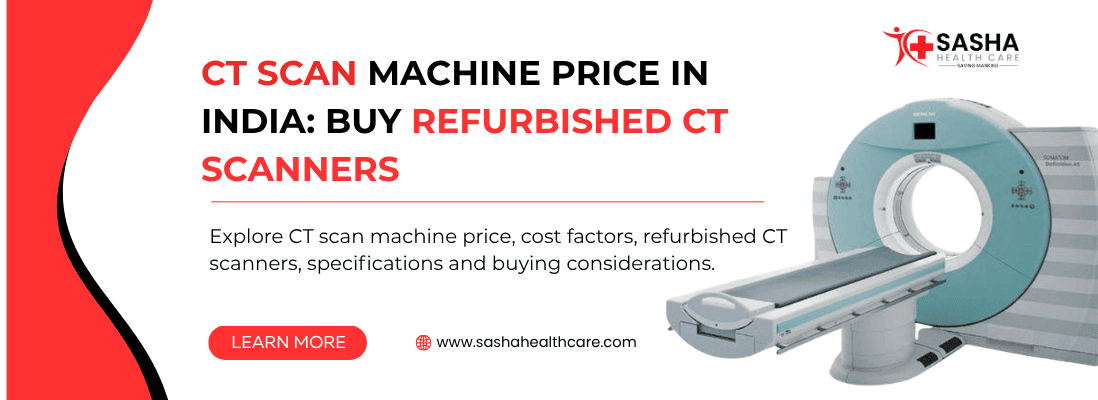
Buy CT Scanners at Best Price in India: CT Scan Machine Price & Cost Guide

Looking to buy a CT scanner in India? The CT scan machine price depends on several factors, including slice configuration, brand, model, machine condition, software, X-ray tube condition, installation requirements and after-sales support. Hospitals and diagnostic centres can consider both new and refurbished CT scan machines depending on their clinical requirements, infrastructure and budget.

Choosing a CT scanner should not be based only on the lowest purchase price. A reliable buying decision should consider machine specifications, image quality, system condition, installation, warranty, service support, spare parts and long-term ownership costs.

CT Scan Machine Price in India

The CT scan machine price in India varies considerably depending on the configuration and condition of the system. A basic CT scanner and a high-end multi-slice CT scanner can have very different acquisition costs.

For refurbished CT scanners, the price can also vary depending on the manufacturer, model year, number of slices, X-ray tube condition, detector condition, software configuration, refurbishment level and warranty.

Some of the major factors that influence CT scanner pricing include:

  • Number of slices
  • Brand and model
  • New or refurbished condition
  • X-ray tube condition and remaining life
  • Detector configuration
  • Gantry condition
  • Patient table
  • Generator
  • Image reconstruction technology
  • Software and clinical applications
  • Workstation configuration
  • Installation requirements
  • Transportation and lifting
  • Site preparation
  • Warranty
  • AMC or CMC options
  • Availability of spare parts and technical support

Because these factors differ from one machine to another, buyers should request a configuration-specific quotation instead of relying on a generic CT machine price.

What is the CT scan machine price?

There is no single price applicable to every CT scanner. The final purchase cost depends on the exact machine configuration, brand, model, condition and services included in the quotation.

For this reason, a buyer comparing two CT scanners should compare the complete configuration and total ownership requirements, rather than comparing only the headline machine price.


What Is the CT Scan Machine Cost?

The CT scan machine cost should be considered as more than the equipment purchase price.

A hospital or diagnostic centre may need to budget for several components associated with purchasing and commissioning a CT scanner.

These can include:

  • CT scanner equipment
  • X-ray tube
  • Patient table
  • Workstation
  • Software
  • Accessories
  • Transportation
  • Lifting
  • Installation
  • Calibration
  • Commissioning
  • Electrical requirements
  • HVAC requirements
  • Radiation shielding and room preparation
  • Warranty
  • Preventive maintenance
  • AMC or CMC
  • Spare parts and future repairs

Therefore, when comparing CT scanner quotations, ask the supplier exactly what is included and excluded.

A machine with a lower initial quotation may not necessarily have the lowest overall ownership cost if important services or components are excluded.


Refurbished CT Scan Machine: Is It a Good Option?

A refurbished CT scan machine can be an option for hospitals and diagnostic centres that want to control their initial equipment investment while obtaining an established CT imaging platform.

Refurbishment should involve more than simply reselling a previously used machine.

Depending on the supplier and equipment, refurbishment and evaluation may include:

  • Mechanical inspection
  • Electrical inspection
  • System testing
  • Image quality assessment
  • X-ray tube evaluation
  • Detector assessment
  • Gantry inspection
  • Patient table testing
  • Software verification
  • Preventive maintenance
  • Calibration
  • Replacement of selected components where required
  • Final testing before installation

However, the term “refurbished” can mean different things in the medical equipment market. Buyers should therefore ask for details about what work has actually been performed on the machine.

Refurbished vs Used CT Scan Machine

A used or pre-owned CT scanner generally refers to equipment that has previously been operated and is being offered for resale.

A refurbished CT scanner may have undergone inspection, testing, servicing and replacement of selected components before being offered to another healthcare facility.

The actual refurbishment process varies by machine and supplier, so buyers should request documentation describing the machine’s condition and the work performed.


Why Buy a Refurbished CT Scan Machine?

A refurbished CT scanner may be suitable for healthcare facilities that have a defined budget but still require CT imaging capabilities.

Potential advantages include:

Lower Initial Investment

Refurbished equipment can provide an alternative to purchasing a completely new system, depending on the model and condition.

Established Technology

A properly evaluated pre-owned system can provide access to established CT platforms that are already widely used in clinical environments.

Budget Flexibility

A refurbished system may allow a diagnostic centre or hospital to allocate part of its budget to other requirements such as infrastructure, staffing, software or service support.

Availability

Depending on market availability, refurbished systems can sometimes be sourced more quickly than certain new configurations.

However, buyers should evaluate the machine carefully before purchase. Lower acquisition cost should never replace proper technical due diligence.


Factors That Affect CT Scan Machine Price in India

1. Number of Slices

The number of slices is one of the commonly discussed specifications when comparing CT scanners.

Configurations can include:

  • 16-slice
  • 32-slice
  • 64-slice
  • 128-slice
  • Higher-end multi-slice configurations

However, a higher slice count does not automatically mean that a particular CT scanner is the best choice for every hospital or diagnostic centre.

The appropriate configuration depends on:

  • Patient volume
  • Clinical applications
  • Scan requirements
  • Throughput
  • Budget
  • Existing infrastructure
  • Future expansion plans

A diagnostic centre with routine imaging requirements may have different needs from a tertiary-care hospital.


2. Brand and Model

The manufacturer and specific model can influence the CT scanner price and long-term ownership considerations.

When comparing different systems, buyers should evaluate:

  • Model generation
  • System specifications
  • Software
  • Clinical applications
  • Service availability
  • Spare parts
  • X-ray tube availability
  • Technical support
  • Upgrade possibilities

Rather than selecting a machine based only on brand name, compare the complete system configuration with the facility’s clinical requirements.


3. New vs Refurbished Condition

The condition of the CT scanner has a major impact on acquisition cost.

A new system generally provides the latest available configuration from the manufacturer, while a refurbished system may provide a more budget-oriented alternative.

When purchasing a refurbished CT scanner, ask about:

  • Original installation date
  • Model
  • Previous usage
  • Tube condition
  • Tube exposure information where available
  • Detector condition
  • Software version
  • Service history where available
  • Components replaced during refurbishment
  • Testing performed
  • Warranty
  • Installation support

4. X-Ray Tube Condition

The X-ray tube is one of the most important components to evaluate when purchasing a CT scanner.

For a refurbished system, buyers should ask the supplier about:

  • Tube model
  • Tube condition
  • Tube usage
  • Tube history where available
  • Expected service considerations
  • Replacement availability
  • Replacement cost

A low purchase price should not be evaluated separately from the condition and future service requirements of the tube.


5. Software and Clinical Applications

Software can significantly affect the functionality and value of a CT scanner.

Depending on the system, available applications may include tools for different clinical workflows, image reconstruction and advanced visualization.

Before purchasing, identify the applications actually required by the facility.

Instead of paying for features that will not be used, buyers should match software capabilities with their clinical workload.


6. Installation and Site Requirements

The CT scanner price is only one part of the procurement process.

The installation site may need appropriate:

  • Electrical infrastructure
  • HVAC
  • Radiation shielding
  • Room dimensions
  • Floor loading considerations
  • Network connectivity
  • Equipment access
  • Patient access
  • Safety arrangements

Transportation and lifting must also be planned, particularly when the equipment needs to be moved into an existing hospital building.

A professional supplier should discuss site requirements before finalizing the installation.


How to Choose the Right CT Scanner for a Hospital or Diagnostic Centre

The right CT scanner depends on the facility’s actual requirements.

Before requesting quotations, define the following:

Patient Volume

Estimate the expected number of examinations per day and determine the required throughput.

Clinical Applications

Identify the examinations that the facility plans to perform.

Slice Configuration

Select the appropriate slice configuration based on clinical requirements rather than simply choosing the highest available specification.

Budget

Establish the equipment budget along with installation, infrastructure and service costs.

Infrastructure

Confirm whether the existing facility can accommodate the CT system.

Service Support

Evaluate the availability of technical support, spare parts and maintenance services.

Warranty

Understand what components and services are covered under the warranty.

AMC/CMC

Ask about preventive maintenance and annual maintenance contract options after the warranty period.

Future Requirements

Consider whether the system can support expected growth in patient volume and clinical services.


New vs Refurbished CT Scan Machine

FactorNew CT ScannerRefurbished CT Scanner
Initial investmentGenerally higherOften more budget-oriented
TechnologyCurrent/new configurationEstablished configuration
Machine historyNewPreviously operated
AvailabilityDepends on manufacturer and configurationDepends on market availability
WarrantyManufacturer/supplier dependentSupplier dependent
Condition assessmentNew equipment checksDetailed inspection and testing are important
Spare partsDepends on modelModel and availability should be verified
Service supportDepends on manufacturer/supplierSupplier and model support should be evaluated
Suitable forFacilities seeking new technologyFacilities considering cost-effective equipment options

The right choice depends on the hospital’s clinical requirements, budget, infrastructure and long-term equipment strategy.


What Should Be Included in a CT Scanner Quotation?

When requesting a quotation, don’t ask only for the CT machine price.

Ask the supplier to provide a detailed scope of supply.

A CT scanner quotation may include:

  • CT gantry
  • Patient table
  • X-ray tube
  • Generator
  • Detector system
  • Operator workstation
  • Software
  • Clinical applications
  • Accessories
  • Installation
  • Transportation
  • Lifting
  • Calibration
  • Commissioning
  • Warranty
  • User training, where applicable
  • Technical support
  • AMC/CMC options

The quotation should clearly identify what is included and what will be charged separately.

This makes it easier to compare proposals from different suppliers.


How to Buy a CT Scan Machine in India

Buying a CT scanner is a major healthcare equipment decision. A structured procurement process can help reduce unexpected costs and technical issues.

Step 1: Define Your Clinical Requirements

Identify the examinations and patient volume expected at the facility.

Step 2: Determine Your Budget

Consider the complete acquisition and ownership cost rather than only the equipment price.

Step 3: Decide Between New and Refurbished

Evaluate whether a new or refurbished CT scanner better matches your requirements.

Step 4: Compare Specifications

Compare slice configuration, model, software, tube, detector and other relevant specifications.

Step 5: Evaluate Machine Condition

For refurbished equipment, request information about machine history, testing and components.

Step 6: Check Service and Spare Parts

Confirm that technical support and important replacement components can be sourced.

Step 7: Assess Site Requirements

Check room dimensions, electrical systems, HVAC, radiation shielding and equipment access.

Step 8: Compare Complete Quotations

Compare the machine, installation, transportation, warranty and service scope.

Step 9: Review Warranty and Support

Understand what is covered and how technical issues will be handled.

Step 10: Plan Installation and Commissioning

Coordinate transportation, lifting, installation, testing and commissioning.


What Should You Check Before Buying a Refurbished CT Scanner?

Before purchasing a refurbished CT scan machine, ask the supplier for as much technical information as reasonably available.

A practical checklist includes:

  • Manufacturer
  • Model
  • Slice configuration
  • Year of manufacture
  • Previous usage information where available
  • X-ray tube condition
  • Detector condition
  • Gantry condition
  • Patient table condition
  • Software configuration
  • System testing details
  • Refurbishment work completed
  • Components replaced
  • Warranty
  • Installation scope
  • Transportation scope
  • Technical support
  • AMC/CMC availability
  • Spare-part availability

If possible, buyers should also arrange a technical evaluation or demonstration before finalizing the purchase.


CT Scanner for Hospital vs Diagnostic Centre

Hospitals and diagnostic centres may have different CT procurement requirements.

CT Scanner for a Hospital

A hospital may require a system capable of supporting a broad range of examinations and potentially higher patient volumes.

The selection may depend on:

  • Emergency imaging requirements
  • Inpatient workload
  • Outpatient workload
  • Clinical specialties
  • Advanced imaging requirements
  • Throughput
  • Integration with hospital systems
CT Scanner for a Diagnostic Centre

A diagnostic centre may place greater emphasis on:

  • Patient volume
  • Routine imaging
  • Operating cost
  • Reliability
  • Service support
  • Budget
  • Return on equipment investment

The ideal system should therefore be selected based on the facility’s specific workflow rather than a generic “best CT scanner” ranking.


Why Choose Sasha HealthCare for CT Scan Machines?

Sasha HealthCare provides medical imaging equipment solutions for hospitals, diagnostic centres and healthcare facilities.

For buyers looking for a CT scan machine in India, Sasha HealthCare can assist with equipment sourcing and related project requirements.

Services and support can include:

  • CT scanner supply
  • Refurbished medical equipment
  • Equipment sourcing
  • Installation and de-installation
  • Transportation and lifting
  • Technical support
  • Repairs
  • Preventive maintenance
  • AMC/CMC support

A CT scanner purchase involves more than supplying the machine. Transportation, installation, commissioning and technical support are important parts of bringing the imaging system into operation.

Looking to Buy a CT Scan Machine in India?

If you are planning to purchase a CT scanner for a hospital, diagnostic centre or healthcare facility, contact Sasha HealthCare with your required configuration, budget and installation requirements.

Sasha HealthCare

Website: https://sashahealthcare.com/

Phone/WhatsApp: +91 8009699599

Email: info@sashahealthcare.com

Request a quotation based on your required CT scanner configuration and project requirements.

Conclusion

Buying a CT scanner is a significant investment for any hospital or diagnostic centre. The CT scan machine price should therefore be evaluated together with the machine’s configuration, condition, clinical capabilities, installation requirements, warranty and long-term service support.

For facilities with budget constraints, a properly evaluated refurbished CT scan machine can be an alternative to purchasing a new system. The key is to evaluate the complete equipment package rather than choosing solely on the lowest quoted price.

Before making a purchase, define your clinical requirements, compare specifications, verify machine condition, assess infrastructure, review warranty and service support, and request a detailed quotation.

If you are planning to buy a CT scanner in India, Sasha HealthCare can help you evaluate equipment options and related installation and support requirements.

Contact Sasha HealthCare for a CT scanner quotation based on your requirements.

What is the CT scan machine price in India?

The CT scan machine price in India varies based on the number of slices, brand, model, machine condition, software, X-ray tube, installation requirements and service support. New and refurbished CT scanners can have significantly different prices.

How much does a refurbished CT scan machine cost?

The cost of a refurbished CT scan machine depends on its brand, model, slice configuration, age, condition, X-ray tube, detector, software and refurbishment work. A supplier should provide a quotation based on the specific machine configuration.

How do I choose the right CT scanner for a hospital?

Choose a CT scanner based on patient volume, clinical applications, required slice configuration, budget, infrastructure, image quality requirements, service support, warranty and future expansion plans. The highest slice count is not necessarily the best choice for every hospital.

CT Scanner Machine Price
CT Scanner Machine Price in India: Complete Buying Guide

India’s healthcare industry is growing quickly, and diagnostic imaging plays a crucial role in accurate medical decisions. Among all diagnostic tools, a CT scan machine has become one of the most essential systems for hospitals, diagnostic centres, and multispecialty clinics.
If you are planning to invest in a CT scanner, understanding the CT Scanner Machine Price, specifications, usage, and long-term cost efficiency is essential.

This guide explains everything you need to know—including secondary factors like CT scan side effects, CT scan machine price variations, computed tomography machine price, cost of producing a CT scan, and common reasons for a CT scan.
The information is written specifically for the Indian market and supported by the expertise of Sasha Healthcare, a trusted medical equipment supplier in India.

Understanding CT Scanner Machine Price in India

A CT scanner (Computed Tomography scanner) uses X-ray technology and advanced computing to create detailed cross-sectional images of internal organs. Because the technology is advanced, prices vary widely.

The CT Scanner Machine Price depends on:

  • Number of slices (2-slice to 512-slice)
  • Brand (GE, Siemens, Philips, Canon, etc.)
  • Tube capacity and cooling
  • Detector quality
  • 3D imaging capability
  • Upgradability
  • Warranty and service packages
  • New vs refurbished systems

Average CT Scan Machine Price in India

Below is a general estimate:

Slice CountEstimated Price Range in India
16-Slice CT₹1.2 crore – ₹2.0 crore
32-Slice CT₹2.5 crore – ₹3.2 crore
64-Slice CT₹3.5 crore – ₹5.5 crore
128-Slice CT₹6 crore – ₹8.5 crore
256-Slice CT₹10 crore – ₹16 crore
320-Slice CT₹18 crore – ₹26 crore

Prices vary based on configuration, after-sales service, and installation requirements.

If you are comparing CT Scan machine price or computed tomography machine price, these ranges help you budget wisely and choose based on your clinical needs.


Factors That Affect CT Scan Machine Price

When choosing a CT scanner in India, consider the following points:

1. Slice Count

Higher slice machines offer faster imaging, reduced motion blur, and higher resolution.

2. Tube Life Expectancy

X-ray tube replacement cost can reach ₹45–70 lakhs, so choosing a long-life tube saves money.

3. Detector Efficiency

Premium detectors provide better clarity and lower radiation exposure.

4. Service & Maintenance

Annual maintenance contracts (AMC) influence long-term cost.

5. Software Capabilities

Advanced features include:

  • Cardiac imaging
  • Neuro-imaging
  • Low-dose scanning software
  • AI-based reconstruction

6. Brand Reputation

Top global brands generally offer consistent performance and better reliability.


How Much Does It Cost to Produce One CT Scan?

Many hospitals ask this question to understand ROI.

The operational cost of producing one CT scan in India generally includes:

  • Electricity
  • Technician salary
  • Radiologist reporting
  • Consumables (contrast dye, accessories)
  • Maintenance and depreciation

The average production cost for one CT scan in India ranges from ₹900 to ₹2,500, depending on the slice count and location.

This is why most centres charge ₹1,500 to ₹8,000 per scan, ensuring financial viability.


What Is the Most Common Reason for a CT Scan?

In India, CT scans are widely used because they are fast, reliable, and offer accurate diagnostics.
The most common reasons include:

  • Headache or trauma (CT Brain)
  • Sinus infections
  • Chest pain (CT Chest)
  • Kidney stones (CT KUB)
  • Suspected fractures
  • Abdominal pain
  • Cancer diagnosis and staging
  • Lung infection evaluation
  • Stroke assessment

CT scans help detect problems early and influence better treatment planning.


CT Scan Side Effects People Should Know

While CT scans are safe, they use radiation, so awareness matters.

Common side effects include:

  • Temporary warming sensation
  • Mild dizziness
  • Slight nausea (especially with contrast dye)
  • Metallic taste after contrast injection
  • Minor allergic reaction to contrast (very rare)

Safety guidelines:

  • Pregnant women should avoid CT scans unless essential
  • Children should undergo scans only when necessary
  • Always inform the doctor about kidney issues before contrast scans

Modern CT scanners have low-dose technology, which reduces radiation exposure dramatically.


Why Choose Sasha Healthcare for Your CT Scanner in India?

Sasha Healthcare is one of India’s reliable suppliers of CT scanners, MRI systems, and other high-end medical imaging equipment.
Hospitals, diagnostic centres, and corporate healthcare chains trust Sasha Healthcare because of its exceptional expertise and professional guidance.

Below is why Sasha Healthcare stands out:


Experience

Sasha Healthcare has years of hands-on experience in delivering CT scanners across India.
Their team understands:

  • Installation requirements
  • Clinical workflow needs
  • Radiation safety
  • Hospital space planning
  • Power and cooling requirements

Their deep field experience ensures clinics and hospitals receive customized recommendations.


Expertise

Sasha Healthcare supplies multiple CT technologies, including:

  • 16-slice
  • 64-slice
  • 128-slice
  • 256-slice
  • 320-slice
  • PET-CT scanners
  • Siemens 1.5 Tesla MRI machines

Technical expertise includes:

  • Installation
  • DQA calibration
  • Tube maintenance
  • Detector optimization

Their team offers the right guidance when deciding between new, refurbished, or high-slice CT scanners.


Authoritativeness

Sasha Healthcare is recognized as a trusted supplier because:

  • They work with globally reputed brands
  • Their documentation is compliant with Indian regulatory standards
  • They provide transparent pricing
  • They support hospitals with AMC and warranty solutions
  • They ensure genuine spare parts and professional service

Clients rely on them for accurate information and honest consultations.


Natural Relevancy in Product Recommendations

Sasha Healthcare always recommends CT scanner models based on:

  • Patient volume
  • Type of diagnostic services needed
  • Budget range
  • ROI expectations
  • Space and power availability

This ensures every hospital invests in the correct system—not just the most expensive one.


Key Highlights of CT Scanner Machine Price

  • Prices vary based on slice count and brand
  • Operational cost per scan ranges from ₹900–₹2500
  • Higher slice CTs offer faster scans and better clinical clarity
  • Typical price range: ₹1.2 crore – ₹26 crore
  • CT scans are commonly used for trauma, stroke, chest issues, and abdominal pain
  • Sasha Healthcare provides installation, maintenance, and expert guidance
  • Modern CT systems come with low-dose radiation features

Conclusions

Understanding the CT Scanner Machine Price helps hospitals and diagnostic centres make smart decisions. Whether you are upgrading your existing facility or planning a new diagnostic centre, evaluating slice count, maintenance cost, imaging quality, and ROI is essential.
With the support of a trusted partner like Sasha Healthcare, you gain the advantage of experience, expert guidance, and genuine equipment solutions. Their commitment to transparency and quality makes them a reliable choice for medical imaging systems in India.
Choosing the right CT scanner ensures better patient care, faster diagnosis, and long-term profitability. The CT Scanner Machine Price becomes a worthy investment when backed by the right supplier and long-term support.

FAQs

1. What is the CT Scanner Machine Price in India?

The price ranges from ₹1. crore to ₹26 crore depending on slice count, features, and brand.

2. What is the CT Scan machine price for a 16-slice model?

It usually costs between ₹1.2 crore and ₹2.0 crore.

3. Does a CT scan have side effects?

Yes, mild nausea or dizziness can occur with contrast scans, but modern scanners use low-dose radiation.

4. How much does it cost to produce one CT scan?

The average cost is ₹900–₹2500 per scan in India.

5. What is the most common reason for a CT scan?

CT Brain, CT Chest, and CT Abdomen scans are the most common, especially for trauma and internal pain.

0