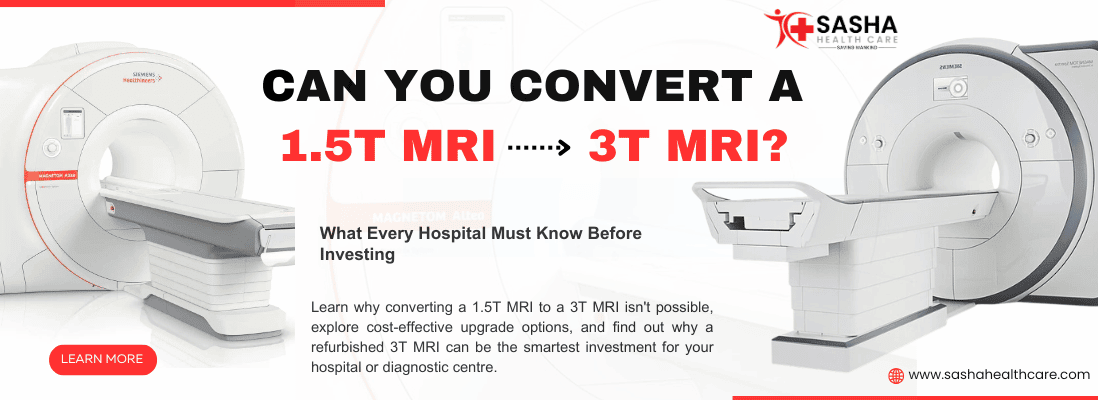
Can we convert a 1.5 T MRI to a 3T MRI?
Hospitals and diagnostic imaging centers are constantly looking for ways to improve imaging quality while maximizing their return on investment. As demand grows for advanced neurological, orthopedic, oncology, and cardiac imaging, many healthcare providers begin asking an important question:
Can we convert a 1.5T MRI to a 3T MRI?
At first glance, upgrading an existing MRI scanner appears to be a cost-effective alternative to purchasing a new machine. After all, if computers, CT scanners, and ultrasound systems can be upgraded with newer hardware and software, shouldn’t an MRI scanner be capable of the same transformation?
The answer, however, is more complex.
A true conversion from a 1.5 Tesla MRI to a 3 Tesla MRI is generally not possible because the magnetic field strength is determined by the scanner’s superconducting magnet, which is specifically designed and manufactured for either 1.5T or 3T operation.
That does not mean your existing MRI system has reached the end of its useful life. Many MRI components—including software, coils, workstations, RF hardware, and AI image reconstruction technologies—can often be upgraded to improve workflow, image quality, and clinical performance without changing the magnetic field strength.
Understanding what can and cannot be upgraded is essential before making a major investment decision. Choosing between an MRI upgrade and a replacement requires evaluating your clinical requirements, patient volume, infrastructure, available budget, and long-term operational goals.
This guide explains the technical reasons why a Convert 1.5T MRI to 3T MRI project is not feasible, explores realistic upgrade options, compares costs, and helps hospitals determine the most practical path forward.
What Does MRI Field Strength Mean?
Before discussing whether a 1.5 Tesla MRI can become a 3 Tesla MRI, it is important to understand what MRI field strength actually represents.
MRI scanners generate extremely powerful magnetic fields that align hydrogen atoms inside the human body. Radiofrequency pulses temporarily disturb this alignment, and when the atoms return to their original state, they emit signals that are processed into detailed medical images.
The strength of this magnetic field is measured in Tesla (T).
Common MRI field strengths include:
| MRI Type | Magnetic Field Strength |
|---|---|
| Low-field MRI | 0.2T–0.5T |
| Mid-field MRI | 1.0T |
| Standard Clinical MRI | 1.5T |
| High-field MRI | 3T |
| Ultra-high Research MRI | 7T and above |
Today, 1.5 Tesla and 3 Tesla MRI systems dominate modern clinical imaging because they provide an excellent balance between image quality, scanning speed, and diagnostic capability.
Why Field Strength Matters
Magnetic field strength directly influences several important imaging characteristics.
Signal-to-Noise Ratio (SNR)
A stronger magnetic field produces more signal from body tissues.
Higher signal means:
- clearer images
- improved tissue contrast
- better visualization of small structures
- greater diagnostic confidence
A 3T MRI generally delivers nearly twice the signal compared with a 1.5T MRI, although the exact improvement depends on the examination and imaging protocol.
Image Resolution
Higher signal allows radiologists to obtain:
- thinner image slices
- finer anatomical detail
- higher spatial resolution
- improved visualization of tiny lesions
This becomes especially valuable in neurological imaging, musculoskeletal examinations, and vascular studies.
Faster Scan Times
Because more signal is available, technologists can often shorten scan times while maintaining image quality.
Benefits include:
- improved patient comfort
- higher daily patient throughput
- reduced motion artifacts
- better operational efficiency
Advanced Clinical Applications
Certain specialized imaging techniques perform exceptionally well on 3 Tesla systems, including:
- Functional MRI (fMRI)
- MR Spectroscopy
- Diffusion Tensor Imaging (DTI)
- High-resolution neuroimaging
- Small joint imaging
- Advanced cardiac MRI
However, higher field strength is not always better for every clinical situation, as discussed later in this guide.
Understanding a 1.5 Tesla MRI System
For more than three decades, the 1.5 Tesla MRI has remained the global clinical standard.
Thousands of hospitals continue to rely on 1.5T systems because they offer excellent diagnostic performance across a broad range of applications.
Advantages of a 1.5T MRI
Excellent Diagnostic Accuracy
A modern 1.5T MRI provides outstanding images for:
- Brain
- Spine
- Abdomen
- Pelvis
- Knee
- Shoulder
- Hip
- Breast
- Cardiac imaging
- Whole-body imaging
For many routine clinical examinations, image quality is more than sufficient for accurate diagnosis.
Lower Purchase Cost
Compared with 3T systems, 1.5 Tesla MRI scanners typically require:
- lower initial investment
- reduced installation expenses
- lower operating costs
- lower service costs
This makes them highly attractive for community hospitals and diagnostic centers.
Reduced Imaging Artifacts
Some MRI artifacts become more pronounced at higher magnetic field strengths.
A 1.5T scanner often experiences fewer issues related to:
- susceptibility artifacts
- dielectric effects
- metal implants
- field inhomogeneity
As a result, many imaging specialists continue to prefer 1.5T systems for patients with orthopedic implants or certain medical devices.
Better Implant Compatibility
Many implanted medical devices have historically been tested and approved specifically for imaging at 1.5 Tesla.
Although compatibility with 3T systems continues to improve, 1.5T MRI remains the preferred option for numerous implanted devices.
Common Clinical Applications
A 1.5T MRI is commonly used for:
- Neurology
- Orthopedics
- Spine imaging
- Abdominal imaging
- Pelvic imaging
- Oncology
- Breast MRI
- Musculoskeletal imaging
- Pediatric imaging
- Cardiac imaging
Limitations of a 1.5 Tesla MRI
Despite its versatility, a 1.5T MRI has some limitations.
These include:
- Lower signal-to-noise ratio than 3T
- Longer scan times for certain protocols
- Reduced visualization of very small lesions
- Lower spatial resolution in advanced neuroimaging
- Less efficient for some research applications
Hospitals with increasing demand for advanced imaging may therefore consider investing in a 3T system.
Understanding a 3 Tesla MRI System
A 3 Tesla MRI uses a magnetic field that is approximately twice as strong as a 1.5 Tesla system.
This increased field strength provides significantly higher signal, enabling superior image quality for many specialized clinical applications.
Higher Signal Strength
One of the greatest advantages of 3T MRI is its higher signal-to-noise ratio.
This additional signal can be used to achieve:
- higher image resolution
- thinner slices
- faster scans
- improved tissue characterization
- enhanced diagnostic confidence
Better Resolution
Radiologists often prefer 3T MRI for detecting subtle abnormalities.
Examples include:
- Multiple sclerosis plaques
- Tiny brain tumors
- Pituitary lesions
- Inner ear pathology
- Small ligament tears
- Cartilage damage
Faster Imaging
A stronger magnetic field can reduce overall examination time while maintaining image quality.
This provides:
- shorter appointments
- increased patient comfort
- higher patient throughput
- improved scheduling efficiency
Advanced Specialty Imaging
3T MRI excels in several demanding clinical specialties.
These include:
Neurology
Ideal for:
- epilepsy evaluation
- stroke imaging
- brain tumor assessment
- neurodegenerative disorders
Orthopedics
Provides exceptional visualization of:
- cartilage
- ligaments
- tendons
- small joints
- sports injuries
Cardiac Imaging
Offers improved temporal and spatial resolution for many cardiac MRI protocols, although image quality can depend on patient-specific factors and scanner optimization.
Research
Many academic hospitals use 3T MRI for:
- neuroscience research
- oncology studies
- cognitive imaging
- functional MRI
- advanced spectroscopy
Can You Convert a 1.5T MRI into a 3T MRI?
The Short Answer
No.
A true conversion from a 1.5 Tesla MRI to a 3 Tesla MRI is generally not technically or economically feasible.
The reason is straightforward:
The superconducting magnet defines the magnetic field strength of an MRI scanner.
Every major MRI manufacturer—including Siemens Healthineers, GE HealthCare, Philips, and Canon Medical—designs its 1.5T and 3T systems with fundamentally different magnet assemblies, gradient systems, RF chains, cryogenic requirements, shielding characteristics, and regulatory approvals.
Because of these engineering differences, simply replacing or “upgrading” the magnet is not comparable to swapping a component in a computer or installing new software. It would effectively require rebuilding the MRI scanner with a different architecture.
In practice, hospitals seeking the clinical capabilities of a 3T MRI typically choose one of two paths:
- Purchase a new 3T MRI system for the latest technology and warranty.
- Invest in a refurbished 3T MRI system, which can provide substantial cost savings while delivering high-quality clinical performance when sourced from a reputable supplier.
Why a 1.5T MRI Cannot Be Converted to a 3T MRI, Upgrade Options, and Cost Comparison
Why Can’t the Magnet Be Upgraded?
Many hospital administrators assume that converting a 1.5 Tesla MRI into a 3 Tesla MRI simply involves replacing the magnet. While this sounds logical, MRI engineering is far more complex.
The superconducting magnet is the foundation of the entire MRI system. Every major component—including gradients, radiofrequency (RF) hardware, cooling systems, shielding, power distribution, and software—is designed specifically for that magnet’s field strength.
Replacing only the magnet would require redesigning almost every critical subsystem. In practice, this would amount to building an entirely new MRI scanner rather than performing an upgrade.
Let’s examine why.
1. The Superconducting Magnet Determines the Field Strength
Unlike many medical devices, an MRI scanner cannot increase its magnetic field strength through software or calibration.
A 1.5T magnet is engineered to produce approximately 1.5 Tesla, while a 3T magnet is engineered to produce approximately 3 Tesla.
These magnets differ in:
- Coil design
- Wire winding configuration
- Superconducting materials
- Current requirements
- Mechanical structure
- Cooling characteristics
The magnet is manufactured and tested as a complete unit. It cannot simply be “boosted” to generate twice the magnetic field.
2. Cryogenic System Differences
Most conventional MRI systems use superconducting magnets cooled by liquid helium.
A 3T MRI generally has different cryogenic requirements than a 1.5T system, including:
- Different helium management
- Enhanced cooling performance
- Pressure control
- Cryostat design
- Quench protection systems
Even if a new magnet could be installed, the existing cryogenic infrastructure would often be incompatible.
3. Gradient System Compatibility
Gradient coils generate the rapidly changing magnetic fields required for image formation.
A 3T MRI typically requires gradients designed to operate within its specific magnetic environment.
Differences may include:
- Higher gradient performance
- Faster slew rates
- Improved cooling
- Different amplifier specifications
- Mechanical vibration control
A 1.5T gradient system may not meet the requirements of a 3T magnet.
4. RF System Compatibility
The radiofrequency (RF) subsystem is also field-strength specific.
At 3 Tesla:
- RF frequency doubles compared with 1.5T.
- RF amplifiers are different.
- RF transmitters differ.
- RF receivers differ.
- RF filters differ.
- Body coil design changes.
As a result, nearly the entire RF chain would require replacement.
5. Magnetic Shielding Requirements
Every MRI suite is designed around the magnetic field produced by the installed scanner.
Moving from 1.5T to 3T changes:
- Fringe field distribution
- Magnetic shielding
- Passive shielding
- Active shielding
- Room safety zones
The MRI room itself may require structural modifications before installing a higher-field system.
6. Electrical Infrastructure
Higher-performance MRI systems often require:
- Different power distribution
- Larger UPS capacity
- Updated transformers
- Additional cooling
- Enhanced HVAC systems
Hospitals may need facility upgrades before installing a 3T MRI.
7. Regulatory Approvals
Medical imaging systems receive regulatory approval as complete, integrated products.
Manufacturers obtain approvals based on the entire system, including:
- Magnet
- RF hardware
- Software
- Gradients
- Safety systems
- Patient table
- Clinical testing
Replacing the magnet would invalidate the original system certification and create significant regulatory and liability concerns.
8. Safety Considerations
MRI safety is one of the most important reasons why true field-strength conversion is not performed.
A higher magnetic field affects:
- Projectile risk
- RF heating
- Implant safety
- Acoustic noise
- SAR (Specific Absorption Rate)
- Patient monitoring protocols
Because these factors change with field strength, a converted scanner would require comprehensive validation and certification.
What Can Actually Be Upgraded?
Although a true Convert 1.5T MRI to 3T MRI project is not possible, many hospitals can significantly extend the life of their MRI system through modernization.
Manufacturers and specialized MRI service providers offer a variety of upgrade options that improve workflow, image quality, and user experience.
1. MRI Software Upgrade
Software upgrades are among the most cost-effective improvements.
Benefits include:
- Faster reconstruction
- New imaging sequences
- Improved workflow
- Enhanced user interface
- Better automation
- AI-assisted imaging (on supported platforms)
These upgrades can improve productivity without changing the magnetic field strength.
2. Coil Upgrades
Modern MRI coils often provide one of the biggest improvements in image quality.
Examples include:
- Head coils
- Knee coils
- Spine coils
- Cardiac coils
- Breast coils
- Body array coils
Advantages:
- Higher signal
- Better patient comfort
- Improved resolution
- Faster scans
3. AI Image Reconstruction
Many manufacturers now offer AI-powered reconstruction software.
Benefits include:
- Reduced scan times
- Lower image noise
- Sharper images
- Increased patient throughput
AI reconstruction can make an older 1.5T scanner perform more efficiently without altering its field strength.
4. Workstation Upgrades
New workstations improve:
- Image processing
- 3D visualization
- Reporting workflow
- PACS integration
- Post-processing speed
Radiologists often notice significant productivity gains after workstation modernization.
5. RF Hardware Upgrades
Depending on the MRI model, some RF components may be upgraded, such as:
- RF amplifiers
- Receiver channels
- Digital processing electronics
These enhancements can improve signal quality while preserving the existing magnet.
6. Gradient Improvements (Where Supported)
Some manufacturers offer limited gradient hardware upgrades for specific MRI models.
Potential benefits include:
- Faster imaging
- Improved diffusion imaging
- Better cardiac performance
- Enhanced advanced sequences
Availability depends on the manufacturer and scanner generation.
7. Patient Table Upgrade
A newer patient table may offer:
- Greater weight capacity
- Improved patient positioning
- Enhanced comfort
- Faster workflow
- Better safety features
MRI Upgrade vs MRI Replacement
Choosing between upgrading an existing scanner and purchasing a replacement depends on several factors.
Comparison Table
| Feature | MRI Upgrade | MRI Replacement |
|---|---|---|
| Initial Cost | Lower | Higher |
| Downtime | Short | Longer |
| Image Quality Improvement | Moderate | Significant |
| Field Strength | Unchanged | Can increase to 3T |
| Warranty | Limited | Full manufacturer warranty (new systems) |
| Technology | Improved | Latest generation |
| Expected Lifespan | Extended | New lifecycle |
| Clinical Capability | Moderate improvement | Major improvement |
| Future Expansion | Limited | Excellent |
| ROI | Good for suitable systems | Better for long-term growth |
Estimated Cost Comparison
Actual pricing varies by manufacturer, model, country, installation requirements, and service contracts. The ranges below are illustrative estimates.
| Upgrade Option | Estimated Cost (USD) |
|---|---|
| Software Upgrade | $20,000–$80,000 |
| Coil Upgrade | $15,000–$150,000 |
| AI Reconstruction Upgrade | $40,000–$200,000 |
| RF Hardware Upgrade | $50,000–$250,000 |
| Gradient Upgrade | $100,000–$400,000 |
| Major System Modernization | $250,000–$700,000 |
| Refurbished 3T MRI | $500,000–$1.2 Million |
| New 3T MRI | $1.5–$3.5+ Million |
Note: Prices vary by region, manufacturer, system configuration, import duties, and installation scope. Always request quotations from authorized manufacturers or reputable refurbishment companies.
When Should You Buy a New 3T MRI?
For some healthcare providers, replacing an older 1.5T MRI with a 3T system offers greater long-term value than investing in extensive upgrades.
A new or refurbished 3T MRI may be the better choice if your facility:
Performs Advanced Neurology
High-resolution brain imaging benefits from:
- Better lesion detection
- Improved white matter visualization
- Advanced diffusion imaging
- Functional MRI (fMRI)
- MR spectroscopy
Focuses on Oncology
Cancer centers often require:
- Improved soft tissue contrast
- Better tumor characterization
- High-resolution follow-up studies
Provides Sports Medicine Services
Orthopedic specialists benefit from:
- Superior cartilage imaging
- High-resolution ligament evaluation
- Better tendon visualization
- Small joint assessment
Has High Patient Volume
Faster imaging protocols can help facilities:
- Reduce waiting times
- Increase daily scan capacity
- Improve patient satisfaction
- Enhance operational efficiency
Supports Research Programs
Academic institutions often require:
- Functional MRI
- Advanced spectroscopy
- Research protocols
- High-resolution imaging
These applications frequently favor 3T systems.
When Does Keeping a 1.5T MRI Make Sense?
Despite the advantages of 3T MRI, a modern 1.5T system remains an excellent investment for many hospitals and imaging centers.
Keeping your current scanner may be the right decision if:
- Most examinations are routine clinical studies.
- The scanner is mechanically reliable.
- Recent software upgrades have improved performance.
- Patient volume does not justify a higher-capacity system.
- Budget constraints make replacement impractical.
- Your facility frequently scans patients with certain implants where 1.5T remains advantageous.
- Your return on investment is still strong.
In many community hospitals, diagnostic centers, and regional healthcare facilities, a well-maintained 1.5T MRI continues to provide excellent clinical value for years.
Common Myths About Converting a 1.5T MRI to a 3T MRI
There are several misconceptions surrounding MRI upgrades. Understanding the facts can help hospitals make informed investment decisions.
Myth 1: A 1.5T MRI Can Be Converted into a 3T MRI by Replacing the Magnet
Fact:
This is the most common misconception. The superconducting magnet is only one part of the MRI system. A true conversion would also require replacing the gradient system, RF hardware, cryogenic components, shielding, power systems, software, and safety certifications. In practice, this is equivalent to installing a completely new MRI scanner.
Myth 2: A Software Upgrade Can Increase MRI Field Strength
Fact:
Software can improve image reconstruction, workflow, and scanning efficiency, but it cannot change the physical magnetic field generated by the superconducting magnet.
Myth 3: A 3T MRI Is Always Better Than a 1.5T MRI
Fact:
Not necessarily. While 3T MRI offers higher signal and better resolution for many applications, 1.5T MRI remains the preferred choice in several situations, including imaging patients with certain implants, reducing susceptibility artifacts, and performing many routine clinical examinations.
Myth 4: Upgrading an Older MRI Is Always Cheaper Than Replacing It
Fact:
Minor upgrades are usually cost-effective. However, if an MRI scanner is more than 10–15 years old and requires extensive modernization, purchasing a refurbished or new 3T MRI may provide better long-term value.
Myth 5: Refurbished 3T MRI Systems Are Inferior
Fact:
A professionally refurbished MRI system from a reputable supplier can deliver excellent clinical performance. Quality refurbishment includes component testing, replacement of worn parts, software updates where available, calibration, and quality assurance before installation.
Expert Recommendations for Hospitals
Before investing in an MRI upgrade or replacement, consider the following:
Evaluate Your Clinical Needs
Assess the types of examinations your facility performs. Routine imaging may be well served by a modern 1.5T system, while advanced neurology, oncology, and research often benefit from 3T MRI.
Analyze Patient Volume
High patient throughput can justify the investment in faster, higher-performance systems.
Review the Age of Your Existing MRI
If your scanner is approaching the end of its expected service life, replacement may offer better reliability and lower maintenance costs than extensive upgrades.
Consider Total Cost of Ownership
Look beyond the purchase price. Include:
- Installation costs
- Service contracts
- Helium consumption
- Power requirements
- Downtime
- Spare parts availability
- Staff training
Work with Experienced MRI Specialists
Consult authorized manufacturers or trusted MRI equipment providers who can assess your existing system and recommend the most practical modernization strategy.
Conclusion
Many healthcare providers ask, “Can we convert a 1.5T MRI to a 3T MRI?” The simple answer is no. While MRI technology allows for significant upgrades in software, coils, AI reconstruction, and workflow, the scanner’s magnetic field strength is determined by its superconducting magnet and overall system design. Because of this, a true conversion from 1.5T to 3T is not technically or economically practical.
Instead of pursuing an impossible field-strength conversion, hospitals should focus on realistic modernization strategies. Upgrading a well-maintained 1.5T MRI can extend its useful life and improve efficiency, while replacing it with a new or refurbished 3T MRI may be the better choice for facilities requiring advanced clinical capabilities and higher patient throughput.
By carefully assessing clinical needs, infrastructure, budget, and long-term goals—and by working with experienced MRI equipment specialists—healthcare organizations can make informed investment decisions that deliver lasting value and high-quality patient care.
Planning to upgrade or replace your MRI system?
At Sasha Health Care, we help hospitals and diagnostic centres evaluate the most cost-effective MRI solutions. Whether you’re considering a software upgrade, modernizing your existing 1.5T scanner, or investing in a refurbished or new 3T MRI system, our experienced team can guide you through equipment selection, installation, site planning, testing, and after-sales support.
Contact Sasha Health Care today for expert consultation and discover the right MRI solution for your facility.
Suggested External References
For factual accuracy and credibility, reference authoritative sources where appropriate:
- U.S. Food and Drug Administration (FDA) – MRI safety and medical device guidance
- American College of Radiology (ACR) – MRI practice parameters and clinical guidance
- Radiological Society of North America (RSNA) – Educational resources and imaging research
- World Health Organization (WHO) – Healthcare technology and medical equipment guidance
- Manufacturer Documentation – Siemens Healthineers, GE HealthCare, Philips, Canon Medical
No. A true conversion is generally not possible because the superconducting magnet determines the scanner’s field strength, and changing it would require replacing most of the MRI system.
The decision depends on factors such as the scanner’s age, clinical requirements, patient volume, available budget, and long-term strategy. An equipment assessment by experienced MRI specialists can help determine the best option.
Typical price ranges are:
Refurbished 3T MRI: approximately USD 500,000–1.2 million
New 3T MRI: approximately USD 1.5–3.5+ million
Costs vary by manufacturer, configuration, country, installation requirements, and service agreements.
Yes. When purchased from a reputable supplier with proper refurbishment, testing, and warranty support, a refurbished 3T MRI can provide excellent value for hospitals seeking advanced imaging at a lower cost than a new system.