
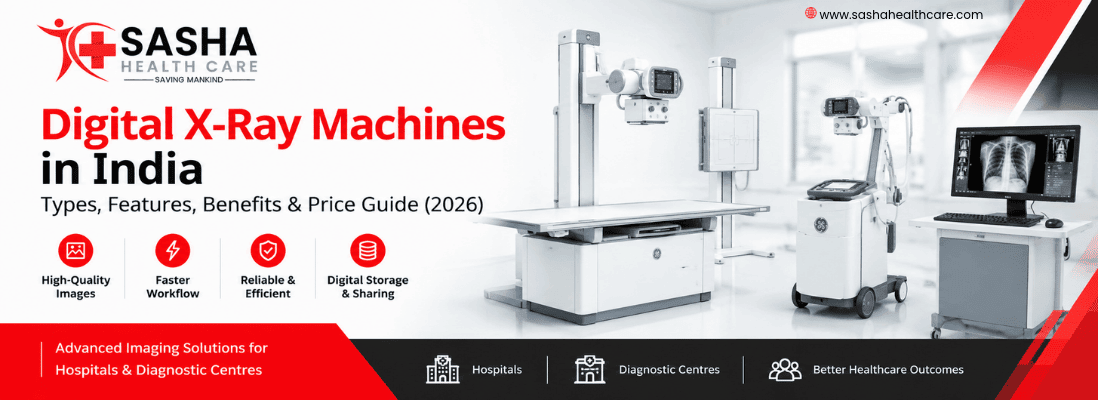
Digital X-Ray Machines in India: Types, Features, Benefits & Price Guide (2026)
Digital X-Ray machines have become an essential part of modern hospitals, diagnostic centres and healthcare facilities across India. With advancements in digital radiography (DR) technology, healthcare providers can obtain high-quality medical images, improve workflow efficiency and reduce the time required for image processing.
A Digital X-Ray Machine uses digital detector technology to capture and process X-ray images electronically. Unlike conventional film-based X-ray systems, digital radiography allows images to be viewed almost immediately on a computer workstation, making diagnosis and patient management more efficient.
Hospitals and diagnostic centres planning to upgrade their radiology departments increasingly consider Digital X-Ray machines because of their image quality, faster workflow, convenient image storage and integration with hospital information systems.
If you are planning to purchase a Digital X-Ray Machine in India, understanding its types, features, price, installation requirements and maintenance costs can help you make an informed investment decision.
What Is a Digital X-Ray Machine?
A Digital X-Ray Machine is a medical imaging system that uses electronic detectors instead of traditional photographic film to capture X-ray images of the human body.
The system converts X-ray energy into digital images that can be displayed on a workstation, stored electronically and shared with medical professionals.
Digital X-Ray systems are commonly used for:
- Chest and lung examinations
- Bone and joint imaging
- Spine examinations
- Orthopaedic imaging
- Abdominal examinations
- Emergency and trauma imaging
- General radiology investigations
Digital radiography is widely used in hospitals, diagnostic centres, medical colleges and multi-speciality healthcare facilities.
How Does a Digital X-Ray Machine Work?
A Digital X-Ray Machine works by passing controlled X-ray radiation through the patient’s body. Different tissues absorb different amounts of radiation, creating an image that is captured by a digital detector.
The basic working process includes:
- Patient positioning: The patient is positioned according to the required examination.
- X-ray exposure: The X-ray tube generates radiation that passes through the body.
- Image detection: A digital flat panel detector captures the transmitted X-rays.
- Image processing: The system converts detector signals into a digital image.
- Image display: The radiologist or technician views the image on a workstation.
- Image storage: Images can be stored and shared through PACS or compatible hospital information systems.
This process helps reduce image-processing delays and supports efficient radiology department operations.
Types of Digital X-Ray Machines
Digital X-Ray machines are available in different configurations depending on hospital requirements, patient volume and clinical applications.
1. Fixed Digital X-Ray Machine
Fixed Digital X-Ray machines are installed in dedicated radiology rooms. They are commonly used in hospitals and diagnostic centres that perform a high volume of routine X-ray examinations.
Key features include:
- Digital flat panel detector
- Motorised or manual positioning options
- Patient examination table
- Wall-mounted chest stand
- Digital image acquisition workstation
2. Portable Digital X-Ray Machine
Portable Digital X-Ray machines are designed for healthcare facilities that require flexible imaging solutions.
They are useful for:
- Intensive care units
- Emergency departments
- Bedside examinations
- Intensive patient monitoring
- Small healthcare facilities
3. Mobile Digital X-Ray System
Mobile Digital X-Ray systems are mounted on movable platforms and can be transported between hospital departments.
They are particularly useful in large hospitals, emergency care units and intensive care facilities where moving patients to the radiology department may be difficult.
Key Features of Digital X-Ray Machines
Before purchasing a Digital X-Ray Machine, hospital owners and diagnostic centre administrators should understand the important technical specifications.
Important features include:
- Flat Panel Detector (FPD): Captures X-ray images digitally.
- Image Resolution: Influences the visibility of anatomical details.
- Detector Size: Determines the imaging area and examination applications.
- Generator Power: Influences exposure capabilities and system configuration.
- Image Processing Software: Supports image enhancement and workflow.
- Workstation: Allows technicians to view and process images.
- PACS Connectivity: Enables digital image storage and sharing.
- DICOM Compatibility: Supports communication with compatible medical imaging systems.
- Radiation Dose Management: Supports appropriate exposure selection and optimisation.
Actual specifications vary depending on the manufacturer, model and configuration.
Benefits of Digital X-Ray Machines for Hospitals
Digital X-Ray technology provides several operational advantages compared with traditional film-based radiography.
1. Faster Image Availability
Digital detectors capture images electronically, allowing technicians to review images shortly after exposure.
2. Improved Workflow Efficiency
Digital image processing reduces the need for traditional film development and helps streamline radiology department operations.
3. Convenient Image Storage
Digital images can be stored electronically and retrieved when required, subject to the hospital’s data management systems.
4. Easy Image Sharing
With suitable PACS and DICOM connectivity, images can be shared with radiologists and other authorised healthcare professionals.
5. Reduced Film and Chemical Requirements
Digital radiography eliminates the need for conventional photographic film and chemical processing.
6. Flexible Hospital Applications
Digital X-Ray machines support multiple examinations, including chest, bone, spine and orthopaedic imaging.
Digital X-Ray vs Conventional X-Ray vs CR vs DR
Understanding the differences between these technologies is important when selecting radiology equipment.
| Feature | Conventional X-Ray | CR System | DR System |
|---|---|---|---|
| Technology | Film-based | Imaging plate | Digital flat panel detector |
| Image processing | Film development | CR reader | Electronic processing |
| Image availability | Delayed | After plate reading | Usually near-instant |
| Film requirement | Yes | No conventional film | No conventional film |
| Workflow | Manual | Semi-digital | Digital |
| Image storage | Physical films | Digital storage | Digital storage |
| Initial investment | Generally lower | Moderate | Generally higher |
Which is better: CR or DR?
DR systems generally offer a faster imaging workflow because images are captured directly using digital detectors. CR systems use imaging plates that must be processed through a reader before images become available.
The best option depends on budget, patient volume, workflow requirements and available infrastructure.
Digital X-Ray Machine Price in India (2026)
The price of a Digital X-Ray Machine in India depends on the detector technology, generator capacity, manufacturer, configuration, software, installation requirements and whether the equipment is new or refurbished.
Hospitals and diagnostic centres should compare the complete system cost rather than considering only the machine’s purchase price.
Digital X-Ray Machine Price Comparison Table
The following table provides indicative budget-planning estimates for different X-Ray system categories in India.
| X-Ray machine type | Indicative price range |
|---|---|
| Conventional X-Ray Machine | ₹5–12 lakh |
| Computed Radiography (CR) System | ₹8–15 lakh |
| Fixed Digital X-Ray (DR) Machine | ₹18–35 lakh |
| Portable Digital X-Ray Machine | ₹12–25 lakh |
| Mobile Digital X-Ray System | ₹20–40 lakh |
| Refurbished Digital X-Ray Machine | ₹8–20 lakh |
Note: These are indicative budget estimates, not verified current manufacturer quotations or fixed market prices. Actual prices may be outside these ranges depending on brand, model, detector specifications, generator capacity, equipment age, refurbishment quality, warranty, accessories, taxes, transportation and installation.
Factors Affecting Digital X-Ray Machine Price
Several factors influence the total investment required to purchase a Digital X-Ray Machine.
1. Detector Technology
The flat panel detector is one of the most important components. Detector type, size, resolution and performance can significantly influence equipment pricing.
2. Generator Capacity
The X-Ray generator’s power and technical configuration affect the machine’s capabilities and overall cost.
3. Brand and Manufacturer
Different manufacturers offer different configurations, software capabilities, service arrangements and warranty terms.
4. New vs Refurbished Equipment
New Digital X-Ray systems generally require a higher investment. Refurbished equipment can offer a more economical option when its technical condition, service history and warranty are properly evaluated.
5. Installation and Infrastructure
Electrical requirements, room preparation, radiation shielding, transportation and installation can add to the total project cost.
Additional Costs to Consider
Before finalising a purchase, hospitals should consider:
- Room preparation and radiation shielding
- Electrical and power requirements
- Computer workstation and software
- PACS integration, where required
- Transportation and installation
- Warranty and technical support
- Annual Maintenance Contract (AMC) or Comprehensive Maintenance Contract (CMC)
Requesting a detailed quotation helps buyers understand the complete investment.
New vs Refurbished Digital X-Ray Machines
Hospitals and diagnostic centres can choose between new and refurbished Digital X-Ray machines depending on their investment capacity and operational requirements.
| Comparison | New Digital X-Ray | Refurbished Digital X-Ray |
|---|---|---|
| Initial investment | Higher | Generally lower |
| Equipment condition | New | Previously used and refurbished |
| Warranty | Manufacturer or seller terms | Supplier-dependent |
| Availability | Depends on model | Depends on stock |
| Installation | Required | Required |
| Technical inspection | Before commissioning | Particularly important |
| Budget suitability | Higher investment | Cost-conscious buyers |
Is a refurbished Digital X-Ray Machine worth buying?
A refurbished Digital X-Ray Machine can be a cost-effective option for hospitals and diagnostic centres when purchased from a reliable supplier.
Before purchasing, verify the detector condition, X-Ray generator performance, image quality, software functionality, equipment history, availability of spare parts and warranty coverage.
Buyers should also request a demonstration and inspect the machine before finalising the transaction.
How to Choose the Right Digital X-Ray Machine for Your Hospital
Selecting the right Digital X-Ray Machine requires evaluating clinical requirements, patient volume, infrastructure and budget.
Consider the following factors:
- Patient volume: High-volume diagnostic centres may benefit from fixed DR systems with efficient workflows.
- Clinical applications: Identify whether the machine will primarily be used for chest, orthopaedic, spine or general radiography.
- Detector specifications: Compare detector size, technology, resolution and durability.
- Image quality: Evaluate actual clinical images and image-processing capabilities.
- Software compatibility: Check DICOM and PACS integration requirements.
- Infrastructure: Ensure the radiology room meets electrical and radiation protection requirements.
- Warranty and service: Understand the warranty, spare parts availability and technical support arrangements.
- Total ownership cost: Consider installation, maintenance, accessories and future operating expenses.
Choosing equipment based on long-term operational requirements can help hospitals achieve better value from their investment.
Why Choose Sasha HealthCare for Medical Imaging Equipment?
Sasha HealthCare is a medical imaging equipment supplier based in Hyderabad, India, supporting hospitals and diagnostic centres with medical equipment requirements.
The company deals in various medical imaging systems, including:
- MRI Machines
- CT Scan Machines
- Digital X-Ray Machines
- Cath Lab Systems
- C-Arm Machines
- Mammography Systems
- PET-CT Machines
- Ultrasound Machines
Sasha HealthCare also supports medical equipment projects through services such as installation and de-installation, transportation coordination, preventive maintenance, AMC and CMC, and technical support.
For hospitals considering a new or refurbished Digital X-Ray Machine, buyers can enquire about equipment availability, specifications, pricing and installation requirements.
Contact Sasha HealthCare
- Website: https://sashahealthcare.com/
- Email: info@sashahealthcare.com
- Phone/WhatsApp: +91 8009699599
- Location: Hyderabad, Telangana, India
Planning to purchase a Digital X-Ray Machine? Contact Sasha HealthCare to discuss your hospital’s requirements and explore suitable equipment options.
The indicative price of a fixed Digital X-Ray Machine in India can range from approximately ₹18 lakh to ₹35 lakh. Prices vary depending on detector specifications, generator capacity, brand, configuration and installation requirements.
Fixed DR systems are commonly suitable for hospitals with regular patient volumes and dedicated radiology departments. Mobile DR systems may be more suitable for bedside imaging and emergency departments.
CR systems use imaging plates that must be processed through a reader, whereas DR systems use digital flat panel detectors to capture images electronically, generally providing faster image availability.
Digital X-Ray machines offer faster image availability, convenient digital storage, easier image sharing, efficient workflow and reduced dependence on conventional photographic films.