
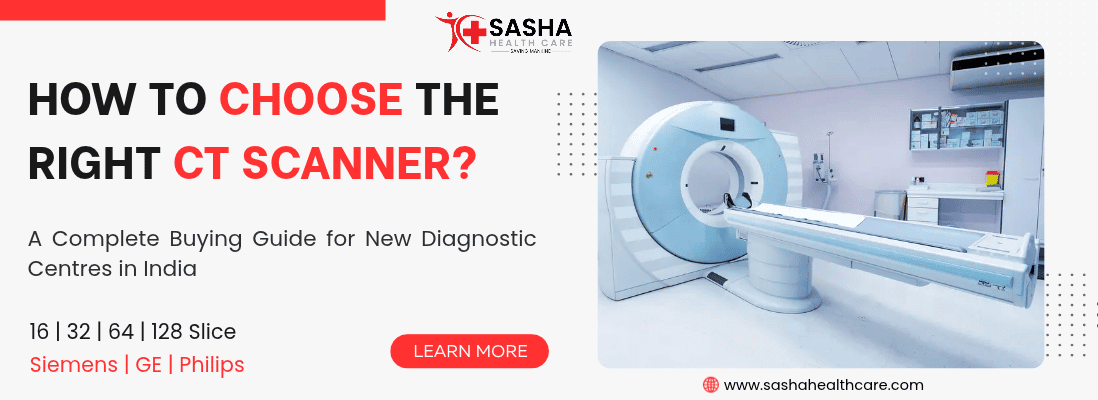
How to Choose a CT Scanner for a New Diagnostic Centre in India: Complete Buying Guide
Starting a new diagnostic centre is a significant investment in the healthcare industry. One of the most important decisions is selecting the right CT scanner that meets patient requirements, diagnostic needs, budget, and future business growth. Choosing the right CT scanner for a diagnostic centre can improve operational efficiency, support accurate imaging, and help build long-term relationships with referring doctors and hospitals.
However, with different scanner configurations, manufacturers, technologies, and pricing options available, selecting the right machine can be challenging.
In this guide, we explain how to choose a CT scanner for a new diagnostic centre in India, including slice configurations, leading brands, technical specifications, infrastructure requirements, pricing factors, and the benefits of purchasing refurbished CT scanners.
1. Understand Your Diagnostic Centre’s Requirements
Before purchasing a CT scanner, understand the clinical and business requirements of your diagnostic centre. The ideal CT scanner depends on the expected patient volume, types of examinations, available investment, and referral network.
Consider the following factors:
- Expected patient volume: Estimate the number of patients you expect daily.
- Types of examinations: Identify whether you will primarily perform routine CT scans, trauma imaging, angiography, or advanced cardiac studies.
- Location: Evaluate the demand for diagnostic imaging services in your target area.
- Referral network: Consider relationships with hospitals, physicians, radiologists, and specialists.
- Future expansion: Select equipment that can accommodate your expected growth.
For example, a diagnostic centre in a growing town with moderate patient volume may find a 16-slice or 32-slice CT scanner suitable for its initial requirements. A high-volume centre planning advanced imaging services may consider 64-slice or 128-slice systems.
The best choice should balance clinical requirements, affordability, and long-term business potential.
2. Choose the Right CT Scanner Slice Configuration
CT scanner slice configuration is one of the most important factors when purchasing imaging equipment. Different configurations support different imaging applications, scan speeds, and clinical requirements.
Here is a general comparison of popular CT scanner configurations.
| CT Scanner | Typical applications | Potential suitability |
|---|---|---|
| 16 Slice CT | Routine diagnostic imaging, brain, chest, abdomen | Small diagnostic centres |
| 32 Slice CT | Routine imaging and broader examination requirements | Growing diagnostic centres |
| 64 Slice CT | Advanced imaging, angiography and selected cardiac applications | Medium to high-volume centres |
| 128 Slice CT | Advanced imaging, cardiac CT and complex examinations | Large diagnostic centres and hospitals |
Actual capabilities depend on the scanner model, detector design, software, acquisition technology, and available applications. Slice count alone does not determine clinical performance.
16 Slice CT Scanner
A 16-slice CT scanner is commonly considered by smaller diagnostic centres and hospitals starting their imaging services.
It can support routine examinations such as:
- Brain CT
- Chest CT
- Abdomen and pelvis CT
- Bone and joint imaging
- Selected contrast-enhanced studies
It can be a practical starting option for facilities with moderate patient volumes and a focus on routine diagnostic imaging.
32 Slice CT Scanner
A 32-slice CT scanner offers additional imaging capabilities compared with many entry-level systems.
It may be suitable for diagnostic centres looking to expand their examination portfolio while maintaining a reasonable investment.
Before purchasing, evaluate its software capabilities, image reconstruction technology, detector specifications, and clinical applications.
64 Slice CT Scanner
A 64-slice CT scanner is widely considered by diagnostic centres and hospitals that require broader clinical applications.
Depending on the model and configuration, it can support:
- CT angiography
- Advanced chest and abdominal imaging
- Trauma imaging
- Selected cardiac CT examinations
- Detailed vascular studies
It can be a suitable option for centres planning to serve a larger referral network.
128 Slice CT Scanner
A 128-slice CT scanner is designed for facilities seeking advanced imaging capabilities.
Depending on the system, it may offer advanced cardiac imaging, faster acquisition, improved workflow, and sophisticated image reconstruction technologies.
It is worth considering for high-volume diagnostic centres and hospitals with advanced imaging requirements.
Buying tip: Do not select a CT scanner based only on its slice count. Compare the actual scanner model, detector configuration, software, clinical applications, tube condition, and reconstruction technology.
3. Evaluate CT Scanner Brands
Selecting a reliable manufacturer is another important part of purchasing a CT scanner. Different brands offer different technologies, software packages, scanner configurations, and service requirements.
Some established CT scanner manufacturers in India include:
Siemens Healthineers
Siemens offers CT scanner systems across different configurations, with technologies for routine and advanced diagnostic imaging. Evaluate the specific model, software, and available applications.
GE HealthCare
GE HealthCare offers CT systems designed for various clinical applications. Consider detector technology, image reconstruction, software availability, and serviceability.
Philips
Philips CT scanners are available in different configurations for routine and advanced imaging. Compare the specific system’s clinical capabilities and maintenance requirements.
When evaluating brands, consider:
- Availability of genuine spare parts.
- Software and application support.
- Equipment service history.
- Technical support availability.
- Compatibility with your diagnostic workflow.
The right model matters more than choosing a brand name alone.
4. New vs Refurbished CT Scanner: Which Is Better?
One of the biggest decisions for a new diagnostic centre is whether to purchase a new or refurbished CT scanner.
Both options have advantages depending on the available budget and business requirements.
| Factor | New CT Scanner | Refurbished CT Scanner |
|---|---|---|
| Initial investment | Generally higher | Generally lower |
| Equipment condition | New equipment | Depends on refurbishment and inspection |
| Technology | Latest available configuration | Depends on model and manufacturing year |
| Budget flexibility | May require higher capital | Can offer more affordable options |
| Warranty | Manufacturer or supplier terms | Depends on supplier agreement |
| Availability | Depends on manufacturer delivery | Depends on available inventory |
Benefits of refurbished CT scanners
A refurbished CT scanner can be a practical investment for diagnostic centres that want to establish imaging services with controlled capital expenditure.
Potential benefits include:
- Lower initial equipment investment.
- Access to established manufacturers and models.
- More flexibility in selecting scanner configurations.
- Opportunity to allocate additional funds towards infrastructure and operations.
However, buyers should verify the equipment’s condition, manufacturing year, tube usage, service history, software licenses, refurbishment scope, and warranty terms before purchasing.
A professionally inspected and appropriately refurbished CT scanner can be considered when it meets the centre’s clinical and operational requirements.
5. Understand CT Scanner Price and Investment in India
The CT scanner machine price in India varies significantly depending on its configuration, manufacturer, model, condition, and technical specifications.
There is no single price applicable to all CT scanners.
The major factors affecting CT scanner prices include:
- Slice configuration: Different configurations have different technical capabilities and investment requirements.
- Brand and model: Siemens, GE, and Philips systems differ in specifications and pricing.
- Manufacturing year: Equipment age can influence market value.
- Tube condition: Tube usage, remaining life, and replacement requirements affect ownership costs.
- Software packages: Advanced applications and licensed software can influence the overall investment.
- Installation costs: Transportation, installation, commissioning, and infrastructure expenses should be considered.
- Warranty and support: Supplier warranty and maintenance arrangements influence total ownership costs.
Before finalizing a purchase, request a detailed quotation covering the equipment, installation, applicable taxes, warranty, and after-sales support.
6. Check Important CT Scanner Technical Specifications
Technical specifications help buyers understand the actual performance and capabilities of a CT scanner.
Before purchasing, review these important parameters:
| Specification | Why it matters |
|---|---|
| Gantry aperture | Patient comfort and positioning |
| Detector technology | Image acquisition capabilities |
| X-ray tube | Scan performance and operating condition |
| Rotation time | Acquisition speed |
| Image reconstruction | Image quality and processing |
| Dose optimization | Radiation dose management |
| Software applications | Available clinical examinations |
| Workstation | Image processing and reporting workflow |
Ask the supplier for the original equipment specifications and available technical documentation.
For refurbished CT scanners, request a demonstration and verify that the major components are functioning correctly.
7. Evaluate Space and Infrastructure Requirements
A CT scanner requires proper infrastructure before installation. Planning the room and supporting facilities in advance can help avoid unnecessary project delays.
Important infrastructure requirements include:
- CT scanner room: Adequate space for equipment installation and patient positioning.
- Electrical supply: Appropriate power capacity, grounding, and electrical protection.
- HVAC: Suitable temperature and humidity control.
- Radiation shielding: Shielding designed according to applicable radiation safety requirements.
- Patient preparation area: Space for patient registration, preparation, and observation where required.
- Control room: A suitable area for the CT operator and imaging workstation.
In India, buyers must also consider applicable Atomic Energy Regulatory Board (AERB) requirements, including relevant approvals, licensing, and radiation safety provisions.
Consult qualified professionals and the relevant authorities before finalizing the CT scanner room design.
8. Consider Installation and Maintenance Requirements
Installation and after-sales support are important for uninterrupted diagnostic centre operations.
Before purchasing a CT scanner, confirm that the supplier can coordinate the required installation and technical support.
Important services to consider include:
- CT scanner transportation and installation.
- Equipment testing and commissioning.
- Preventive maintenance.
- Breakdown maintenance.
- Genuine spare parts availability.
- Technical support.
- Annual Maintenance Contract (AMC) or Comprehensive Maintenance Contract (CMC), where available.
Also check the availability and cost of critical components such as X-ray tubes and detector-related parts.
A reliable maintenance arrangement can help reduce unexpected downtime and support long-term equipment performance.
9. How to Choose a Reliable CT Scanner Supplier in India
Selecting the right CT scanner supplier is just as important as selecting the equipment.
A reliable supplier should provide transparent equipment details, technical information, and support throughout the purchase and installation process.
Before choosing a supplier, consider the following:
1. Verify equipment details: Check the manufacturer, model, manufacturing year, configuration, and technical specifications.
2. Request equipment inspection: Review the machine condition and available testing reports.
3. Understand warranty terms: Confirm what components and services are covered.
4. Check installation support: Discuss transportation, site readiness, installation, and commissioning arrangements.
5. Confirm spare parts availability: Ensure that essential components can be sourced when required.
6. Evaluate after-sales support: Understand the supplier’s maintenance capabilities and technical response arrangements.
Why Consider Sasha HealthCare?
Sasha HealthCare provides medical imaging equipment solutions for hospitals and diagnostic centres across India.
For healthcare facilities planning to purchase CT scanners, Sasha HealthCare offers equipment sourcing solutions focused on helping buyers evaluate suitable machine options based on their requirements.
Whether you are establishing a new diagnostic centre or expanding an existing imaging facility, selecting the right equipment and supplier can make an important difference to your investment.
Explore: Sasha HealthCare – Medical Imaging Equipment Supplier
10. Common Mistakes to Avoid When Buying a CT Scanner
First-time diagnostic centre investors should avoid these common purchasing mistakes:
- Choosing a CT scanner based only on its purchase price.
- Selecting a higher slice configuration without assessing actual patient demand.
- Ignoring X-ray tube condition and replacement costs.
- Not checking software licenses and available applications.
- Overlooking installation and infrastructure expenses.
- Purchasing refurbished equipment without proper inspection.
- Ignoring warranty and after-sales support.
- Not evaluating future spare parts availability.
A detailed technical and financial evaluation before purchasing can help prevent unnecessary expenses.
Conclusion
Choosing the right CT scanner for a new diagnostic centre requires careful consideration of clinical requirements, patient volume, scanner configuration, equipment condition, budget, infrastructure, and after-sales support.
A 16-slice or 32-slice CT scanner may suit centres focusing on routine imaging, while 64-slice and 128-slice systems may be appropriate for facilities planning broader and more advanced imaging services.
Both new and refurbished CT scanners can be considered depending on investment capacity and operational requirements. The important thing is to evaluate the actual machine specifications, condition, warranty, and technical support before making a decision.
Planning to establish a new diagnostic centre or upgrade your existing imaging facility?
Contact Sasha HealthCare to discuss your CT scanner requirements and explore suitable medical imaging equipment options.