
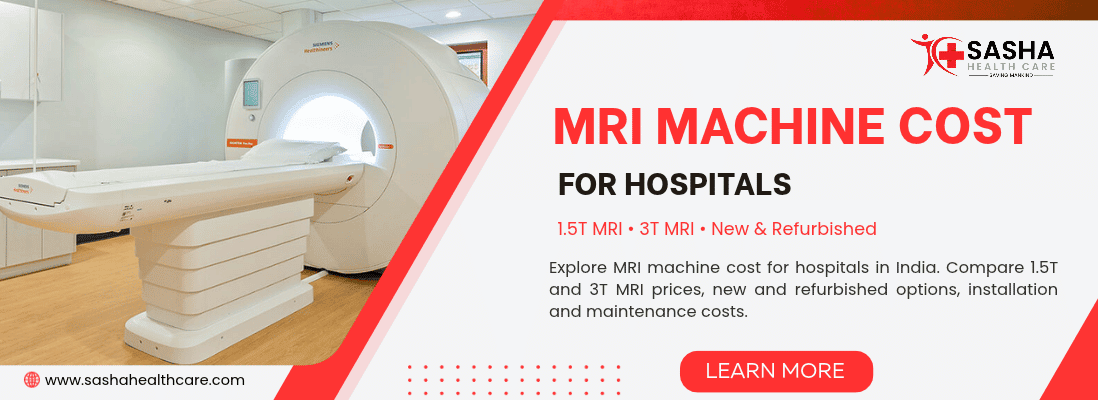
MRI Machine Cost for Hospitals in India – Complete Buying Guide
Investing in an MRI machine is an important decision for hospitals planning to expand their diagnostic imaging capabilities. Understanding the MRI machine cost for hospitals in India helps hospital owners, administrators, radiologists and healthcare investors make informed purchasing decisions.
The price of an MRI machine depends on several factors, including magnetic field strength (1.5 Tesla or 3 Tesla), manufacturer, technology, equipment condition, software applications and installation requirements.
Hospitals can consider new MRI machines or refurbished MRI equipment depending on their clinical requirements and investment budget. Apart from the equipment purchase price, hospitals should also evaluate installation, infrastructure, maintenance and operational expenses.
In this guide, we explain MRI machine prices, different Tesla options, popular brands, installation expenses and important factors hospitals should consider before purchasing an MRI machine.
How Much Does an MRI Machine Cost for a Hospital in India?
The MRI machine cost for a hospital in India varies depending on whether the hospital purchases new or refurbished equipment. Magnetic field strength, brand, model year, software configuration and equipment condition also influence the final price.
Generally, refurbished MRI machines can provide hospitals with an opportunity to acquire established imaging technology at a lower initial investment than comparable new equipment.
The following table provides an indicative comparison of MRI equipment categories.
MRI Machine Price Comparison in India
| MRI Machine Category | Magnetic Strength | Price Range |
|---|---|---|
| Refurbished MRI Machine | 1.5 Tesla | ₹1.5–4 crore |
| Refurbished MRI Machine | 3 Tesla | ₹3–6 crore |
| New MRI Machine | 1.5 Tesla | ₹4–7 crore |
| New MRI Machine | 3 Tesla | ₹7–12+ crore |
Note: These are broad illustrative budgeting estimates, not verified live market quotations. Actual prices may vary significantly depending on brand, model, configuration, equipment condition, accessories, taxes and installation scope. Obtain a supplier quotation before making investment decisions.
Hospitals should compare the complete project investment rather than evaluating equipment purchase price alone.
MRI Machine Price Based on Tesla Strength
MRI machines are available with different magnetic field strengths. The most commonly considered options for hospitals are 1.5 Tesla and 3 Tesla MRI systems.
The selection depends on the hospital’s clinical requirements, patient volume, available infrastructure and budget.
1.5 Tesla MRI Machine Cost for Hospitals
A 1.5T MRI machine is a popular choice for multi-specialty hospitals and diagnostic imaging centres because it supports a wide range of routine and advanced clinical examinations.
Common applications include:
- Brain and spine imaging
- Musculoskeletal imaging
- Abdominal MRI
- Pelvic imaging
- Cardiac MRI, with appropriate configurations
- Neurological examinations
- Joint and soft tissue imaging
Hospitals considering refurbished Siemens, GE or Philips 1.5T MRI machines should evaluate system condition, gradient performance, software availability, coil configuration and service support.
A refurbished 1.5T MRI machine may be a suitable investment for hospitals looking to establish or expand MRI services while managing capital expenditure.
3 Tesla MRI Machine Cost for Hospitals
A 3T MRI machine operates at a higher magnetic field strength and can offer advantages for selected advanced imaging applications.
Common applications include:
- Advanced neurological imaging
- High-resolution musculoskeletal imaging
- Functional MRI (fMRI)
- Advanced vascular imaging
- Prostate imaging
- Research and specialized clinical applications
However, 3T MRI systems may require a higher initial investment and more detailed infrastructure planning.
Hospitals should evaluate whether their patient volume, clinical requirements and specialist availability justify investing in a 3T MRI system.
New vs Refurbished MRI Machine Cost for Hospitals
One of the most important decisions when purchasing an MRI machine is choosing between new and refurbished equipment.
Both options have advantages, depending on the hospital’s financial plan and diagnostic requirements.
| Comparison Factor | New MRI Machine | Refurbished MRI Machine |
|---|---|---|
| Initial investment | Generally higher | Generally lower |
| Equipment condition | New equipment | Depends on refurbishment quality |
| Technology | Latest available configuration | Depends on model and upgrade history |
| Warranty | Manufacturer/supplier terms | Supplier-specific terms |
| Spare parts | Depends on model | Depends on model and availability |
| Installation | Required | Required |
| Maintenance | AMC/CMC options | AMC/CMC options, subject to coverage |
| Budget suitability | Higher capital budget | Cost-conscious investment |
Benefits of Refurbished MRI Machines
Refurbished MRI machines can be an attractive option for hospitals seeking to control initial equipment investment.
Key benefits include:
- Lower initial purchase cost compared with equivalent new systems.
- Access to established MRI technology.
- Availability of different magnetic field strengths.
- Potentially faster procurement depending on equipment availability.
- Opportunity to expand imaging services within a planned budget.
However, hospitals should not select refurbished equipment based on price alone.
Before purchasing, evaluate equipment history, refurbishment documentation, system performance, software compatibility, available coils, warranty, spare parts and technical service support.
Popular MRI Machine Brands for Hospitals
Several international manufacturers offer MRI systems used in hospitals and diagnostic centres across India.
The right brand depends on clinical applications, available budget, technology requirements and long-term service considerations.
Siemens Healthineers
Siemens Healthineers offers MRI systems across different field strengths and clinical applications.
Hospitals evaluating refurbished Siemens MRI machines can consider models such as MAGNETOM Essenza, Avanto and other available configurations.
GE HealthCare
GE HealthCare provides MRI systems designed for different hospital and diagnostic imaging requirements.
Hospitals should evaluate available SIGNA models based on imaging applications, system specifications and serviceability.
Philips
Philips offers MRI technology for routine and advanced diagnostic applications.
When evaluating Philips MRI equipment, hospitals should consider available configurations, coils, software and installation requirements.
Canon Medical Systems
Canon Medical Systems provides MRI solutions for different clinical requirements.
Hospitals should compare the technical specifications and available support before finalizing their purchase.
Additional Costs Involved in MRI Machine Installation
Purchasing an MRI machine is only one part of establishing an MRI department. Hospitals must also prepare the required infrastructure and installation facilities.
The additional investment depends on the MRI model, site condition and project scope.
Important installation requirements include:
1. Site Planning and Infrastructure
The hospital needs adequate space for the MRI scanner, operator room, equipment room, patient preparation area and other supporting facilities.
2. RF Shielding
Radiofrequency shielding helps protect MRI imaging from external electromagnetic interference.
3. Magnetic Shielding
Magnetic shielding requirements depend on the scanner’s magnetic field, room layout and surrounding environment.
4. HVAC and Cooling Systems
MRI systems require suitable environmental conditions and cooling arrangements to maintain equipment performance.
5. Electrical Infrastructure
Hospitals must arrange suitable electrical supply, grounding and power protection according to manufacturer specifications.
6. Quench Pipe and Safety Infrastructure
For superconducting MRI systems, appropriate quench pipe arrangements and MRI safety provisions are important.
7. Transportation and Installation
MRI equipment transportation, positioning, installation, testing and commissioning require experienced technical coordination.
Hospitals should obtain a detailed project quotation covering the responsibilities of the equipment supplier and hospital infrastructure team.
MRI Machine Maintenance Cost for Hospitals
MRI machines require regular maintenance to maintain system performance and reduce unexpected equipment downtime.
Hospitals should plan maintenance expenses while preparing their MRI equipment investment budget.
Important maintenance services include:
- Preventive Maintenance: Regular inspection and maintenance of MRI equipment.
- Annual Maintenance Contract (AMC): Scheduled maintenance and agreed service coverage.
- Comprehensive Maintenance Contract (CMC): Maintenance coverage as defined in the contract, potentially including specified spare parts.
- Liquid Helium Filling and Top-Up: Required for applicable superconducting MRI systems depending on their design and helium management technology.
- Cold Head Replacement: Replacement of the cold head when required.
- Genuine Spare Parts: Availability of compatible and suitable replacement components.
- Breakdown Services: Technical assistance to diagnose and resolve equipment problems.
Maintenance costs vary according to MRI model, equipment age, service coverage, spare parts requirements and operating conditions.
Hospitals should compare AMC and CMC terms carefully before selecting a service provider.
How to Choose the Right MRI Machine for Your Hospital
Selecting the right MRI machine requires evaluating both clinical requirements and financial considerations.
Here are seven important factors hospitals should consider.
1. Hospital Patient Volume
Estimate the expected number of MRI examinations per day and future patient demand.
2. Clinical Requirements
Identify the examinations your radiology department plans to perform. Routine imaging requirements may differ from advanced neurological or specialized imaging needs.
3. 1.5T vs 3T Selection
Choose magnetic field strength according to clinical requirements, budget and specialist availability.
4. New vs Refurbished Equipment
Compare purchase price, system condition, available technology, warranty and long-term maintenance.
5. Infrastructure Availability
Evaluate room dimensions, RF shielding, electrical systems, HVAC and other installation requirements.
6. Technical Support
Check the availability of trained engineers, genuine spare parts and maintenance services.
7. Total Cost of Ownership
Consider equipment purchase, installation, maintenance, operating expenses and future upgrades.
A well-planned MRI investment can help hospitals expand diagnostic capabilities while managing long-term operating costs.
Why Choose Sasha HealthCare for MRI Machine Requirements?
Sasha HealthCare is a medical equipment supplier based in Hyderabad, India, supporting hospitals and diagnostic centres with medical imaging equipment solutions.
Sasha HealthCare focuses on refurbished medical imaging equipment and related technical services.
Our MRI Equipment and Services
- Refurbished MRI machine supply.
- Siemens, GE and Philips MRI equipment options, subject to availability.
- 1.5T and 3T MRI machine solutions.
- MRI transportation and installation coordination.
- MRI de-installation services.
- Preventive maintenance services.
- Annual Maintenance Contract (AMC).
- Comprehensive Maintenance Contract (CMC).
- Liquid helium filling and top-up services.
- MRI cold head replacement.
- Genuine MRI spare parts and technical support.
With Pan-India equipment supply capabilities, Sasha HealthCare works with hospitals and diagnostic centres looking for suitable medical imaging equipment solutions.
Whether you are establishing a new MRI department or upgrading an existing facility, selecting the right equipment and technical support partner is essential.
Explore: Sasha HealthCare – MRI Machine Supplier in India
Conclusion
Understanding the MRI machine cost for hospitals in India is essential before investing in diagnostic imaging equipment. Hospitals should evaluate magnetic field strength, manufacturer, equipment condition, infrastructure, installation expenses and maintenance requirements before making a purchase.
Both new and refurbished MRI machines can be considered depending on the hospital’s clinical requirements and available investment budget.
Choosing an experienced medical equipment supplier can also help hospitals coordinate equipment procurement, transportation, installation and ongoing technical support.
Planning to purchase an MRI machine for your hospital?
Contact Sasha HealthCare to explore refurbished Siemens, GE and Philips MRI machine options, including 1.5T and 3T systems.
MRI machine prices vary depending on field strength, manufacturer, model and equipment condition. Refurbished systems generally require a lower initial investment than comparable new systems. Hospitals should obtain quotations based on their specific requirements.
The indicative budgeting range for a refurbished 1.5T MRI machine may be approximately ₹1.5–4 crore. The final price depends on brand, model, configuration, condition and installation scope.
A refurbished 3T MRI system may have an indicative budgeting range of ₹3–6 crore. Actual prices depend on system specifications, refurbishment quality and available accessories.
A 1.5T MRI system is suitable for many routine and advanced diagnostic applications. A 3T system can provide advantages for selected advanced imaging applications. The right choice depends on clinical requirements and investment capacity.
Hospitals should verify equipment history, refurbishment quality, magnet condition, gradient performance, software, coils, warranty, spare parts availability and technical service support.