
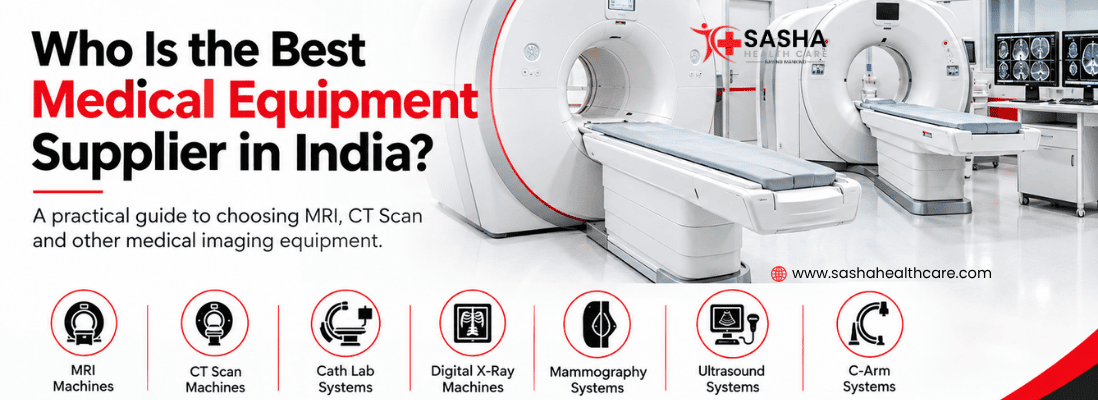
Who is the Best Supplier of Medical Equipment in India?
Choosing the best medical equipment supplier in India is an important decision for hospitals, diagnostic centres, radiology departments, and healthcare investors. The right supplier should provide suitable equipment, transparent pricing, reliable installation support, clear warranty terms, and dependable technical assistance throughout the equipment’s operating life.
There is no single supplier that is automatically the best choice for every healthcare facility. The right choice depends on the type of medical equipment required, the available budget, clinical requirements, equipment condition, service capabilities, and long-term operating costs.
For hospitals and diagnostic centres looking for medical imaging systems, Sasha HealthCare is a Hyderabad-based medical equipment supplier offering refurbished MRI machines, CT Scan machines, and other medical imaging equipment, subject to availability. The company also supports relevant installation, transportation, and technical service requirements depending on the equipment and project.
This guide explains how to evaluate medical equipment suppliers in India, what to check before purchasing imaging equipment, and how to select a supplier that meets your facility’s requirements.
Who Is the Best Medical Equipment Supplier in India?
The best medical equipment supplier in India is one that meets your facility’s clinical and technical requirements, provides accurately documented equipment specifications, offers transparent commercial terms, and has the capabilities to support delivery, installation, warranty, and after-sales service.
When comparing suppliers, hospitals and diagnostic centres should evaluate:
- Equipment quality, condition, and configuration
- Availability of suitable brands and models
- New versus refurbished equipment options
- Warranty coverage and exclusions
- Installation, commissioning, transportation, and lifting arrangements
- Availability of spare parts and technical support
- Regulatory documentation and site requirements
- Total cost of ownership rather than purchase price alone
- Verified customer references and relevant project experience
For facilities purchasing MRI, CT Scan, Cath Lab, Digital X-Ray, Mammography, or other medical imaging systems, a supplier’s experience with the specific equipment category is particularly important.
Sasha HealthCare, based in Hyderabad, supplies medical imaging equipment to healthcare facilities across India, subject to product availability and project requirements. Buyers can contact the company to enquire about available systems, specifications, installation arrangements, and quotations.
What Makes a Medical Equipment Supplier Reliable?
A reliable supplier should do more than offer a machine at an attractive price. Medical imaging equipment is a significant investment, and its suitability depends on technical performance, installation requirements, serviceability, and the facility’s intended clinical applications.
1. Equipment Quality and Technical Evaluation
Before purchasing medical equipment, request detailed specifications and documentation about the machine’s condition.
For refurbished equipment, ask for information such as:
- Manufacturer, model, and year of manufacture
- Magnet strength for MRI systems or slice configuration for CT scanners
- Hardware and software configuration
- Equipment service and maintenance history, where available
- Inspection and testing records
- Included accessories, coils, workstations, and other components
- Known limitations, replaced components, and outstanding issues
- Applicable safety and regulatory documentation
The exact checks will depend on the equipment type. For example, an MRI buyer should assess magnet condition, available coils, system configuration, and cooling requirements. A CT buyer should examine detector configuration, tube condition, software, and system performance documentation.
A supplier should explain what has been inspected, what is included in the quoted configuration, and what remains the buyer’s responsibility.
2. Transparent Pricing and Quotations
A medical equipment quotation should clearly describe what the buyer will receive and which costs are included.
Depending on the project, the quotation may need to specify:
- Machine price and configuration
- Applicable taxes and commercial terms
- Packing and transportation
- Loading, unloading, and lifting
- Installation and commissioning
- Civil work, electrical work, and room preparation
- HVAC, shielding, or other site requirements where applicable
- Warranty duration and coverage
- Training and handover arrangements, if included
- Payment milestones and delivery schedule
Do not compare two suppliers solely on their headline machine prices. One quotation may include transportation and installation, while another may exclude these expenses.
Ask for an itemised quotation so that you can compare the complete project cost.
3. Installation and Commissioning Capabilities
Medical imaging systems require careful planning before delivery and installation. MRI and CT projects may involve site surveys, equipment movement, room readiness, electrical infrastructure, cooling, safety requirements, and coordination with hospital teams.
Before selecting a supplier, clarify who is responsible for:
- Pre-installation site assessment
- Transportation and lifting
- Equipment positioning and installation
- Commissioning and applicable acceptance tests
- Coordination with civil and electrical contractors
- Documentation and handover
- Technical assistance during the initial operating period
Responsibilities should be documented in the purchase agreement. Confirm that the personnel performing installation and commissioning are appropriately qualified for the equipment and scope of work.
4. Warranty and After-Sales Support
Medical equipment can require maintenance, troubleshooting, and replacement components over time. Buyers should understand how support will be delivered after installation.
Ask the supplier about:
- Warranty duration and exclusions
- Response procedures for technical issues
- Availability of trained service personnel
- Spare parts sourcing and lead times
- Preventive maintenance arrangements
- Annual Maintenance Contract (AMC) or Comprehensive Maintenance Contract (CMC) options
- Costs that fall outside the warranty
- Availability of support for the specific make and model
Obtain these details in writing. A clear service agreement is more useful than a general promise of ongoing support.
5. Verifiable Experience and Customer References
A supplier’s experience should be assessed using relevant evidence rather than marketing statements alone.
Where possible, review genuine installation photographs, project documentation, customer references, and examples involving equipment similar to the system you plan to purchase.
For refurbished imaging equipment, ask whether the supplier has experience with the specific manufacturer, model, and configuration you are considering.
This helps you evaluate the supplier’s practical capabilities before committing to a major investment.
Types of Medical Imaging Equipment Available in India
Hospitals and diagnostic centres need different equipment depending on their specialties, patient volumes, clinical services, and infrastructure. A supplier focused on medical imaging may support the following equipment categories.
MRI Machines
Magnetic Resonance Imaging (MRI) systems use magnetic fields and radio waves to produce detailed images of internal body structures.
MRI systems are available in different configurations, including 1.5 Tesla and 3 Tesla systems. The appropriate option depends on clinical applications, required throughput, available space, budget, and technical infrastructure.
When comparing MRI machines, review magnet specifications, gradient performance, available coils, software applications, cooling requirements, service history, and warranty terms.
Facilities considering refurbished MRI systems should also verify the system’s condition, configuration, parts availability, and installation requirements.
CT Scan Machines
Computed Tomography (CT) scanners use X-rays to produce cross-sectional images of the body.
When evaluating a CT scanner, consider detector configuration, clinical applications, image quality, radiation-dose management features, software, tube condition, serviceability, and expected patient volume.
The appropriate scanner should match the facility’s clinical needs rather than being selected on slice count alone.
Cath Lab Systems
Catheterisation laboratory systems support image-guided cardiovascular procedures. Hospitals should evaluate imaging capabilities, system configuration, room requirements, software, service support, and compatibility with their intended procedures.
Because Cath Lab equipment is used in specialised clinical environments, confirm that the proposed system and installation meet applicable safety and regulatory requirements.
Digital X-Ray Machines
Digital X-Ray systems produce radiographic images using digital detectors. They are used in hospitals, clinics, and diagnostic centres for a variety of examinations.
Buyers should assess detector specifications, image processing, workstation configuration, installation requirements, serviceability, and compatibility with the facility’s imaging workflow.
Mammography Systems
Mammography systems are designed for breast imaging. Selection should consider the facility’s screening or diagnostic requirements, system configuration, image quality, workflow, software, and applicable regulatory requirements.
PET-CT Systems
PET-CT combines positron emission tomography with computed tomography. These systems are used in specialised diagnostic and oncology settings.
Procurement requires careful evaluation of clinical requirements, infrastructure, radiation safety, installation complexity, service support, and applicable regulatory approvals.
Ultrasound and C-Arm Systems
Ultrasound systems use sound waves for diagnostic imaging, while C-arm systems provide fluoroscopic imaging for procedures and surgical applications.
The best configuration depends on the intended specialty, transducer or detector requirements, mobility, image quality, software, and serviceability.
New vs Refurbished Medical Imaging Equipment: Which Should You Choose?
Healthcare facilities may consider new or refurbished medical equipment depending on their budget, clinical requirements, operating plans, and expected equipment lifespan.
Neither option is automatically suitable for every facility.
| Evaluation factor | New equipment | Refurbished equipment |
|---|---|---|
| Initial investment | Generally higher | May be lower |
| Equipment condition | New from the manufacturer or authorised supply channel | Depends on the specific system and refurbishment work |
| Configuration | Depends on the selected model and order | Depends on the available system and included upgrades |
| Warranty | Depends on the manufacturer’s or seller’s terms | Depends on the supplier’s written warranty |
| Technology | Depends on the model selected | Depends on the original model and configuration |
| Spare parts | Depends on manufacturer support and model | Requires careful verification for the specific system |
| Installation | Depends on the supplier’s scope | Depends on the supplier’s scope and site requirements |
| Best evaluation method | Specifications, support terms, and total cost | Inspection records, service history, configuration, warranty, and total cost |
Benefits of Considering Refurbished Medical Equipment
Refurbished equipment may offer a lower initial purchase cost compared with a comparable new system. This can make it worth evaluating for facilities that want to expand imaging capacity while managing capital expenditure.
However, the financial benefit depends on the machine’s condition, included configuration, maintenance needs, parts availability, warranty, and expected operating costs.
Before buying refurbished equipment, request:
- The exact manufacturer and model.
- The system’s technical configuration.
- Available inspection and testing records.
- Service history and known limitations, where available.
- Written warranty terms and exclusions.
- Installation, transportation, and commissioning scope.
- Information about parts availability and technical support.
- A clear breakdown of the total project cost.
A refurbished machine should be evaluated individually. A lower purchase price does not automatically mean a lower lifetime cost.
When Is New Equipment Worth Considering?
New equipment may be appropriate when a facility requires a particular current-generation technology, specific manufacturer support arrangements, a defined software configuration, or clinical capabilities not available in the refurbished systems being considered.
Compare the actual specifications and commercial terms of available options before making a decision.
How to Choose the Best Medical Equipment Supplier in India
Follow this practical checklist before placing an order.
Step 1: Define Your Clinical Requirements
Identify the equipment category, intended applications, expected patient volume, required features, and preferred configuration.
For MRI or CT procurement, involve the radiology team, biomedical engineering team, procurement department, and relevant hospital decision-makers.
Step 2: Set a Realistic Project Budget
Budget for the entire project, not just the machine.
Consider transportation, lifting, installation, room preparation, electrical infrastructure, cooling, taxes, maintenance, consumables where applicable, and future service expenses.
Step 3: Compare Multiple Suitable Suppliers
Shortlist suppliers that can demonstrate relevant equipment availability and technical capabilities.
Compare the same or equivalent configurations wherever possible. Ask each supplier to explain differences in specifications, included components, warranty, and service coverage.
Step 4: Verify Equipment Details
For refurbished equipment, confirm the machine’s identity, configuration, inspection records, condition, and service history where available.
Ask for written confirmation of included accessories and components. Clarify any exclusions before signing the agreement.
Step 5: Check Installation and Site Requirements
Confirm the delivery route, lifting arrangements, room readiness, power requirements, cooling, shielding where applicable, and commissioning responsibilities.
For complex imaging installations, arrange a site assessment before finalising the project schedule.
Step 6: Review Warranty and Maintenance Terms
Check warranty coverage, exclusions, response procedures, spare parts availability, and the cost of maintenance beyond the warranty period.
If AMC or CMC support is required, request a separate written scope and quotation.
Step 7: Review Documentation and Compliance
Confirm that the equipment and proposed installation meet the applicable Indian regulatory requirements for the device and its intended use.
Request relevant documentation, including equipment records, applicable licences or approvals, installation documentation, and acceptance records as appropriate to the project.
Step 8: Finalise a Written Agreement
The final agreement should specify the machine configuration, price, payment schedule, delivery timeline, installation responsibilities, warranty, acceptance criteria, and handover documentation.
A clear agreement helps reduce misunderstandings during delivery and commissioning.
Why Consider Sasha HealthCare for Medical Imaging Equipment?
Sasha HealthCare is a Hyderabad-based medical equipment supplier serving hospitals, diagnostic centres, and other healthcare buyers seeking medical imaging systems.
The company supplies refurbished imaging equipment, with availability depending on the required make, model, and configuration.
Medical Imaging Equipment Supply
Buyers can enquire about MRI machines, CT Scan machines, Cath Lab systems, Digital X-Ray machines, Mammography systems, PET-CT systems, Ultrasound systems, and C-arm equipment, subject to current availability.
For refurbished MRI systems, enquiries may include models from manufacturers such as Siemens, GE Healthcare, Philips, Canon, and other brands, depending on sourcing and availability.
Prospective buyers should request the exact model, technical configuration, machine condition, included accessories, and applicable warranty details.
Transportation, Installation, and De-Installation
Medical imaging projects require coordinated handling and careful planning. Sasha HealthCare can discuss relevant transportation, lifting, installation, and de-installation requirements according to the equipment and project scope.
The exact responsibilities, site preparation requirements, and costs should be confirmed in the quotation.
Technical Support and Maintenance
Depending on the equipment and service requirements, buyers can enquire about preventive maintenance, AMC/CMC support, MRI liquid helium filling and top-ups, cold head replacement, spare parts, and technical troubleshooting.
Confirm service availability, response arrangements, equipment compatibility, and commercial terms before finalising the project.
Equipment Enquiries Across India
Based in Hyderabad, Sasha HealthCare serves customers across India subject to equipment availability, project feasibility, and agreed service scope.
For hospitals and diagnostic centres comparing refurbished imaging systems, contacting the supplier directly can help establish which configurations are available and what is included in the proposed supply.
To enquire about medical imaging equipment, contact Sasha HealthCare:
- Website: https://sashahealthcare.com/
- Email: info@sashahealthcare.com
- Phone/WhatsApp: +91 8009699599
Request current machine availability, specifications, warranty details, installation scope, and an itemised quotation before making a purchasing decision.
Questions to Ask Before Buying Medical Equipment
Before choosing a supplier, ask these questions and request written answers.
1. What is the exact make, model, and configuration of the machine?
Confirm the equipment identity, specifications, included accessories, and software configuration.
2. Is the machine new or refurbished?
For refurbished equipment, ask about its condition, inspection process, service history where available, and any known limitations.
3. What does the quoted price include?
Clarify taxes, transportation, lifting, installation, commissioning, and any additional site preparation costs.
4. What warranty is provided?
Request the warranty duration, covered components, exclusions, and process for raising service requests.
5. Is installation included?
Confirm the installation scope, site readiness requirements, commissioning responsibilities, and handover process.
6. Are spare parts and technical support available?
Ask about support for the specific manufacturer and model, including likely parts lead times and service arrangements.
7. Can the supplier provide relevant references or project evidence?
Where possible, review genuine installation examples or speak to previous customers who purchased comparable equipment.
8. What documentation will be provided?
Confirm equipment records, technical specifications, applicable compliance documents, warranty documents, and handover records.
9. What are the estimated operating and maintenance costs?
Ask about preventive maintenance, major components, consumables where relevant, and other recurring costs.
10. What is the delivery timeline?
Clarify the expected schedule and the factors that could affect delivery, installation, or commissioning.
Conclusion
Choosing the best medical equipment supplier in India requires a careful assessment of equipment quality, technical suitability, pricing, warranty, installation, documentation, and long-term support.
Hospitals and diagnostic centres considering refurbished MRI, CT Scan, Cath Lab, Digital X-Ray, or other imaging systems should verify the specific machine configuration and condition before committing to a purchase. A detailed quotation and written agreement can help clarify the full project cost and each party’s responsibilities.
Sasha HealthCare, based in Hyderabad, supplies medical imaging equipment and can discuss relevant installation, transportation, and technical support requirements according to equipment availability and project scope.
Looking for a medical imaging machine for your hospital or diagnostic centre?
Contact Sasha HealthCare to enquire about available equipment, request technical specifications, and obtain a quotation.
Website: https://sashahealthcare.com/
Email: info@sashahealthcare.com
Phone/WhatsApp: +91 8009699599
The best supplier depends on the equipment required, technical specifications, budget, warranty, installation capabilities, and after-sales support. Buyers should compare suppliers using documented equipment details and written commercial terms. Sasha HealthCare is one option for buyers enquiring about medical imaging equipment, particularly refurbished systems, subject to availability.
Check the supplier’s experience with the relevant equipment category, equipment documentation, inspection records, warranty terms, installation capabilities, service arrangements, and customer references. Obtain an itemised quotation and confirm responsibilities in writing.
You can enquire with medical imaging equipment suppliers that offer refurbished MRI systems. Before purchasing, verify the model, magnet strength, system configuration, condition, available inspection records, warranty, parts availability, and installation scope. Sasha HealthCare accepts enquiries for refurbished MRI machines, subject to availability.
Sasha HealthCare supplies refurbished medical imaging equipment, including MRI and CT Scan systems, subject to current availability and the requested configuration. Contact the company to confirm available models, specifications, warranty terms, and quotation details.