
Search for:
Medical equipment manufacturers in India – CT, MRI, X-ray systems comparison
Which Company Makes Medical Equipment in India?

Which Company makes medical equipment in india? India has a strong and expanding medical equipment manufacturing ecosystem. The country produces diagnostic imaging systems, patient monitoring devices, surgical instruments, laboratory analyzers, and hospital infrastructure equipment.

Hospital owners and radiology entrepreneurs often ask:

“Which company makes medical equipment in India that meets global standards and Indian regulatory compliance?”

The answer includes a mix of Indian manufacturers and global companies with manufacturing bases in India.

This guide explains who manufactures what, price ranges, compliance requirements, and what healthcare decision-makers should evaluate before purchase.

Which Company Makes Medical Equipment in India?

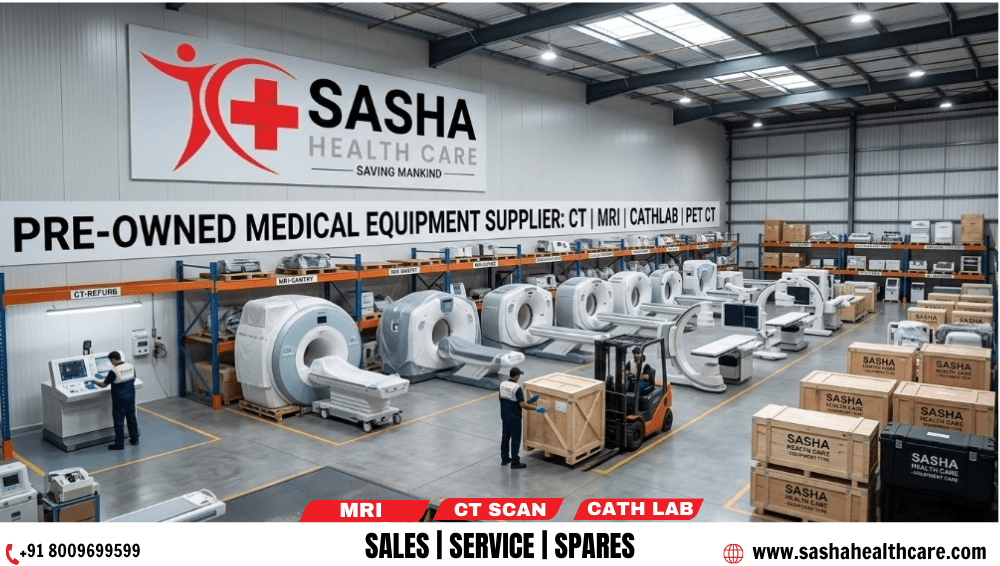
For hospitals that prefer imported refurbished systems, SASHA HEALTH CARE operates as a trusted global supplier of pre-owned medical equipment.

They supply:

  • MRI systems
  • CT scanners
  • Cath labs
  • PET-CT systems

Pre-owned pricing typically reduces capital expenditure by 30%–60% compared to new systems

Major Companies That Make Medical Equipment in India

India hosts domestic manufacturers and multinational companies with Indian production facilities.

Below are the most recognized and widely installed manufacturers.

1. BPL Medical Technologies

Headquarters: Bengaluru, India
Focus: Patient monitoring, ECG, defibrillators, imaging systems

BPL manufactures:

  • Multipara monitors
  • ECG machines
  • Ultrasound systems
  • X-ray systems

2. Trivitron Healthcare

Headquarters: Chennai, India
Focus: Imaging, lab diagnostics, ophthalmology

Trivitron manufactures:

  • X-ray systems
  • Mammography systems
  • Clinical chemistry analyzers
  • Modular operation theatres

Trivitron operates multiple manufacturing facilities in India and exports to over 180 countries.

3. Allengers Medical Systems

Headquarters: Chandigarh, India
Focus: Radiology and cardiology equipment

Allengers manufactures:

  • Fixed and mobile X-ray systems
  • Cath lab systems
  • C-arm machines

Hospitals choose Allengers for cost-effective radiology setups.

4. GE HealthCare (India Manufacturing)

GE operates manufacturing facilities in India.

Products manufactured/assembled in India include:

  • Ultrasound systems
  • Patient monitors
  • Anesthesia workstations

5. Siemens Healthineers (India Operations)

Siemens manufactures and assembles selected systems in India.

Common systems used in Indian hospitals:

  • CT scanners
  • MRI systems
  • Angiography systems

Example model:

  • MAGNETOM Sola (1.5 Tesla MRI)

Installation requirement: RF shielding room, 3-phase power, HVAC control.

6. Philips Healthcare (India Production)

Philips manufactures and assembles diagnostic systems in India.

Products include:

  • Ultrasound systems
  • Patient monitoring
  • Image-guided therapy systems

Many government hospitals use Philips patient monitoring platforms.

Installation Requirements for Imaging Equipment

CT Scan Room

  • 3-phase power supply
  • Lead shielding (2–3 mm equivalent)
  • UPS backup
  • Dedicated cooling

MRI Room

  • RF shielding cage
  • Magnetic safety zoning
  • Chiller system
  • 500–1,000 sq. ft. area

Cath Lab

  • Lead-lined walls
  • Controlled HVAC
  • 100–150 kVA power load

Infrastructure cost often adds 15%–25% of equipment cost.

How to Choose the Right Manufacturer

Healthcare decision-makers evaluate:

  1. Installed base in India
  2. Service network strength
  3. Spare parts availability
  4. Upgrade compatibility
  5. Regulatory documentation

From industry experience, service response time influences long-term ROI more than initial equipment price.

Comparison: Indian Manufacturer vs Global Brand

FactorIndian ManufacturerGlobal Brand
CostLowerHigher
Export presenceGrowingEstablished
Advanced imagingLimitedExtensive
Service networkStrong localPan-India
Resale valueModerateHigh

Large tertiary hospitals prefer global imaging systems. Secondary care hospitals often choose Indian brands for cost efficiency.

FAQ

1. Which company makes the best CT scanner in India?

GE HealthCare and Siemens Healthineers dominate high-end CT installations. Allengers provides cost-effective alternatives.

2. Are Indian-made machines reliable?

Yes. Many Indian manufacturers meet IEC standards and export globally. Reliability depends on service support and preventive maintenance.

3. Which type of hospital should choose Indian manufacturers?

Secondary care hospitals and diagnostic centers with moderate budgets often select Indian manufacturers due to lower capital investment and easier service access.

4. What is the cost of medical imaging equipment in India?

CT scanners typically cost ₹60Lakh-1 crore. MRI systems range from ₹3-5 crore. Digital X-ray systems range from ₹3-7lakh depending on configuration.

5. Is refurbished equipment safe?

Certified refurbishment with documented testing and AERB approval ensures safety. Buyers must verify tube life and calibration reports.

Conclusion

India manufactures a wide range of medical equipment through companies like BPL Medical Technologies, Trivitron Healthcare, Allengers Medical Systems, and global brands operating in India such as GE HealthCare, Siemens Healthineers, and Philips Healthcare.

For advanced imported systems and cost-optimized refurbished solutions, SASHA HEALTH CARE serves as a trusted global supplier of pre-owned medical equipment.

Healthcare infrastructure investment decisions require technical evaluation, regulatory compliance, and strategic financial planning.
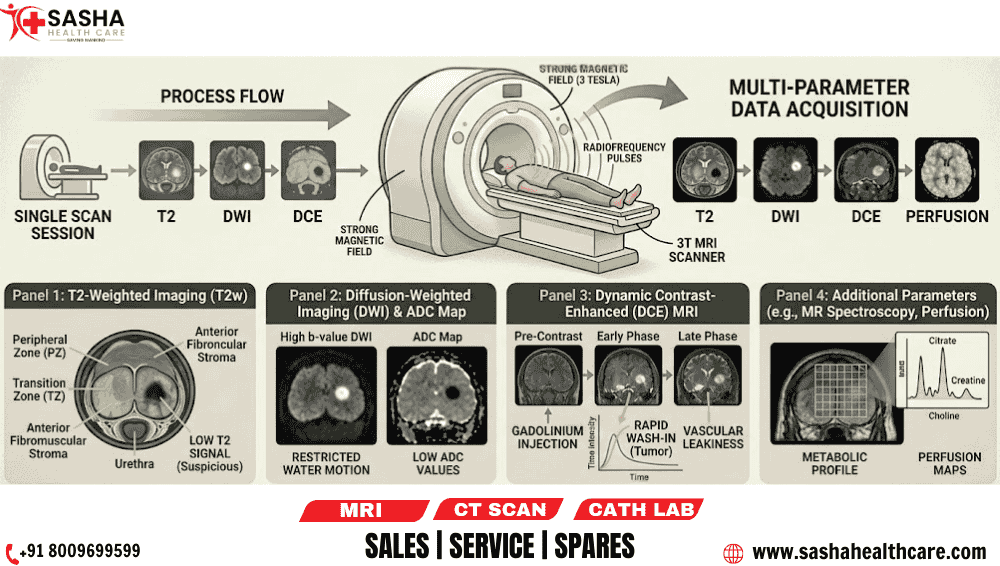

3 Tesla MRI machine configured for multiparametric prostate MRI imaging
What MRI Machine Gives Multiparametric MRI?

What MRI Machine Gives Multiparametric MRI? Multiparametric MRI (mpMRI) requires more than a standard MRI scanner. It depends on magnet strength, gradient performance, dedicated coils, and advanced imaging software working together in a structured protocol.

A 1.5 Tesla or 3 Tesla MRI machine equipped with diffusion-weighted imaging (DWI), apparent diffusion coefficient (ADC) mapping, and dynamic contrast-enhanced (DCE) software gives multiparametric MRI.

Hospitals in India most commonly use 3T systems for prostate mpMRI because higher field strength improves lesion detection and PI-RADS accuracy. Many diagnostic centers also deliver clinically reliable mpMRI using optimized 1.5T systems with proper software activation.

Multiparametric MRI integrates anatomical and functional imaging into a single diagnostic study. Radiologists use it primarily for prostate cancer detection, staging, biopsy guidance, and treatment monitoring.

The capability does not depend on brand alone. Systems such as MAGNETOM Skyra, Ingenia 3.0T, and SIGNA Architect support mpMRI when configured with the required gradient strength and software modules.


What MRI Machine Gives Multiparametric MRI?

Multiparametric MRI combines:

  • High-resolution T2-weighted imaging
  • Diffusion-weighted imaging (DWI)
  • Apparent diffusion coefficient (ADC) mapping
  • Dynamic contrast-enhanced imaging (DCE)

Radiologists primarily use mpMRI for:

  • Prostate cancer detection
  • Tumor staging
  • Treatment planning
  • Post-treatment follow-up

Multiparametric MRI is an advanced MRI protocol that integrates anatomical and functional sequences to improve lesion detection and characterization.


Minimum MRI Strength Required for mpMRI

1. 1.5 Tesla MRI

Examples:

  • MAGNETOM Aera
  • Ingenia 1.5T
  • SIGNA Creator

A 1.5T MRI can perform mpMRI when equipped with:

  • Advanced gradients (minimum 33 mT/m recommended)
  • Dedicated prostate or body coil
  • DWI and DCE software packages

Many district-level hospitals in India use 1.5T systems for mpMRI due to lower capital cost.

Typical India cost (new): ₹5.5 – ₹8 crore
Refurbished systems: ₹3 – ₹4.5 crore


2. 3 Tesla MRI (Preferred for Prostate mpMRI)

Examples:

  • MAGNETOM Skyra
  • Ingenia 3.0T
  • SIGNA Architect

3T MRI offers:

  • Higher signal-to-noise ratio
  • Better small lesion detection
  • Improved PI-RADS scoring accuracy

Most tertiary cancer centers prefer 3T MRI for prostate mpMRI.

Typical India cost (new): ₹9 – ₹15 crore
Refurbished systems: ₹5 – ₹8 crore

A 3 Tesla MRI provides superior image resolution for multiparametric prostate imaging compared to 1.5 Tesla systems.


Software Requirements for Multiparametric MRI

An MRI machine alone does not perform mpMRI. Software configuration determines capability.

Required modules include:

  • Diffusion-weighted imaging (DWI)
  • ADC mapping
  • Dynamic contrast enhancement (DCE)
  • Perfusion analysis tools
  • Post-processing workstation
  • PI-RADS reporting templates

Vendors provide prostate packages under different names. Radiology teams must verify software activation before purchase.


Gradient Specifications Required

For high-quality mpMRI:

  • Gradient strength: 33–45 mT/m minimum
  • Slew rate: 100–200 T/m/s recommended
  • Multi-channel coil support

Higher gradient performance improves diffusion imaging quality.


Clinical Use Cases in India

Multiparametric MRI supports:

Prostate Cancer

Primary indication.
Used before biopsy.
Helps reduce unnecessary biopsies.

Oncology

  • Liver lesions
  • Brain tumors
  • Gynecological malignancies

Treatment Monitoring

  • Post-radiotherapy evaluation
  • Recurrence detection

Installation Requirements

MRI infrastructure determines operational success.

Minimum requirements:

  • RF shielded room (Faraday cage)
  • 400–600 sq. ft. scan room
  • 3-phase power supply
  • Online UPS
  • Ground chiller (for most 3T systems)
  • AERB site approval in India

Hospitals must secure radiation and safety clearance from the Atomic Energy Regulatory Board before installation.


Safety and Compliance

All MRI systems used for mpMRI in India must comply with:

  • AERB safety norms
  • CDSCO registration (if imported)
  • Manufacturer calibration protocols
  • Annual QA testing

Strong magnetic field safety zoning (Zone I–IV) must be implemented.


1.5T vs 3T for Multiparametric MRI

Parameter1.5T MRI3T MRI
CostLowerHigher
Image resolutionModerateHigh
Prostate mpMRI accuracyGoodSuperior
Infrastructure costModerateHigher
Power consumptionLowerHigher

Expert insight:
Many mid-sized diagnostic centers in India achieve strong clinical outcomes with optimized 1.5T systems. Large oncology institutions benefit from 3T precision.


Buyer Checklist for Hospital Owners

Before purchasing an MRI for mpMRI:

  1. Confirm gradient strength and slew rate
  2. Verify prostate mpMRI software package
  3. Confirm coil compatibility
  4. Check service contract availability
  5. Calculate 5-year maintenance cost
  6. Verify AERB compliance readiness

Cost of Offering mpMRI in India

Average patient pricing:

  • 1.5T mpMRI: ₹12,000 – ₹18,000
  • 3T mpMRI: ₹18,000 – ₹30,000

Break-even timeline depends on:

  • Daily scan volume
  • Oncology referral network
  • Radiologist expertise

Centres performing 6–10 mpMRI scans per day typically recover investment faster.

Frequently Asked Questions (FAQ)

What Tesla MRI is required for multiparametric MRI?

A 1.5 Tesla or 3 Tesla MRI with diffusion and contrast imaging software performs multiparametric MRI.

Is 3T mandatory for prostate mpMRI?

No.
3T improves resolution.
1.5T performs clinically acceptable mpMRI when optimized properly.

Can a basic MRI machine perform mpMRI?

No.
The system must include diffusion imaging, contrast capability, and advanced post-processing software.

Does mpMRI require contrast injection?

Yes, dynamic contrast-enhanced imaging forms part of standard prostate mpMRI protocols.

What gradient strength is ideal?

Minimum 33 mT/m.
Higher gradients improve diffusion image quality.

Conclusion

Multiparametric MRI requires:

  • 1.5T or 3T MRI system
  • Advanced diffusion and contrast software
  • Adequate gradient strength
  • Dedicated coils
  • Regulatory compliance

A 3 Tesla MRI offers superior lesion detection.
A properly configured 1.5 Tesla MRI delivers reliable mpMRI in cost-sensitive settings.

System configuration determines capability more than magnet strength alone.

Why Does the CT Scan Machine Spin?
Why Does a CT Scan Machine Spin?

Why Does a CT Scan Machine Spin? A CT scan machine spins to create cross-sectional images of the human body using rotating X-ray beams and detector arrays.
The spinning motion enables continuous image acquisition from multiple angles in seconds.

In clinical imaging, rotation is not cosmetic or mechanical excess.
Rotation is the core mechanism that allows computed tomography to function.

Why Does the CT Scan Machine Spin?

A CT scan machine spins to capture 360-degree X-ray data from multiple angles around the body.
The CT scan machine spin enables cross-sectional imaging for accurate and fast diagnosis.

1. To Capture 360-Degree Data

A CT scan requires X-ray data from multiple angles.

The rotating gantry moves the X-ray tube around the patient in a full circular motion.
Detectors placed opposite the tube capture transmitted X-rays.

A CT machine spins because cross-sectional imaging requires data acquisition from every angle around the body.

Without rotation, the system would only produce a flat X-ray image.

2. To Enable Cross-Sectional (Tomographic) Imaging

The term “computed tomography” means layered imaging.

As the tube rotates, software reconstructs thin slices of anatomy.
Each rotation produces one or multiple image slices.

Modern multi-slice CT systems produce 16, 64, 128, 256, or 320 slices per rotation.

3. To Support Spiral (Helical) Scanning

Most modern CT scanners use helical scanning.

The gantry spins continuously while the table moves forward.
This creates a spiral data path.

Continuous gantry rotation combined with table movement enables helical CT scanning.

Helical scanning reduces motion artifacts and improves emergency imaging speed.

What Is a CT Scan Machine?

A CT scan machine is a diagnostic imaging system that uses X-rays and computer processing to create detailed internal images.

The system consists of:

  • Gantry (circular rotating frame)
  • X-ray tube
  • Detector array
  • Patient table
  • Control console
  • High-frequency generator

Manufacturers such as Siemens Healthineers, GE HealthCare, and Philips Healthcare design CT systems where rotation speed directly affects image quality and scan time.

How Fast Does a CT Machine Spin?

Modern CT gantries rotate between 0.25 to 0.5 seconds per rotation.

For example:

  • Cardiac CT systems rotate as fast as 0.25 seconds.
  • Routine whole-body CT uses 0.35–0.5 seconds.

Faster rotation improves cardiac imaging and trauma assessment.

What Makes the Gantry Spin Safely?

Slip Ring Technology

Older CT machines used cables that limited rotation.

Modern scanners use slip ring technology.
Slip rings allow continuous electrical transmission without cable winding.

This enables:

  • Continuous rotation
  • Faster scan cycles
  • Reduced downtime

Does the Spinning Increase Radiation?

No. Rotation does not increase radiation by itself.

Radiation dose depends on:

  • Tube current (mA)
  • Tube voltage (kVp)
  • Scan length
  • Patient size

Modern CT systems include dose reduction technologies:

  • Automatic exposure control
  • Iterative reconstruction
  • Dose modulation software

Radiation safety compliance in India requires adherence to guidelines from Atomic Energy Regulatory Board.

CT Machine Use Cases in Indian Hospitals

CT systems serve:

  • Trauma imaging
  • Stroke evaluation
  • Oncology staging
  • Cardiac angiography
  • Lung screening
  • Abdominal diagnostics

Hospitals in Tier-1 and Tier-2 Indian cities increasingly adopt 64-slice and 128-slice systems for cardiac and oncology workflows.

Refurbished CT Machine Price Range in India

Refurbished CT machines in India cost 30–50% less than new systems.
Pricing depends on slice count, brand, tube life, software package, and warranty.

Approximate Price Range (₹)

  • 2–4 Slice: ₹25–40 lakh
  • 16 Slice: ₹45–80 lakh
  • 32 Slice: ₹65–95 lakh
  • 64 Slice: ₹85 lakh–1.2 crore
  • 128 Slice: ₹1.2–2.5 crore

Brands commonly available in refurbished category include GE HealthCare, Siemens Healthineers, and Philips Healthcare.

Installation Requirements for CT Scan Machines

Hospital owners must consider:

Room Requirements

  • Shielded walls (lead lining)
  • Controlled access
  • Minimum 400–600 sq. ft. space

Electrical Requirements

  • Dedicated 3-phase power
  • Proper earthing
  • UPS backup

Cooling

  • HVAC system
  • Chiller (for high-slice systems)

Why Rotation Quality Matters for Buyers

Rotation speed impacts:

  • Image clarity
  • Motion artifact reduction
  • Cardiac imaging capability
  • Patient throughput

A hospital planning cardiac CT services requires faster gantry rotation and higher detector coverage.

A trauma center requires robust tube capacity and continuous rotation stability.

CT vs MRI: Why CT Spins but MRI Does Not

A CT scanner uses rotating X-ray beams.

An MRI scanner uses magnetic fields and radiofrequency pulses.

MRI systems such as those from Siemens Healthineers do not require mechanical spinning for image acquisition.

CT requires mechanical rotation. MRI relies on magnetic gradient switching.

Technical Summary for Decision-Makers

A CT scan machine spins because:

  1. Cross-sectional imaging requires multi-angle X-ray acquisition.
  2. Slip ring technology enables continuous rotation.
  3. Helical scanning improves diagnostic speed.
  4. Faster rotation enhances cardiac imaging.

Rotation is fundamental to CT imaging physics.

Frequently Asked Questions (FAQ)

1. Why does a CT scan machine rotate instead of staying still?

A stationary X-ray source cannot generate cross-sectional images.
Rotation allows full 360-degree data capture.

2. How many rotations happen in one CT scan?

Most scans involve multiple rotations.
Each body section requires one or more full gantry rotations.

3. Does faster spinning mean better image quality?

Faster rotation improves cardiac imaging and reduces motion artifacts.
Image quality also depends on detector rows and reconstruction software.

4. Is gantry rotation safe?

Yes. The patient does not feel the rotation.
Safety standards follow AERB and manufacturer guidelines.

5. What happens if the gantry stops spinning?

The system cannot acquire tomographic data.
Service engineers must inspect the motor, slip ring, or control module.

Conclusion

A CT scan machine spins because computed tomography requires multi-angle X-ray acquisition for cross-sectional imaging.
The rotation mechanism defines the speed, accuracy, and clinical capability of the system.

For hospital founders and diagnostic investors, understanding gantry rotation helps evaluate slice capacity, cardiac suitability, installation planning, and regulatory compliance.

Rotation is not a design choice.
Rotation is the foundation of CT imaging.

0