
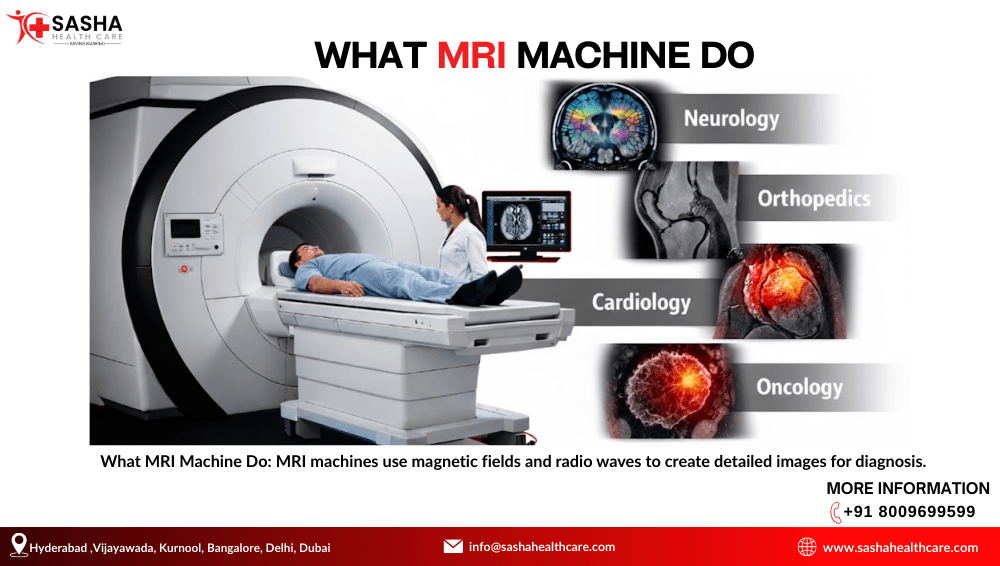
What MRI Machine Do
An MRI machine creates detailed images of internal organs, soft tissues, and bones using strong magnetic fields and radiofrequency signals. Hospitals and diagnostic centers use MRI systems to diagnose neurological, orthopedic, cardiac, and oncological conditions without ionizing radiation.
An MRI machine uses a powerful magnet and radio waves to produce high-resolution images of the human body without X-ray exposure.
What MRI Machine Do
An MRI system aligns hydrogen protons inside the body using a strong magnetic field.
Radiofrequency coils send pulses that disturb this alignment.
The system measures the energy released when protons realign.
A computer converts this data into cross-sectional images.
Radiologists interpret these images for clinical diagnosis.
MRI scanners rely on hydrogen proton alignment and radiofrequency signals to generate diagnostic images.
Main Components of an MRI Machine
Superconducting Magnet
The magnet creates a constant magnetic field measured in Tesla.
Common strengths include 1.5 Tesla and 3 Tesla.
Gradient Coils
Gradient coils control spatial encoding.
They allow slice-by-slice image formation.
RF Coils
RF coils transmit and receive radiofrequency signals.
Different coils exist for brain, spine, knee, and cardiac imaging.
Computer and Console
The console processes signals into images.
Radiologists control scan parameters here.
Types of MRI Machines Used in India
1.5 Tesla MRI
Hospitals use this as the clinical standard.
It balances image quality and operating cost.
Examples include Siemens Magnetom Essenza and GE Signa Explorer.
3 Tesla MRI
This system provides higher resolution images.
Neurology and research centers prefer it.
Examples include Siemens Magnetom Skyra and Philips Ingenia.
Open MRI
Open MRI improves patient comfort.
It suits claustrophobic and obese patients.
What MRI Machine Do in Clinical Practice
MRI scans detect soft tissue abnormalities with high accuracy.
Doctors use MRI for early disease detection.
Neurology
MRI identifies brain tumors, stroke, epilepsy, and multiple sclerosis.
Orthopedics
MRI visualizes ligaments, cartilage, spine, and joints.
Cardiology
Cardiac MRI evaluates heart structure and function.
Oncology
MRI helps detect, stage, and monitor tumors by providing high-contrast soft tissue images without radiation exposure.
Installation Requirements for MRI Machines
MRI installation needs a dedicated shielded room.
RF shielding prevents external signal interference.
Hospitals require stable power supply and HVAC systems.
Magnetic safety zoning follows IEC and AERB guidelines.
Typical room size ranges from 600 to 800 sq ft.
Floor load capacity must support heavy equipment.
Safety and Compliance Standards
MRI systems follow IEC 60601 safety standards.
Indian facilities comply with AERB safety norms.
Hospitals enforce magnetic safety protocols.
Staff screen patients for implants and metallic objects.
MRI Machine Cost in India
MRI machine prices vary by field strength and brand.
- 1.5 Tesla MRI: ₹6 crore to ₹10 crore (NEW)
- 3 Tesla MRI: ₹12 crore to ₹20 crore (NEW)
- Refurbished MRI: ₹3 crore to ₹6 crore
Prices exclude civil work and shielding costs.
Operational and Maintenance Considerations
MRI systems require cryogen management.
Helium levels need regular monitoring.
Annual maintenance contracts cover gradients, coils, and software.
Downtime impacts diagnostic revenue.
Hospitals plan trained technologists and radiologists.
Workflow efficiency affects ROI.
Expert Perspective from Industry Experience
Diagnostic centers choose MRI based on patient load and case mix.
Urban hospitals prefer 3 Tesla systems for advanced imaging.
Tier-2 cities favor 1.5 Tesla MRI for cost efficiency.
Sasha Health Care supports hospitals with equipment sourcing and technical guidance.
Role of Sasha Health Care
Sasha Health Care works with hospitals and imaging centers across India.
The company supplies MRI systems and diagnostic imaging solutions.
Their team understands site planning, compliance, and operational needs.
Decision-makers rely on domain expertise and industry standards.
FAQs
Most hospitals use 1.5 Tesla MRI systems due to cost and versatility.
MRI does not use ionizing radiation.
Most MRI scans take 20 to 45 minutes.
MRI systems should meet IEC standards and AERB guidelines.
Certified refurbished MRI systems meet clinical safety standards when installed correctly.
Conclusion
An MRI machine plays a critical role in modern medical diagnosis by producing high-resolution images of soft tissues without radiation exposure. Hospitals and diagnostic centers rely on MRI systems for accurate evaluation of neurological, orthopedic, cardiac, and oncological conditions.
Proper selection of field strength, compliance with safety standards, and correct installation directly affect clinical outcomes and operational efficiency. With experienced suppliers like Sasha Health Care, healthcare decision-makers can align technology choice with patient demand, regulatory requirements, and long-term diagnostic goals.