
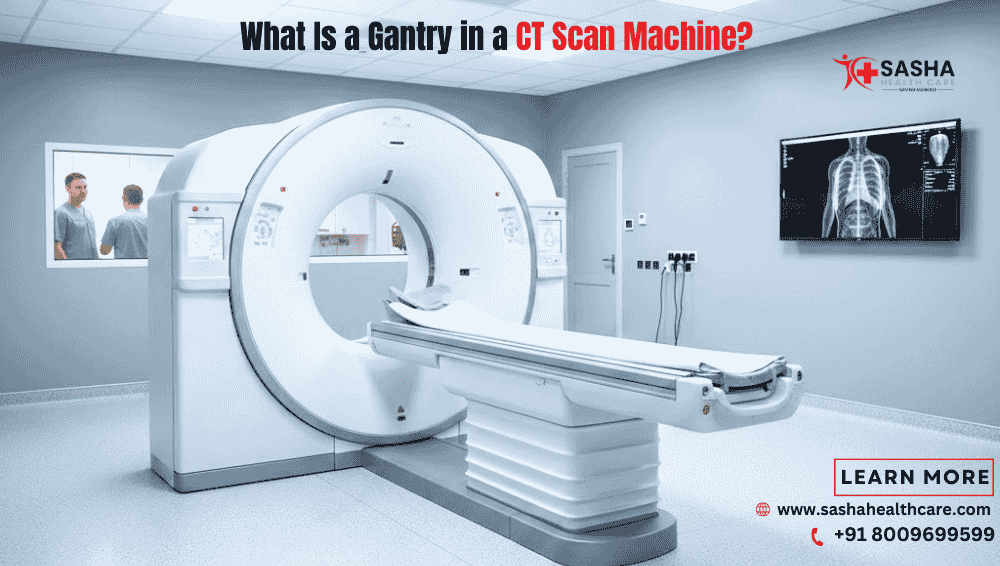
What Is a Gantry in a CT Scan Machine?
A gantry in a CT scan machine is the circular structural unit that houses the X-ray tube, detectors, rotation system, and data acquisition hardware.
It forms the core imaging assembly of every Computed Tomography system used in modern diagnostic radiology.
Hospital planners, radiologists, and imaging center owners consider the gantry the most critical mechanical and imaging component of the CT scanner.
What Is a Gantry in a CT Scan Machine?
The CT gantry supports and rotates the X-ray source and detector array around the patient to produce cross-sectional anatomical images.
It creates the physical framework for image acquisition.
It determines scan speed, image resolution, and patient accessibility.
Main Components Inside a CT Gantry
X-ray Tube Assembly
The X-ray tube generates the radiation beam.
Tube power rating (kW), heat capacity (MHU), and focal spot size influence image quality and scan speed.
Detector Array
Detectors capture attenuated X-rays after they pass through the patient.
Modern systems use solid-state detectors with high quantum efficiency.
Slip Ring Technology
Slip rings allow continuous rotation without cable twisting.
This design enables spiral (helical) CT scanning.
Gantry Motor and Rotation System
High-precision motors drive rotation speeds as low as 0.25 seconds per revolution.
Fast rotation improves cardiac and trauma imaging.
Data Acquisition System (DAS)
DAS converts detector signals into digital data for image reconstruction.
Gantry Opening (Bore) Size
The gantry bore refers to the circular opening where the patient table moves through.
Typical bore diameters:
- Standard CT: 70 cm
- Wide-bore CT: 75–80 cm
Large bores support bariatric, oncology, and interventional procedures.
Gantry Tilt Function
Many CT systems allow gantry tilting up to ±30 degrees.
Radiologists use tilt for:
- Brain imaging to avoid eye lens radiation
- Spine and orthopedic alignment
- Trauma positioning
Role of Gantry in Image Quality
Gantry engineering directly affects spatial resolution, motion artifact control, and dose efficiency.
Key influencing factors:
- Rotation speed
- Detector coverage (mm)
- Tube stability
- Mechanical balance
Poor gantry alignment causes image artifacts.
Gantry in Multi-Slice CT Systems
Modern CT scanners such as:
- GE Revolution ACT
- Siemens SOMATOM go.Top
- Philips Incisive CT
- Canon Aquilion Lightning
use advanced gantry designs to support 16-slice to 640-slice imaging platforms.
Installation Requirements for CT Gantry
CT gantry installation demands precise civil and electrical preparation.
Room Requirements
- Room size: 300–500 sq ft typical
- Floor load capacity: 1,500–2,500 kg
- Controlled temperature and humidity
Electrical Requirements
- Dedicated power supply
- Online UPS
- Proper grounding
Radiation Shielding
Lead shielding per AERB guidelines in India.
Gantry Safety and Compliance
CT gantries comply with international medical device standards.
Relevant certifications:
- IEC 60601-1 (Electrical Safety)
- IEC 60601-2-44 (CT Equipment Safety)
- AERB (India radiation safety approval)
- CE Mark / FDA clearance
Safety systems include:
- Interlocks
- Emergency stop
- Tube cooling monitoring
Gantry Maintenance Factors
Routine gantry servicing includes:
- Bearing inspection
- Tube alignment check
- Detector calibration
- Slip ring maintenance
Improper maintenance leads to vibration artifacts.
Organizations such as SASHA HEALTH CARE, which supply diagnostic imaging systems, assess gantry condition before equipment installation and commissioning.
Cost Impact of Gantry Technology
Advanced gantry design increases system cost due to high-speed rotation engineering and detector integration.
Indicative CT system pricing in India:
- Refurbished 16-slice CT: ₹70 lakh – ₹80 lakh
- 128-slice CT: ₹90 – ₹1.5 crore
- Premium cardiac CT: ₹2 crore+
High-performance gantries drive these costs.
Gantry vs Other CT Components
| Component | Function |
|---|---|
| Gantry | Houses imaging hardware |
| Patient Table | Moves patient through bore |
| Console | Controls scan parameters |
| Workstation | Image reconstruction |
Clinical Use Cases Where Gantry Design Matters
- Cardiac CT angiography
- Trauma whole-body scans
- Oncology planning
- Neuro imaging
- Interventional CT
Fast rotation and stable mechanics support motion-sensitive studies.
FAQ
The gantry rotates the X-ray tube and detectors around the patient to capture imaging data.
Most CT scanners use a 70 cm bore. Wide-bore systems reach 80 cm.
Faster rotation reduces motion blur and improves cardiac imaging.
Yes. Many systems allow ±30° tilt for specialized imaging.
Yes. Efficient detector alignment and tube control improve dose optimization.
Summary
Refurbished CT scan machines offer cost-effective access to essential and advanced imaging technology, enabling hospitals and diagnostic centers to expand services without prohibitive capital spend. When properly evaluated, installed, and maintained, these systems provide long-term clinical utility and economic advantage for healthcare facilities in India.