
How to Operate a CT Scan Machine
How to Operate a CT Scan Machine ??? Operating a CT (Computed Tomography) scan machine involves clinical knowledge, technical training, radiation safety compliance, and strict procedural control. In India, CT scanners are operated by certified radiology technologists under the supervision of registered radiologists, following AERB and NABH guidelines.
A CT scan machine converts X-ray signals into cross-sectional images using a rotating gantry, detector array, and computer reconstruction system. Safe operation depends on correct patient positioning, protocol selection, dose optimization, and image verification.
How to Operate a CT Scan Machine ??
Operating a CT scanner does not mean simply pressing scan buttons.
It includes:
- Preparing and screening the patient
- Selecting the correct scan protocol
- Positioning the patient accurately
- Executing the scan safely
- Reviewing image quality before submission
A CT scan machine is operated by a trained radiologic technologist who controls patient positioning, scan parameters, radiation dose, and image acquisition according to clinical protocol.
Who Is Authorized to Operate a CT Scanner in India?
In India, CT scanners must be operated by qualified personnel only.
Required Qualifications
- Diploma or Degree in Radiology / Medical Imaging Technology
- Valid registration with State Paramedical Council (where applicable)
- Training certification on the specific CT model
Regulatory Bodies
- AERB (Atomic Energy Regulatory Board)
- PCPNDT Authority (for applicable studies)
- NABH / NABL (for accredited centers)
Indian regulations mandate that CT scanners be operated only by trained radiologic technologists under AERB-approved radiation safety programs.
Main Components You Must Understand Before Operation
Understanding machine components is essential before live operation.
Core CT Scan System Parts
- Gantry: Houses X-ray tube and detectors
- Patient Table: Motorized, precision-controlled
- X-ray Tube: Generates high-energy radiation
- Detector Array: Captures attenuated X-rays
- Console & Workstation: Controls scan and reconstruction
Popular CT systems in India include:
- Siemens SOMATOM series
- GE Revolution and BrightSpeed
- Philips Brilliance and Incisive CT
- Canon (Toshiba) Aquilion series
Step-by-Step Process to Operate a CT Scan Machine
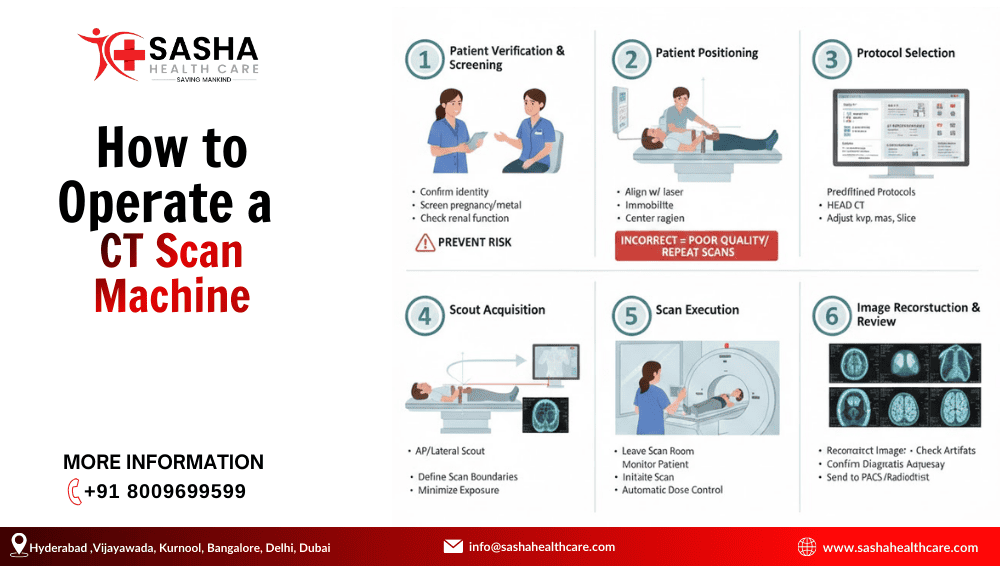
Step 1: Patient Verification and Screening
- Confirm patient identity and clinical indication
- Screen for pregnancy and metal implants
- Check renal function for contrast studies
Patient screening is mandatory before CT scanning to prevent radiation risk and contrast-related complications.
Step 2: Patient Positioning
- Align patient using laser guides
- Immobilize using straps or cushions
- Ensure anatomical region is centered in gantry
Incorrect positioning leads to:
- Increased radiation dose
- Poor image quality
- Repeat scans
Step 3: Protocol Selection
CT machines include predefined protocols such as:
- Head CT
- HRCT Chest
- CT Abdomen Pelvis
- CT Angiography
Parameters adjusted include:
- kVp
- mAs
- Slice thickness
- Pitch
- Scan range
Step 4: Scout (Topogram) Acquisition
- Perform AP or lateral scout image
- Define exact scan boundaries
- Minimize unnecessary exposure
Step 5: Scan Execution
- Leave scan room before exposure
- Monitor patient via camera and intercom
- Initiate scan from control console
Modern CT systems use:
- Automatic Exposure Control (AEC)
- Dose modulation software
Step 6: Image Reconstruction and Review
- Reconstruct axial, coronal, sagittal images
- Check for motion artifacts
- Confirm diagnostic adequacy
Images are then sent to:
- PACS
- Radiologist workstation
Radiation Safety and Compliance Requirements
Radiation safety is non-negotiable.
Mandatory Safety Practices
- ALARA principle (As Low As Reasonably Achievable)
- Lead shielding where applicable
- Regular dose audits
- Radiation warning signage
Compliance Standards
- AERB equipment registration
- Periodic QA testing
- Radiation Safety Officer (RSO) appointment
CT scan operation in India must comply with AERB radiation safety norms, including dose optimization and routine quality assurance testing.
Installation and Infrastructure Requirements
CT operation depends on correct installation.
Space and Shielding
- Lead-lined walls as per AERB layout approval
- Dedicated control room
- Patient preparation area
Power and Cooling
- Three-phase electrical supply
- UPS and generator backup
- HVAC for temperature control
Operating Costs and Practical Considerations
While operation itself has no direct “per-scan machine cost,” practical expenses include:
Cost Factors
- X-ray tube lifespan
- Annual maintenance contract (AMC)
- Power consumption
- Technologist salaries
CT scanners in India typically range from:
- 16-slice: ₹80-90 Lakh
- 64-slice: ₹90– 1cr
- 128-slice and above: ₹1 crore+
Common Operating Errors to Avoid
- Incorrect protocol selection
- Poor patient centering
- Overexposure due to manual mAs
- Skipping scout verification
These errors increase:
- Radiation dose
- Repeat scan rates
- Legal and compliance risks
Expert Perspective from Field Practice
From operational audits across Indian diagnostic centers, the most consistent performance improvements come from:
- Regular technologist retraining
- Protocol standardization
- Dose tracking software implementation
High-quality CT operation is a process discipline, not just equipment capability.
Frequently Asked Questions (FAQ)
Only trained radiology technologists with appropriate certification, under radiologist supervision, as per AERB rules.
Radiologists usually supervise and interpret scans. Day-to-day machine operation is handled by technologists.
Yes. Contrast-enhanced CT requires trained staff, emergency preparedness, and renal safety checks.
Most routine CT scans take 5–10 minutes, excluding preparation time.
AERB approval, radiation safety training, and periodic quality assurance certification are mandatory.