
What MRI Machine Gives Multiparametric MRI?
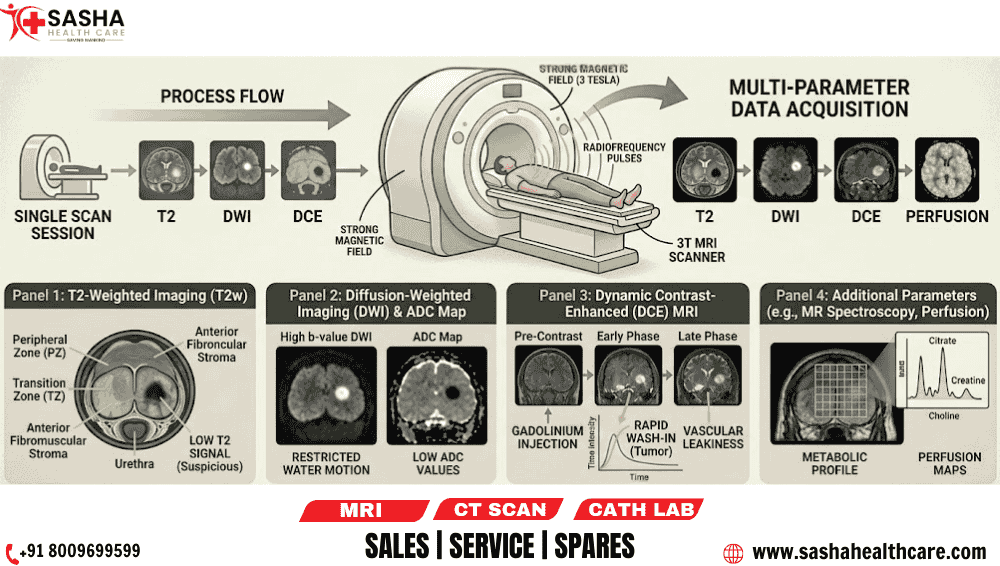
What MRI Machine Gives Multiparametric MRI? Multiparametric MRI (mpMRI) requires more than a standard MRI scanner. It depends on magnet strength, gradient performance, dedicated coils, and advanced imaging software working together in a structured protocol.
A 1.5 Tesla or 3 Tesla MRI machine equipped with diffusion-weighted imaging (DWI), apparent diffusion coefficient (ADC) mapping, and dynamic contrast-enhanced (DCE) software gives multiparametric MRI.
Hospitals in India most commonly use 3T systems for prostate mpMRI because higher field strength improves lesion detection and PI-RADS accuracy. Many diagnostic centers also deliver clinically reliable mpMRI using optimized 1.5T systems with proper software activation.
Multiparametric MRI integrates anatomical and functional imaging into a single diagnostic study. Radiologists use it primarily for prostate cancer detection, staging, biopsy guidance, and treatment monitoring.
The capability does not depend on brand alone. Systems such as MAGNETOM Skyra, Ingenia 3.0T, and SIGNA Architect support mpMRI when configured with the required gradient strength and software modules.
What MRI Machine Gives Multiparametric MRI?
Multiparametric MRI combines:
- High-resolution T2-weighted imaging
- Diffusion-weighted imaging (DWI)
- Apparent diffusion coefficient (ADC) mapping
- Dynamic contrast-enhanced imaging (DCE)
Radiologists primarily use mpMRI for:
- Prostate cancer detection
- Tumor staging
- Treatment planning
- Post-treatment follow-up
Multiparametric MRI is an advanced MRI protocol that integrates anatomical and functional sequences to improve lesion detection and characterization.
Minimum MRI Strength Required for mpMRI
1. 1.5 Tesla MRI
Examples:
- MAGNETOM Aera
- Ingenia 1.5T
- SIGNA Creator
A 1.5T MRI can perform mpMRI when equipped with:
- Advanced gradients (minimum 33 mT/m recommended)
- Dedicated prostate or body coil
- DWI and DCE software packages
Many district-level hospitals in India use 1.5T systems for mpMRI due to lower capital cost.
Typical India cost (new): ₹5.5 – ₹8 crore
Refurbished systems: ₹3 – ₹4.5 crore
2. 3 Tesla MRI (Preferred for Prostate mpMRI)
Examples:
- MAGNETOM Skyra
- Ingenia 3.0T
- SIGNA Architect
3T MRI offers:
- Higher signal-to-noise ratio
- Better small lesion detection
- Improved PI-RADS scoring accuracy
Most tertiary cancer centers prefer 3T MRI for prostate mpMRI.
Typical India cost (new): ₹9 – ₹15 crore
Refurbished systems: ₹5 – ₹8 crore
A 3 Tesla MRI provides superior image resolution for multiparametric prostate imaging compared to 1.5 Tesla systems.
Software Requirements for Multiparametric MRI
An MRI machine alone does not perform mpMRI. Software configuration determines capability.
Required modules include:
- Diffusion-weighted imaging (DWI)
- ADC mapping
- Dynamic contrast enhancement (DCE)
- Perfusion analysis tools
- Post-processing workstation
- PI-RADS reporting templates
Vendors provide prostate packages under different names. Radiology teams must verify software activation before purchase.
Gradient Specifications Required
For high-quality mpMRI:
- Gradient strength: 33–45 mT/m minimum
- Slew rate: 100–200 T/m/s recommended
- Multi-channel coil support
Higher gradient performance improves diffusion imaging quality.
Clinical Use Cases in India
Multiparametric MRI supports:
Prostate Cancer
Primary indication.
Used before biopsy.
Helps reduce unnecessary biopsies.
Oncology
- Liver lesions
- Brain tumors
- Gynecological malignancies
Treatment Monitoring
- Post-radiotherapy evaluation
- Recurrence detection
Installation Requirements
MRI infrastructure determines operational success.
Minimum requirements:
- RF shielded room (Faraday cage)
- 400–600 sq. ft. scan room
- 3-phase power supply
- Online UPS
- Ground chiller (for most 3T systems)
- AERB site approval in India
Hospitals must secure radiation and safety clearance from the Atomic Energy Regulatory Board before installation.
Safety and Compliance
All MRI systems used for mpMRI in India must comply with:
- AERB safety norms
- CDSCO registration (if imported)
- Manufacturer calibration protocols
- Annual QA testing
Strong magnetic field safety zoning (Zone I–IV) must be implemented.
1.5T vs 3T for Multiparametric MRI
| Parameter | 1.5T MRI | 3T MRI |
|---|---|---|
| Cost | Lower | Higher |
| Image resolution | Moderate | High |
| Prostate mpMRI accuracy | Good | Superior |
| Infrastructure cost | Moderate | Higher |
| Power consumption | Lower | Higher |
Expert insight:
Many mid-sized diagnostic centers in India achieve strong clinical outcomes with optimized 1.5T systems. Large oncology institutions benefit from 3T precision.
Buyer Checklist for Hospital Owners
Before purchasing an MRI for mpMRI:
- Confirm gradient strength and slew rate
- Verify prostate mpMRI software package
- Confirm coil compatibility
- Check service contract availability
- Calculate 5-year maintenance cost
- Verify AERB compliance readiness
Cost of Offering mpMRI in India
Average patient pricing:
- 1.5T mpMRI: ₹12,000 – ₹18,000
- 3T mpMRI: ₹18,000 – ₹30,000
Break-even timeline depends on:
- Daily scan volume
- Oncology referral network
- Radiologist expertise
Centres performing 6–10 mpMRI scans per day typically recover investment faster.
Frequently Asked Questions (FAQ)
A 1.5 Tesla or 3 Tesla MRI with diffusion and contrast imaging software performs multiparametric MRI.
No.
3T improves resolution.
1.5T performs clinically acceptable mpMRI when optimized properly.
No.
The system must include diffusion imaging, contrast capability, and advanced post-processing software.
Yes, dynamic contrast-enhanced imaging forms part of standard prostate mpMRI protocols.
Minimum 33 mT/m.
Higher gradients improve diffusion image quality.
Conclusion
Multiparametric MRI requires:
- 1.5T or 3T MRI system
- Advanced diffusion and contrast software
- Adequate gradient strength
- Dedicated coils
- Regulatory compliance
A 3 Tesla MRI offers superior lesion detection.
A properly configured 1.5 Tesla MRI delivers reliable mpMRI in cost-sensitive settings.
System configuration determines capability more than magnet strength alone.