
Why Does a CT Scan Machine Spin?
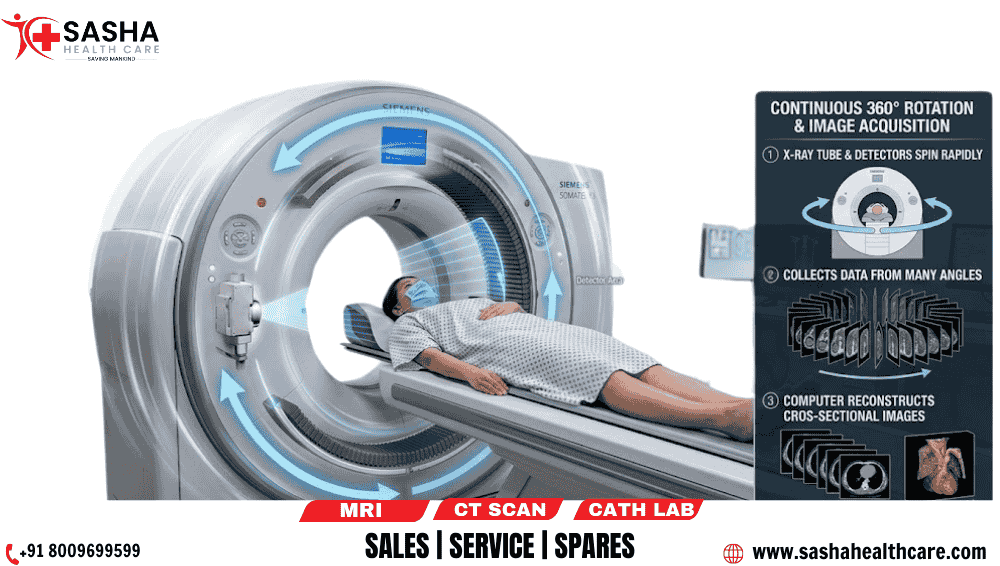
Why Does a CT Scan Machine Spin? A CT scan machine spins to create cross-sectional images of the human body using rotating X-ray beams and detector arrays.
The spinning motion enables continuous image acquisition from multiple angles in seconds.
In clinical imaging, rotation is not cosmetic or mechanical excess.
Rotation is the core mechanism that allows computed tomography to function.
Why Does the CT Scan Machine Spin?
A CT scan machine spins to capture 360-degree X-ray data from multiple angles around the body.
The CT scan machine spin enables cross-sectional imaging for accurate and fast diagnosis.
1. To Capture 360-Degree Data
A CT scan requires X-ray data from multiple angles.
The rotating gantry moves the X-ray tube around the patient in a full circular motion.
Detectors placed opposite the tube capture transmitted X-rays.
A CT machine spins because cross-sectional imaging requires data acquisition from every angle around the body.
Without rotation, the system would only produce a flat X-ray image.
2. To Enable Cross-Sectional (Tomographic) Imaging
The term “computed tomography” means layered imaging.
As the tube rotates, software reconstructs thin slices of anatomy.
Each rotation produces one or multiple image slices.
Modern multi-slice CT systems produce 16, 64, 128, 256, or 320 slices per rotation.
3. To Support Spiral (Helical) Scanning
Most modern CT scanners use helical scanning.
The gantry spins continuously while the table moves forward.
This creates a spiral data path.
Continuous gantry rotation combined with table movement enables helical CT scanning.
Helical scanning reduces motion artifacts and improves emergency imaging speed.
What Is a CT Scan Machine?
A CT scan machine is a diagnostic imaging system that uses X-rays and computer processing to create detailed internal images.
The system consists of:
- Gantry (circular rotating frame)
- X-ray tube
- Detector array
- Patient table
- Control console
- High-frequency generator
Manufacturers such as Siemens Healthineers, GE HealthCare, and Philips Healthcare design CT systems where rotation speed directly affects image quality and scan time.
How Fast Does a CT Machine Spin?
Modern CT gantries rotate between 0.25 to 0.5 seconds per rotation.
For example:
- Cardiac CT systems rotate as fast as 0.25 seconds.
- Routine whole-body CT uses 0.35–0.5 seconds.
Faster rotation improves cardiac imaging and trauma assessment.
What Makes the Gantry Spin Safely?
Slip Ring Technology
Older CT machines used cables that limited rotation.
Modern scanners use slip ring technology.
Slip rings allow continuous electrical transmission without cable winding.
This enables:
- Continuous rotation
- Faster scan cycles
- Reduced downtime
Does the Spinning Increase Radiation?
No. Rotation does not increase radiation by itself.
Radiation dose depends on:
- Tube current (mA)
- Tube voltage (kVp)
- Scan length
- Patient size
Modern CT systems include dose reduction technologies:
- Automatic exposure control
- Iterative reconstruction
- Dose modulation software
Radiation safety compliance in India requires adherence to guidelines from Atomic Energy Regulatory Board.
CT Machine Use Cases in Indian Hospitals
CT systems serve:
- Trauma imaging
- Stroke evaluation
- Oncology staging
- Cardiac angiography
- Lung screening
- Abdominal diagnostics
Hospitals in Tier-1 and Tier-2 Indian cities increasingly adopt 64-slice and 128-slice systems for cardiac and oncology workflows.
Refurbished CT Machine Price Range in India
Refurbished CT machines in India cost 30–50% less than new systems.
Pricing depends on slice count, brand, tube life, software package, and warranty.
Approximate Price Range (₹)
- 2–4 Slice: ₹25–40 lakh
- 16 Slice: ₹45–80 lakh
- 32 Slice: ₹65–95 lakh
- 64 Slice: ₹85 lakh–1.2 crore
- 128 Slice: ₹1.2–2.5 crore
Brands commonly available in refurbished category include GE HealthCare, Siemens Healthineers, and Philips Healthcare.
Installation Requirements for CT Scan Machines
Hospital owners must consider:
Room Requirements
- Shielded walls (lead lining)
- Controlled access
- Minimum 400–600 sq. ft. space
Electrical Requirements
- Dedicated 3-phase power
- Proper earthing
- UPS backup
Cooling
- HVAC system
- Chiller (for high-slice systems)
Why Rotation Quality Matters for Buyers
Rotation speed impacts:
- Image clarity
- Motion artifact reduction
- Cardiac imaging capability
- Patient throughput
A hospital planning cardiac CT services requires faster gantry rotation and higher detector coverage.
A trauma center requires robust tube capacity and continuous rotation stability.
CT vs MRI: Why CT Spins but MRI Does Not
A CT scanner uses rotating X-ray beams.
An MRI scanner uses magnetic fields and radiofrequency pulses.
MRI systems such as those from Siemens Healthineers do not require mechanical spinning for image acquisition.
CT requires mechanical rotation. MRI relies on magnetic gradient switching.
Technical Summary for Decision-Makers
A CT scan machine spins because:
- Cross-sectional imaging requires multi-angle X-ray acquisition.
- Slip ring technology enables continuous rotation.
- Helical scanning improves diagnostic speed.
- Faster rotation enhances cardiac imaging.
Rotation is fundamental to CT imaging physics.
Frequently Asked Questions (FAQ)
A stationary X-ray source cannot generate cross-sectional images.
Rotation allows full 360-degree data capture.
Most scans involve multiple rotations.
Each body section requires one or more full gantry rotations.
Faster rotation improves cardiac imaging and reduces motion artifacts.
Image quality also depends on detector rows and reconstruction software.
Yes. The patient does not feel the rotation.
Safety standards follow AERB and manufacturer guidelines.
The system cannot acquire tomographic data.
Service engineers must inspect the motor, slip ring, or control module.
Conclusion
A CT scan machine spins because computed tomography requires multi-angle X-ray acquisition for cross-sectional imaging.
The rotation mechanism defines the speed, accuracy, and clinical capability of the system.
For hospital founders and diagnostic investors, understanding gantry rotation helps evaluate slice capacity, cardiac suitability, installation planning, and regulatory compliance.
Rotation is not a design choice.
Rotation is the foundation of CT imaging.