
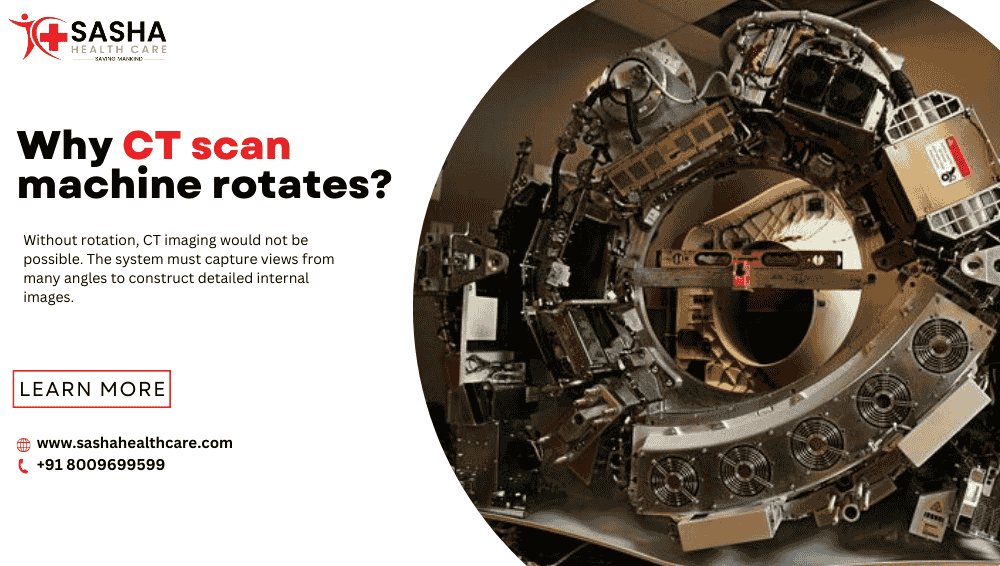
Why CT scan machine rotates?
A CT scan machine rotates to capture multiple X-ray images of the body from different angles, allowing a computer to create detailed cross-sectional and 3D images of internal organs, bones, blood vessels, and tissues. This rotation ensures high diagnostic accuracy and precise visualization of internal structures.
How a Rotating CT Scan Machine Works
A CT (Computed Tomography) scanner uses a rotating X-ray tube and detector system inside a circular structure called a gantry.
🔄 How the Rotation Happens
- The patient lies on a motorized table that moves slowly through the gantry
- Inside the ring, the X-ray tube rotates 360 degrees around the body
- Opposite the tube are detectors that capture X-rays after they pass through tissues
- A computer reconstructs data into cross-sectional images (slices)
Modern scanners use continuous spiral (helical) rotation to produce smoother and faster imaging.
❓ Why CT scan machine rotates?
Without rotation, CT imaging would not be possible. The system must capture views from many angles to construct detailed internal images.
Rotation enables:
- 3D reconstruction of organs
- Detection of small tumors and lesions
- Accurate imaging of blood vessels
- Clear visualization of fractures
- Organ function and perfusion studies
✅ Key Benefits of Rotating CT Technology
| Benefit | Why It Matters |
|---|---|
| High diagnostic accuracy | Detects internal issues early |
| Fast scanning | Critical for trauma and emergencies |
| Thin slice imaging | Shows very small abnormalities |
| Reduced motion blur | Clear images even in short breath-hold |
| Whole-body capability | Used in cancer, heart, and brain imaging |
Entity Authority Section: Deep Technical Understanding
What Components Rotate?
In modern CT scanners, not the entire machine rotates — only specific parts inside the gantry:
- X-ray tube
- Detector array
- Data transmission system
The patient remains still while the internal assembly spins at high speed, sometimes completing rotations in less than 0.3 seconds.
CT Scan vs MRI: Rotation Comparison
| Feature | CT Scan | MRI |
|---|---|---|
| Rotating parts | Yes (X-ray tube & detectors) | No rotation |
| Imaging principle | X-rays | Magnetic fields & radio waves |
| Speed | Very fast | Slower |
| Best for | Bones, lungs, trauma | Soft tissues, brain, joints |
CT rotation is necessary for image creation. MRI machines do not rotate because they use magnetic resonance signals instead of X-ray projections.
Real-World Medical Use Cases
Emergency Medicine
Rapid rotating CT scanners detect:
- Internal bleeding
- Brain stroke
- Chest injuries
Oncology (Cancer Care)
- Tumor detection
- Treatment planning
- Monitoring therapy response
Cardiology
- Coronary CT angiography
- Calcium scoring
- Heart structure analysis
Orthopedics
- Complex fractures
- Spine evaluation
Types of CT Rotation Technology
- Axial CT – Stops and rotates for each slice
- Helical (Spiral) CT – Continuous rotation while the table moves
- Multi-slice CT – Multiple detector rows capture several slices per rotation
Helical and multi-slice CT are standard in modern Indian hospitals.
Frequently Asked Questions
It uses rotating X-rays and detectors to create detailed cross-sectional images of organs, bones, and tissues inside the body.
Rotation allows the machine to capture images from multiple angles, helping computers build accurate 3D internal views.
CT scans use controlled radiation. When medically necessary, the benefits of diagnosis outweigh the small radiation risk.
Most CT scans take 5–10 minutes, while the actual image capture takes only a few seconds.
No, the scan is painless. You only need to lie still while the machine works.
Conclusion
The rotation of a CT scan machine is not a design choice — it is the core principle that makes cross-sectional imaging possible. By capturing X-ray data from multiple angles, CT technology delivers precise, fast, and life-saving diagnostic information used daily in modern healthcare across India and worldwide.