
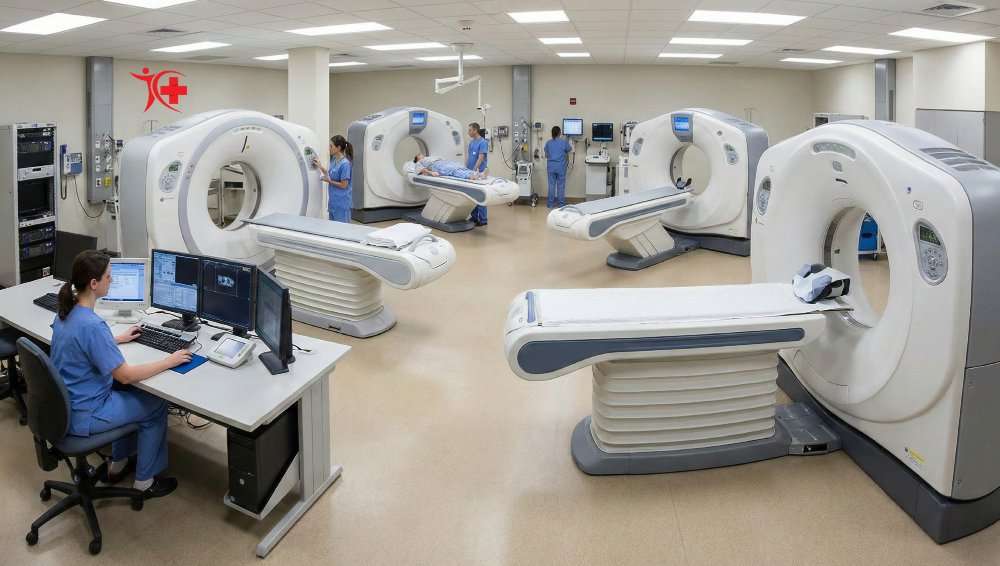
What are the best CT scanners for hospitals?
The best CT scanners for hospitals are systems that balance image quality, speed, radiation dose management, and long-term reliability. In most Indian and international hospital settings, 64-slice and 128-slice CT scanners are considered the standard for general multi-specialty use. High-volume tertiary hospitals often use 128-slice, 256-slice, or higher systems for advanced cardiac and neuro imaging.
The appropriate CT scanner depends on patient volume, case complexity, and budget. For trauma centers and cardiac hospitals, faster rotation times and higher slice counts are essential. For district hospitals and mid-size diagnostic centers, a 32-slice or 64-slice CT scanner is typically sufficient.
From practical clinical experience, slice count alone does not determine quality. Detector technology, gantry speed, tube capacity, reconstruction software, and service support play equally important roles.
Standard CT Scanner Categories Used in Hospitals
16-Slice CT Scanners
Used in smaller hospitals and rural diagnostic centers.
- Suitable for routine brain and chest scans
- Lower acquisition cost
- Limited cardiac imaging capability
32-Slice CT Scanners
Common in mid-size hospitals.
- Faster acquisition than 16-slice
- Improved image clarity
- Suitable for general trauma and abdominal imaging
64-Slice CT Scanners
Considered the minimum standard for multi-specialty hospitals.
- Enables basic cardiac CT angiography
- Better temporal resolution
- Suitable for emergency departments
128-Slice and Above
Used in advanced tertiary hospitals.
- High-speed cardiac imaging
- Low-dose protocols
- Suitable for high patient throughput
Widely Installed CT Scanner Models in Hospitals
Hospitals globally and in India frequently use systems from the following manufacturers:
- Siemens Healthineers (SOMATOM series)
- GE HealthCare (Revolution and Optima series)
- Philips Healthcare (Ingenuity and Incisive series)
- Canon Medical Systems (Aquilion series)
These manufacturers are preferred due to long-term reliability, detector stability, and structured service programs.
- A 64-slice CT scanner is widely regarded as the minimum standard for cardiac-capable imaging in multi-specialty hospitals.
- Most tertiary hospitals performing coronary CT angiography use 128-slice or higher CT systems.
- CT scanner installation typically requires 600–800 square feet of shielded space with AERB-compliant radiation protection in India.
- The average lifespan of a hospital-grade CT scanner is 8 to 12 years, depending on tube usage and maintenance.
- X-ray tube replacement cost can range between ₹40 lakh to ₹1 crore, depending on model and manufacturer.
Key Technical Factors That Define the Best CT Scanner
1. Detector Technology
Modern flat-panel detectors improve image clarity and reduce noise.
2. Gantry Rotation Speed
Faster rotation improves cardiac imaging and reduces motion artifacts.
3. Tube Capacity
Higher heat capacity tubes support heavy patient load.
4. Dose Reduction Software
Advanced iterative reconstruction reduces radiation exposure.
5. Service Infrastructure
Availability of spare parts and trained engineers impacts uptime.
Which CT Scanner Is Best for Different Hospital Types?
| Hospital Type | Recommended CT Category |
|---|---|
| Small District Hospital | 16–32 slice |
| Mid-Size Multi-Specialty | 64 slice |
| Cardiac Specialty Center | 128 slice or higher |
| Teaching / Tertiary Hospital | 128–256 slice |
The “best” CT scanner is the one aligned with clinical demand rather than maximum slice count.
Installation and Compliance Requirements
In India, CT installation requires:
- AERB approval before commissioning
- Radiation shielding layout approval
- Dedicated power supply and UPS
- HVAC temperature control
- Structured grounding system
Non-compliance can delay operations and certification.
Operational Considerations
Hospitals should evaluate:
- Daily patient volume
- Emergency case frequency
- Cardiac imaging demand
- Tube life expectancy
- Long-term maintenance contracts
CT scanners in high-volume hospitals may perform 40–60 scans per day, requiring robust cooling systems and preventive maintenance.
For most hospitals, a 64-slice CT scanner offers the best balance between cost, capability, and cardiac imaging performance.
Yes, a 128-slice CT scanner provides faster imaging and better cardiac detail, but it is typically required only in high-volume or specialty centers
Siemens, GE, Philips, and Canon are widely used in hospitals due to established service infrastructure and clinical validation.
A hospital CT suite typically requires 600–800 square feet including control room and shielding.
With proper maintenance, a hospital-grade CT scanner can operate effectively for 8–12 years.