
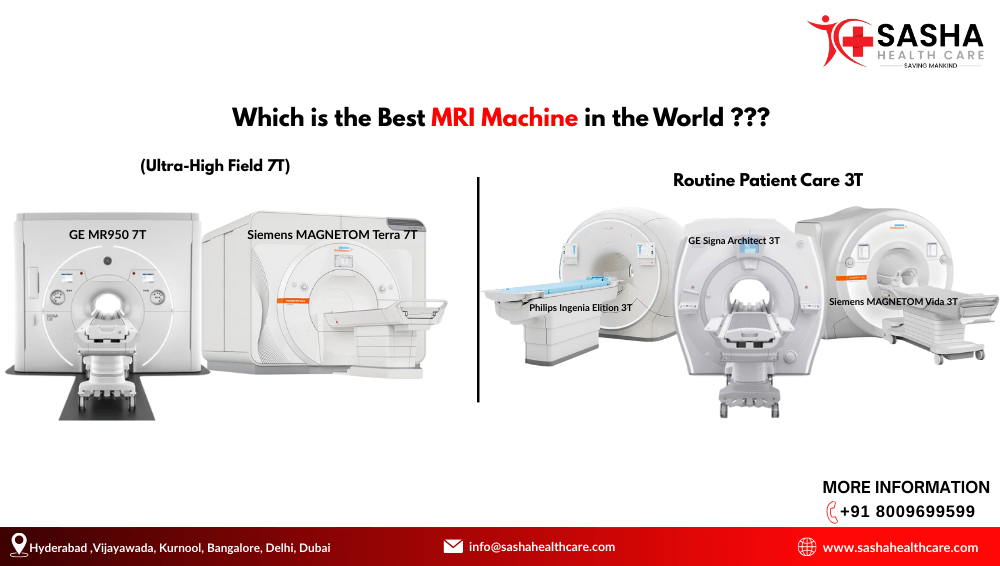
There is no single “best” MRI machine in the world for all use cases.
The best MRI machine depends on clinical purpose, magnetic field strength, image quality requirements, patient volume, and operational constraints. In global clinical practice, 3 Tesla (3T) MRI systems from Siemens Healthineers, GE HealthCare, and Philips represent the highest standard for routine diagnostic imaging, while 7 Tesla (7T) MRI systems deliver the highest spatial resolution for advanced neuro and research applications.
For hospitals and diagnostic centers, a 3T MRI offers the best balance of image quality, scan speed, clinical versatility, and regulatory approval. For research institutions and specialized neuroscience centers, 7T MRI provides unmatched detail but limited clinical use.
Which is the Best MRI Machine in the World
Best Clinical MRI (Routine Patient Care)
- Siemens MAGNETOM Vida 3T
- GE Signa Architect 3T
- Philips Ingenia Elition 3T
These systems dominate tertiary hospitals in the US, Europe, Japan, and India.
Best Research MRI (Ultra-High Field)
- Siemens MAGNETOM Terra 7T
- GE MR950 7T
- Philips 7T MRI systems
These systems operate mainly in academic and research institutions.
Clear Technical Comparison
| Parameter | 3 Tesla MRI | 7 Tesla MRI |
|---|---|---|
| Magnetic field | 3.0 Tesla | 7.0 Tesla |
| Primary use | Clinical diagnostics | Research, neuroimaging |
| Image resolution | High | Ultra-high |
| Regulatory approval | Widely approved | Limited approval |
| Global installations | Thousands | Few hundred |
- A 3 Tesla MRI system provides up to 2× higher signal-to-noise ratio compared to a 1.5 Tesla MRI.
- A 7 Tesla MRI operates at 7.0 Tesla magnetic field strength, more than double that of standard clinical MRI systems.
- As of recent global deployments, 3T MRI systems form the backbone of advanced clinical imaging worldwide.
- 7T MRI systems remain restricted to specialized centers due to cost, infrastructure demands, and regulatory limits.
- Most routine neurological, orthopedic, and cardiac MRI exams do not require field strength above 3 Tesla.
Key Clarification
Clinical excellence depends on gradient performance, RF coils, software, and workflow—not only magnetic field strength.
“Best” does not mean highest Tesla alone.
Higher Tesla increases resolution but also increases cost, artifacts, safety complexity, and power requirements.
Frequently Asked Questions (FAQ)
Yes for research and microstructural brain imaging. No for routine clinical diagnosis.
A 3 Tesla MRI offers the best clinical performance, patient throughput, and regulatory acceptance.
Siemens Healthineers, GE HealthCare, and Philips lead global MRI technology by installations and clinical adoption.
No. Higher Tesla increases sensitivity but also increases artifacts and operational complexity.
The 1.5 Tesla MRI remains the most installed globally, while 3 Tesla leads in advanced diagnostics.
Conclusion
There is no single MRI machine that qualifies as the best in all situations. 3 Tesla MRI systems represent the global standard for clinical excellence, offering the optimal balance of image quality, scan speed, safety, and regulatory acceptance for routine patient care. 7 Tesla MRI systems deliver the highest imaging resolution, but their use remains limited to research and highly specialized applications. The best MRI machine is therefore defined by clinical need, regulatory approval, infrastructure capability, and intended use rather than magnetic field strength alone.